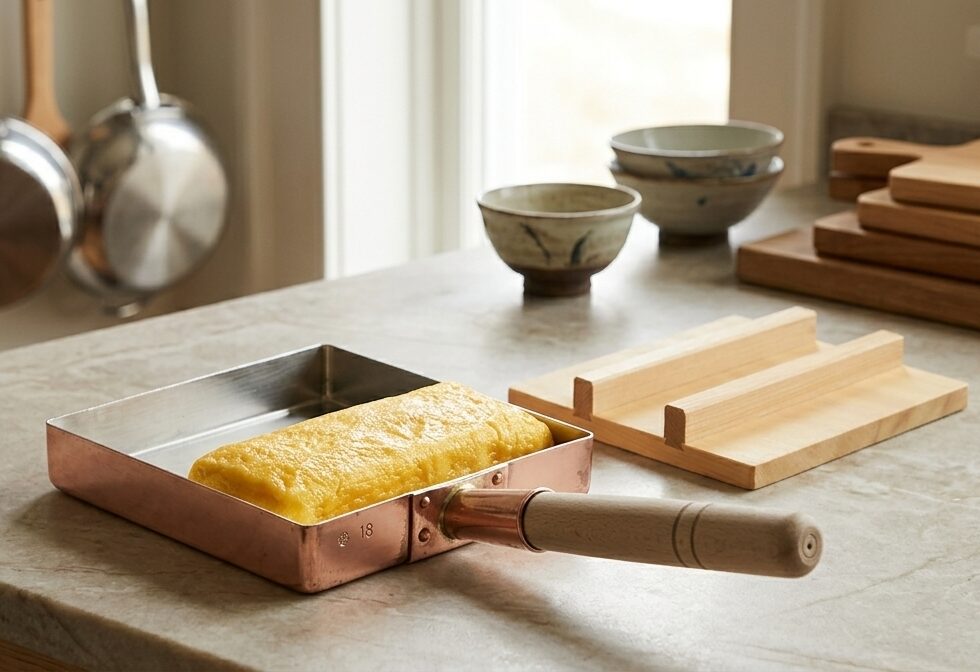
If you just want the short version: TIKUSAN’s Tamagoyaki Copper Pan ($151.99) has by far the largest number of Amazon customer ratings among the products we compared, and it’s one of the items featured in TIKUSAN’s official Best Sellers collection. It’s a serious tool for a specific job — Japanese rolled omelets — rather than an everyday pan, but it’s the clearest example of what this brand does well.
TIKUSAN is a Japan-based kitchenware exporter that’s built a surprisingly wide Amazon.com catalog — donabe, tamagoyaki pans, sushi tubs, graters, drop lids, rice ball presses, and more — almost all carrying an explicit “Made in Japan” claim on the listing itself, not just a Japanese-sounding brand name. We’ve already featured TIKUSAN products in several of our category guides (hangiri tubs, onigiri molds, and others), so we pulled together the brand’s actual best sellers into one place: which ones are genuinely worth buying, which claims hold up, and where each one fits into a Japanese kitchen.
🏆 Best Choice: TIKUSAN Tamagoyaki Copper Pan →
- How We Picked These
- Comparison Table
- What Makes TIKUSAN Worth Choosing
- The TIKUSAN Lineup in Detail
- Which One Should You Buy?
- About TIKUSAN
- Care and Maintenance
- Frequently Asked Questions
- Is TIKUSAN a real Japanese brand, or just an import label?
- Are all TIKUSAN products made in Japan?
- What’s the difference between a hangiri and a regular mixing bowl?
- Do I need a dedicated tamagoyaki pan, or can I use a regular frying pan?
- What’s a masu actually used for?
- Is the instant pickle maker the same as traditional Japanese pickle-pressing?
- Final Thoughts
How We Picked These
Rather than guessing at what’s popular, we started from TIKUSAN’s own “Best Sellers” collection on their official store (tikusan.net) and cross-checked each item against its actual Amazon.com listing — confirming price, stock, customer rating, and an explicit “Made in Japan” statement in the listing itself. One item from TIKUSAN’s own best-seller list, a cast iron takoyaki pan, didn’t make our cut here: its Amazon listing doesn’t state a country of manufacture anywhere in the bullets or description, so we couldn’t verify it the way we could the other five. (We’ve covered takoyaki pans from other verified Japanese brands in a separate guide.) We treated “Made in Japan” as a product-level claim, not a brand-level assumption — we didn’t infer country of origin from the TIKUSAN name, the product’s Japanese-style design, or the fact that it was sold through TIKUSAN’s own store.
Comparison Table
| Product | Price | Rating | Reviews | Best For |
|---|---|---|---|---|
| Tamagoyaki Copper Pan | $151.99 | 4.5 | 101 | Serious tamagoyaki makers |
| Hangiri Sushi Tub | $73.99 | 4.6 | 55 | Sushi night, mixing rice |
| Onigiri Mold (Kanto Style) | $46.99 | 4.7 | 25 | Bento, quick rice balls |
| Instant Pickle Maker | $33.99 | 4.2 | 40 | Quick tsukemono at home |
| Wooden Sake Masu Cups | $21.99 | 4.4 | 17 | Gifting |
*Prices, ratings, and review counts checked September 9, 2026; may change.
What Makes TIKUSAN Worth Choosing
- Explicit Made in Japan claims, product by product. We checked each listing individually rather than assuming the whole catalog qualifies — one item (the cast iron takoyaki pan) didn’t state a country of manufacture and was excluded from this guide as a result.
- Genuine category range. TIKUSAN isn’t a single-product brand — its Amazon catalog spans copper cookware, wooden sushi tools, ceramic mortars, graters, drop lids, and more, which is unusual for a smaller Japanese import brand.
- Materials commonly used for these specific tools. Sawara cypress for the sushi tub, hinoki for the sake cups, copper for the tamagoyaki pan — these are the materials Japanese kitchens commonly use for these specific tools, not generic substitutes.
- Mixed but generally solid review history. Ratings across our five picks range from 4.2 to 4.7 stars, with review counts from 17 to 101 — enough for some real customer feedback, though still much smaller than what you’d see for a mass-market cookware brand.
- Price varies a lot by category. The copper tamagoyaki pan is a real investment at $151.99; the sake cups are $21.99. Don’t assume “TIKUSAN” alone tells you what price bracket you’re in.
The TIKUSAN Lineup in Detail
Tamagoyaki Copper Pan — Best for Serious Tamagoyaki Makers
This is a dedicated pan for tamagoyaki, the layered, slightly sweet rolled omelet served at breakfast, in bento boxes, and at sushi counters. It’s a 9.4-inch (24×24cm) square copper pan with a wooden lid, and its listing explicitly states “Made in Japan.” Copper is commonly used for tamagoyaki pans because it heats and cools quickly, which matters when you’re building up thin layers of egg one at a time; TIKUSAN’s listing describes this model as a copper tamagoyaki pan made in Japan.
At 4.5 stars from 101 ratings, it has by far the largest review base of any product in this guide, and it’s one of the items currently featured in TIKUSAN’s own Best Sellers collection.
Pros
- Explicit Made in Japan claim on the listing
- By far the most-reviewed product in this lineup, with a consistently high rating
- Copper construction is commonly used for tamagoyaki, not a substitute material
- Comes with a matching wooden lid
Cons
- The most expensive item in this guide by a wide margin
- Single-purpose pan — it’s not a general-purpose frying pan
- Copper cookware typically needs hand care rather than dishwasher use; check the listing’s specific care notes before buying
Bottom line: if you make tamagoyaki with any regularity, this is the easiest product in this guide to justify spending more on, thanks to its dedicated design and by far the largest review base.
Hangiri Sushi Tub — Best for Sushi Night
A hangiri is the wide, flat wooden tub used to mix vinegar into freshly cooked rice for sushi — the wide, shallow shape helps release heat and moisture as you fold in the seasoning, and the wood is traditionally associated with sushi rice preparation. This 10.6-inch tub is made of sawara cypress with a copper band, and the listing states “Made in Japan.” At 4.6 stars from 55 ratings, it has a solid, if not huge, track record.
We’ve covered hangiri tubs from multiple brands in more depth in our dedicated hangiri guide, including this same TIKUSAN model alongside other options.
Pros
- Explicit Made in Japan claim
- Sawara cypress is commonly used for this tool, chosen for its moisture-wicking properties
- Copper band construction matches traditional hangiri design
Cons
- Wooden tubs need a pre-soak before first use and careful drying after — skipping this can lead to cracking
- Takes up real cabinet space; it’s a large, flat item
- Only useful if you actually make sushi rice at home with any frequency
Bottom line: a traditional-style tool that makes sense if you regularly prepare sushi rice at home.
Onigiri Mold (Kanto Style) — Best for Bento and Quick Meals
This three-mold press shapes rice into a triangular onigiri shape — TIKUSAN markets this specific mold as “Kanto Style,” and sells a rounder Kansai-style version separately. The listing states “Made in Japan” and describes it as BPA-free. At 4.7 stars from 25 ratings, it’s the highest-rated product in this guide, though with a smaller review count than the tamagoyaki pan.
We’ve compared this alongside other onigiri mold brands in our dedicated onigiri mold guide.
Pros
- Explicit Made in Japan and BPA-free claims
- Highest star rating of any product in this guide
- Makes three onigiri at once — genuinely useful for bento prep or feeding kids
Cons
- Smallest review count in this lineup (25), so the track record is shorter than the tamagoyaki pan or hangiri tub
- Kanto-style shape only — if you specifically want the rounder Kansai style, check the listing carefully before buying, since TIKUSAN sells both
Bottom line: an easy, low-cost way to make onigiri-making faster without sacrificing the traditional shape.
Instant Pickle Maker — Best for Quick Tsukemono
This is a press-style container for tsukemono, Japanese quick pickles — you pack in sliced vegetables, twist the top-mounted press down, and the pressure helps draw moisture out of the vegetables so the seasoning can penetrate faster than in a plain container. The listing states “Made in Japan” and describes it as BPA-free. At 4.2 stars from 40 ratings, it’s the lowest-rated item in this guide, though still solidly positive.
This is the one product here we haven’t covered in a dedicated guide yet — a genuinely new category for the site.
Pros
- Explicit Made in Japan and BPA-free claims
- Press mechanism is simpler than weighting a bowl with plates, and takes less counter space
- Good entry point if you’ve never made tsukemono at home before
Cons
- Lowest star rating in this guide (4.2); if you prefer a traditional ceramic or wooden pickle crock, the plastic construction may not be what you’re looking for
- 2.2-liter capacity is modest — fine for a few servings, not for large-batch pickling
Bottom line: a practical, unglamorous tool that makes quick pickles more convenient to start at home.
Wooden Sake Masu Cups — Best for Gifting
A masu is a square wooden box traditionally used for measuring rice or sake, and drinking sake from one is traditionally associated with celebrations and shrine events in Japan. This one is made of hinoki (Japanese cypress) and holds 4.9 fl oz (8 shaku), per the listing. The listing states “Made in Japan.” At 4.4 stars from 17 ratings, it has the smallest review count in this guide, but hinoki’s aromatic quality is well documented and it’s a wood commonly used for masu.
If you’re setting up a full sake-serving setup rather than just cups, our tokkuri and ochoko guide covers the bottle-and-cup side of things — a masu offers a different sake-serving style from the tokkuri-and-ochoko setup, not a replacement for it.
Pros
- Explicit Made in Japan claim
- Hinoki construction, a wood commonly used for this type of item
- Inexpensive and genuinely gift-appropriate — a recognizable piece of Japanese drinking culture
Cons
- Smallest review count of any product in this guide (17) — a promising but shorter track record
- Unfinished wood needs to be hand-washed and dried promptly, not left soaking
- A single cup, not a full set — if you’re hosting, you’ll want to buy more than one
Bottom line: a small, inexpensive way to bring a traditional Japanese sake-serving vessel to the table, especially as a gift.
Which One Should You Buy?
- You make tamagoyaki or want to start: the copper pan is the brand’s flagship product for a reason.
- Sushi night is a regular thing at your house: the hangiri tub is the traditional tool for the job.
- You pack bento lunches or want faster rice balls: the onigiri mold.
- You want to try making pickles at home without much commitment: the instant pickle maker.
- You’re buying a gift, or want a casual way to serve sake: the sake masu cups.
About TIKUSAN
TIKUSAN describes itself as a company that exports Japanese products — sourced from Japanese manufacturers and suppliers — to customers overseas. Its Amazon catalog spans several traditional Japanese kitchenware categories: copper cookware, wooden sushi and sake tools, ceramic mortars, and stainless graters, among others. That’s real breadth for a brand this size — but it also means not every item in the catalog carries the same clear country-of-manufacture documentation. For this guide, we didn’t assume a product was made in Japan simply because it carried the TIKUSAN name; we checked the country-of-origin statement on each individual Amazon listing instead.
Care and Maintenance
For the copper tamagoyaki pan: hand wash and dry promptly after each use. Copper cookware is generally not dishwasher-safe and can develop tarnish if left wet; check the listing or any included care card for specific guidance before your first use.
For the wooden hangiri tub and sake masu cups: both are unfinished or lightly finished wood (sawara cypress and hinoki respectively) and should never be soaked or run through a dishwasher. Rinse with plain water, wipe dry, and let them air-dry fully before storing to avoid warping or mold.
For the onigiri mold and pickle maker: both are BPA-free plastic and easier to maintain — hand wash is the safest default, though check each specific listing for dishwasher-safe claims before assuming.
Frequently Asked Questions
Is TIKUSAN a real Japanese brand, or just an import label?
TIKUSAN describes itself as a company that exports Japanese kitchenware to customers overseas, sourcing from Japanese manufacturers and suppliers. It’s not a single-product brand — its Amazon catalog spans several traditional Japanese kitchen tool categories.
Are all TIKUSAN products made in Japan?
Not universally, based on what we found — most of the listings we checked for this guide explicitly state “Made in Japan,” but at least one item in TIKUSAN’s own best-seller lineup (a cast iron takoyaki pan) did not make that claim on its Amazon listing. Always check the specific listing rather than assuming the whole brand qualifies.
What’s the difference between a hangiri and a regular mixing bowl?
A hangiri is wide and shallow rather than deep, which lets you fold seasoning into a large batch of rice quickly without overworking it, and the wood surface is traditionally associated with helping manage excess moisture as you mix — a difference from a ceramic or metal bowl.
Do I need a dedicated tamagoyaki pan, or can I use a regular frying pan?
You can make a rough version of tamagoyaki in a round pan, but the square shape is what gives the traditional rolled, layered look its clean rectangular cross-section. If you make it more than occasionally, a dedicated pan makes the technique considerably easier.
What’s a masu actually used for?
Traditionally a masu was a wooden measuring box for rice or sake; today it’s most associated with drinking sake at celebrations, shrine festivals, and casual gatherings, sometimes with a pinch of salt on the rim.
Is the instant pickle maker the same as traditional Japanese pickle-pressing?
It works on the same principle as a traditional weighted tsukemono crock — pressure draws moisture out of the vegetables and speeds up pickling — just in a smaller, more countertop-friendly plastic container rather than a large ceramic crock with stone weights.
Final Thoughts
TIKUSAN’s catalog is genuinely wider than most single-category Japanese kitchenware brands we’ve covered, and four of the five products here — the tamagoyaki pan, hangiri tub, onigiri mold, and sake masu cups — carry a clear, listing-stated Made in Japan claim backed by a reasonable Amazon review history. The instant pickle maker rounds out the list as a solid, if less traditional, entry point into tsukemono. The one thing worth remembering: “TIKUSAN” on the label isn’t itself a guarantee — we found at least one popular item in their own lineup that didn’t carry the same documentation, which is why checking each listing individually mattered more than trusting the brand name alone.
Prices and Amazon ratings in this guide were checked on September 9, 2026, and may change.
コメント