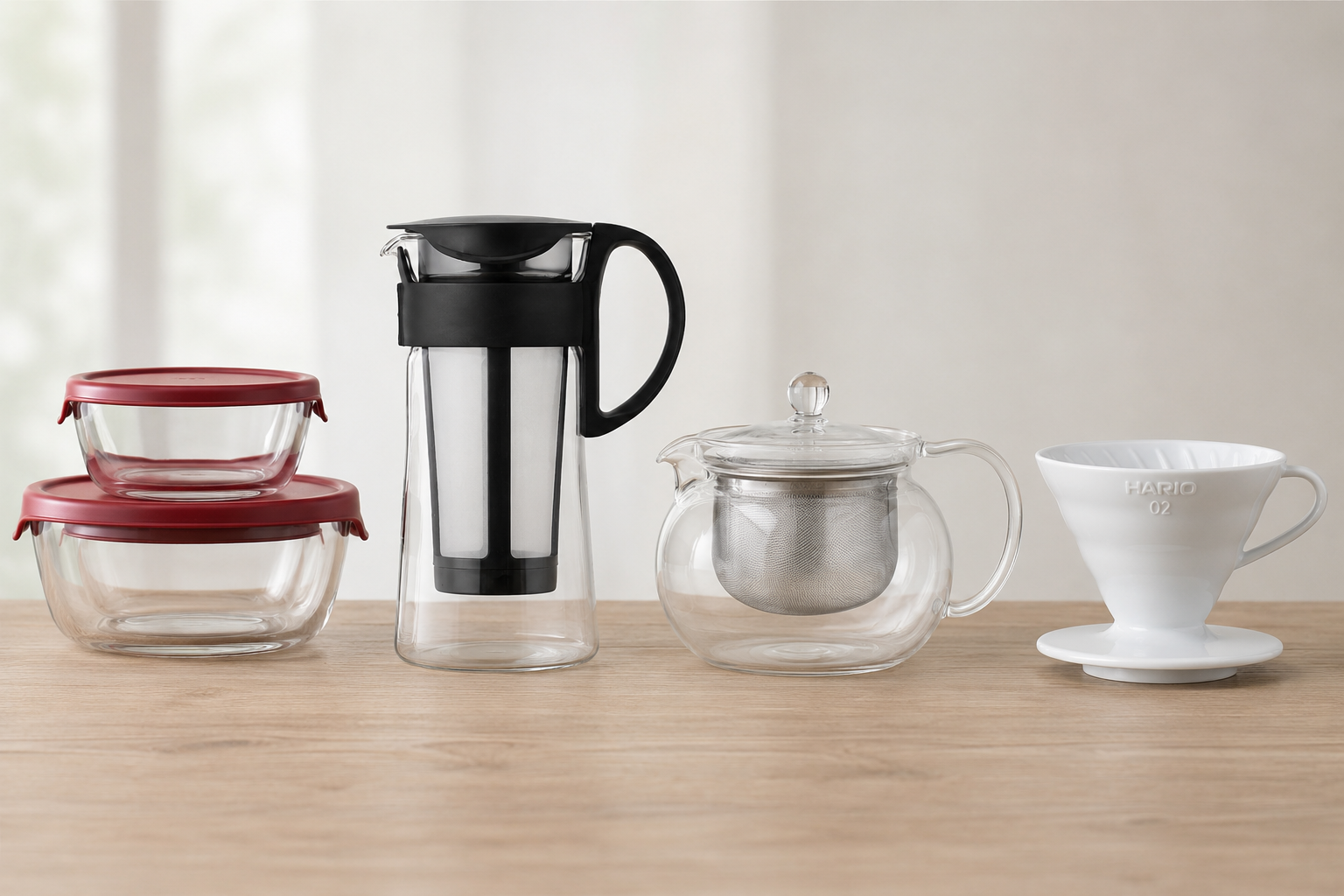
If you’ve ever used a pour-over coffee dripper, brewed cold brew in the fridge overnight, or seen a glass teapot with a rounded, minimalist shape, there’s a good chance it was HARIO. The Tokyo-based glassmaker has been quietly behind some of the most recognizable coffee and tea gear in the world, including the V60 dripper ($12.70), while still making everything in its own factory in Japan.
Who Is HARIO?
HARIO was founded in 1921 by Hiromu Shibata, who opened a glass factory in Kanda Sudacho, Tokyo, to produce laboratory glassware. The name HARIO comes from combining the Japanese words for glass (玻璃, hari) and king (王, ō) — roughly, “King of Glass.”
The company’s shift toward the kitchen came in 1948, when it began making coffee siphons, taking advantage of the heatproof glass and processing techniques it had already developed for lab equipment. Over the following decades, that heatproof-glass expertise expanded into the wider range of coffee, tea, and kitchen glassware HARIO is known for today, including the V60 pour-over dripper, ChaCha kyusu teapots, and cold brew makers.
What sets HARIO apart from most glassware brands on Amazon is that it still manufactures in Japan. According to the company, HARIO is the only manufacturer with a heatproof glass factory in Japan, and in 1972 it developed what it describes as an “all-electric melting furnace” — a technique that melts raw materials with electricity instead of gas, which the company says lets the factory run without smokestacks. That’s a manufacturing detail, not a taste or performance claim, but it’s part of why HARIO’s glass has stayed a Japan-made product across a century of growth, rather than moving offshore the way a lot of housewares eventually do.
4 HARIO Products Worth Knowing
| Product | Price | Category | Best For |
|---|---|---|---|
| V60 Dripper 02 | $12.70 | Coffee | Pour-over beginners & enthusiasts |
| ChaCha Kyusu “Maru” 700ml | $20.25 | Tea | Everyday loose-leaf tea |
| Mizudashi Cold Brew Coffee Maker | $21.20 | Coffee | Cold brew at home |
| Heat-Resistant Glass Storage Set | $18.35 | Kitchen | Microwave-safe food storage |
What to Know Before You Buy HARIO
- Not everything is 100% Japan-made, piece by piece. HARIO’s glass is made in Japan, but on some products a secondary part — like a plastic lid or a metal strainer — is sourced elsewhere. Check the specific listing rather than assuming every component of every product shares the same origin; we note this explicitly below wherever it applies.
- Heatproof glass is not the same as tempered or borosilicate marketing claims you may see on cheaper knockoffs. HARIO’s listings describe their glass as treated to resist thermal shock (sudden temperature changes), which is why it’s rated safe for hot water, the microwave, and in some cases the stovetop — but always check the specific product’s stated heat limits rather than assuming.
- Coffee gear dominates the lineup, but it’s not the whole brand. HARIO also makes teapots, cold brew bottles, mixing bowls, and food storage — worth knowing if you only associate the name with pour-over coffee.
- Sizes matter more than they look like they would. The V60 dripper alone comes in multiple sizes (01 for 1–2 cups, 02 for 1–4 cups, and others) — buying the wrong size for your household is a common first-time mistake with this brand.
- Filters and accessories are brand-specific. HARIO’s V60 paper filters are shaped for the V60’s cone angle and won’t perform the same in a flat-bottomed dripper from another brand, and vice versa.
HARIO Products in Detail
Disclosure: As an Amazon Associate I earn from qualifying purchases.
V60 Dripper 02 — Best for Pour-Over Coffee
The V60 is arguably HARIO’s most famous product worldwide, and it’s the one most likely to show up in a café’s brew bar as well as a home kitchen. The name refers to the 60-degree angle of its cone shape (the “V” is the cone itself), and the spiral ribs on the interior wall are widely described in the pour-over coffee community as preventing the paper filter from sticking flush to the plastic, which lets air escape and can help with more even extraction. The single large hole at the bottom means the flow rate isn’t fixed by the dripper — it’s controlled by how you pour, which is part of why the V60 has a reputation as a more hands-on, skill-rewarding brewer than some flat-bottomed alternatives.
This specific listing is the plastic version in white, priced at $12.70, with 4.8 out of 5 stars across roughly 3,500 ratings, and the product page states it’s made in Japan. HARIO also sells ceramic, glass, and metal versions of the same V60 shape at higher price points if you want more heat retention or a heavier feel on the counter.
Pros: inexpensive entry point into pour-over coffee; widely compatible with V60-shaped paper filters from multiple brands; lightweight and easy to clean; strong owner ratings.
Cons: plastic construction retains less heat than the ceramic or glass versions; requires a separate server or cup underneath, and a kettle with reasonably controlled pour for best results; a manual pour-over takes more attention than an automatic drip machine.
Bottom line: if you want to try pour-over coffee without committing much money, this is the standard starting point — and it’s the same shape serious home brewers upgrade into ceramic or glass versions of later.
ChaCha Kyusu “Maru” 700ml — Best for Everyday Tea
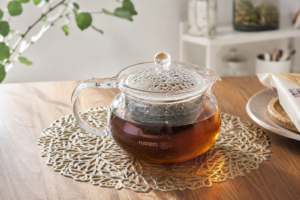
The ChaCha Kyusu is HARIO’s glass take on a kyusu, the traditional Japanese teapot with a built-in strainer for loose-leaf tea. It’s a minimalist, rounded design in heatproof glass, dishwasher safe, with a large strainer basket that the listing says is sized to let tea leaves expand fully for better flavor. We cover kyusu shopping in more depth, including traditional clay options, in our full kyusu teapot guide.
One origin detail worth being precise about: the listing states the glass teapot and lid are made in Japan, but the stainless steel strainer is made in China. That’s a genuinely common pattern for multi-material kitchenware — the glass body is HARIO’s core manufacturing strength, while a small steel mesh part is sourced elsewhere — but it means this product isn’t 100% Japan-made end to end, and we’d rather say that plainly than round it up. At $20.25 with roughly 15,800 ratings, it’s also the most-reviewed product in this guide by a wide margin.
I’ve personally used this teapot for years, and it’s one of the HARIO products I can genuinely recommend from experience. The clear glass makes it easy to see the color of the tea as it brews, so I can judge the strength without lifting the lid. I also like being able to immediately see when the pot or strainer needs cleaning. In my experience, regular washing and an occasional deeper clean every few months have been enough to keep mine in good condition for years.
Pros: large strainer basket for better leaf expansion; dishwasher safe; simple, modern look that fits most kitchens; by far the most-reviewed product here, with a large base of owner feedback to draw on.
Cons: the strainer component is made in China, not Japan, so the “Made in Japan” claim applies to the glass body and lid specifically; glass construction means it’s less forgiving of drops than a ceramic or cast iron teapot.
Bottom line: a genuinely useful, no-fuss daily teapot, as long as you’re comfortable with a glass body and know the strainer itself isn’t part of the Japan-made claim.
Mizudashi Cold Brew Coffee Maker 1000ml — Best for Cold Brew
The Mizudashi is a glass cold brew pitcher with a removable fine-mesh filter basket: add coarse-ground coffee to the basket, add water, and leave it in the refrigerator to brew. The listing describes a slender spout for controlled pouring and says the filter is reusable after washing, so there’s no ongoing cost for paper filters the way there is with the V60. At $21.20 with roughly 12,000 ratings, it’s a well-established product in HARIO’s lineup, and the listing states it’s made in Japan.
Pros: reusable filter means no recurring filter cost; simple enough to use daily without a learning curve; doubles as a serving pitcher straight from the fridge; large sample size of owner reviews to judge it by.
Cons: cold brew takes planning ahead (typically steeped overnight or longer), unlike a quick pour-over; glass construction needs the same care as any glass pitcher in a crowded fridge.
Bottom line: if you already drink cold brew regularly, this removes the recurring cost and mess of paper filters or a French press plunger.
Heat-Resistant Glass Storage Set — Best for Everyday Kitchen Use
Not every HARIO product is coffee or tea gear. This set of heat-resistant glass storage containers (two small, one medium) is a good example of the same glassmaking used for everyday food storage rather than a beverage ritual. The listing states the glass is rated to a heat-resistant temperature difference of 248°F (120°C), the polypropylene lids are rated to 284°F (140°C), and the containers are microwave safe with the lid on, though the lid itself isn’t oven safe. The product page states the set is made in Japan, priced at $18.35 with around 590 ratings.
From a practical standpoint, I prefer glass storage containers over plastic for long-term use. Glass is less prone to staining and lingering odors, and I find it easier to keep looking clean over time. Being able to microwave these containers with the lid on also makes them especially convenient for everyday food storage and reheating.
Pros: genuinely microwave-safe glass (with lid on) rather than a container you have to transfer food out of first; two sizes in one set; made in Japan, unlike most budget glass storage on Amazon.
Cons: the lid is not oven safe, only the glass portion; smaller review base than HARIO’s coffee and tea products, so there’s less long-term feedback to draw on; glass containers are heavier and more breakable than plastic equivalents.
Bottom line: a solid pick if you want to reduce plastic in your kitchen storage and specifically want something that can go straight from the fridge to the microwave.
Which HARIO Piece Should You Start With?
- New to pour-over coffee? Start with the V60 Dripper 02 — it’s the cheapest way into HARIO’s most iconic product.
- Want a daily loose-leaf tea routine? The ChaCha Kyusu Maru is the simplest, most reviewed option.
- Already drink cold brew regularly? The Mizudashi pays for itself by removing paper filter costs.
- Trying to cut down on plastic food storage? The heat-resistant glass storage set is the most practical, least “coffee ritual” pick here.
Caring for HARIO Heatproof Glass
HARIO’s heatproof glass is generally described by the company as treated to resist thermal shock, which is why products like the ChaCha Kyusu and Mizudashi are rated safe for hot liquids and, in some cases, the dishwasher. That said, “heatproof” doesn’t mean indestructible — avoid setting a piece straight from the fridge onto a hot stovetop or into boiling water, since a sudden, extreme temperature swing is the scenario thermal-shock-resistant glass is designed to reduce the risk of, not eliminate entirely. Hand washing is always a safe default even on dishwasher-rated pieces if you want to extend the life of a piece you particularly like, and always check the specific product’s stated heat limits (like the 248°F glass / 284°F lid ratings on the storage containers above) rather than assuming one HARIO product’s limits apply to another.
Common Mistakes to Avoid
- Assuming every part of every product is made in Japan. As the ChaCha Kyusu shows, a glass body can be Japan-made while a smaller component (like a steel strainer) is sourced elsewhere — check the specific listing rather than assuming.
- Buying the wrong V60 size. Size 01 is meant for 1–2 cups and size 02 for 1–4 cups; buying a size that doesn’t match your household’s usual brew volume is a common first purchase mistake.
- Using off-brand filters and expecting identical results. The V60’s spiral ribs and cone angle are part of its brewing behavior — a generic flat-bottomed filter won’t replicate it.
- Extreme temperature swings with glass. Even heat-resistant glass is more about resisting thermal shock than being fully shatterproof — avoid moving a piece directly between very hot and very cold conditions.
FAQ
Is all HARIO glassware made in Japan?
The glass itself generally is — the company states it’s the only manufacturer with a heatproof glass factory in Japan — but some products include non-glass parts (like the ChaCha Kyusu’s steel strainer) that are sourced from other countries. Check the specific product listing rather than assuming a blanket claim.
What does “V60” actually mean?
It refers to the 60-degree angle of the dripper’s cone shape, with the “V” representing the cone itself.
Is HARIO glass oven-safe?
It depends on the specific product — some glass components are oven safe while lids or other parts often are not, as with the heat-resistant storage containers above. Always check the individual listing’s stated heat ratings rather than assuming.
Do I need a HARIO-brand filter for the V60?
Not strictly, but the V60’s shape (cone angle and spiral ribs) is specifically designed around its own filter shape, so a generic filter or one made for a different dripper shape may not replicate the same flow behavior.
Is HARIO only a coffee brand?
No — while its coffee gear (especially the V60) is what it’s best known for internationally, the company also makes tea, kitchen glassware, and food storage, drawing on the same heatproof glass manufacturing.
Is glassware from a coffee-focused brand actually good for daily kitchen use?
Based on owner reviews of products like the heat-resistant storage set, yes — HARIO’s core expertise is heatproof glass generally, not just coffee-shaped glass, so the same manufacturing quality carries over to non-coffee products.
What You’ll Also Need
If you’re starting a pour-over habit with the V60, you’ll also need a compatible paper filter and a kettle you can pour with reasonable control — a basic gooseneck kettle makes a noticeable difference over a standard kettle’s wide spout. If loose-leaf tea is more your interest, our full kyusu teapot comparison covers traditional clay options from Tokoname and Arita alongside the HARIO glass pick above, if you want to compare styles before deciding.
Final Thoughts
HARIO’s appeal isn’t really about any single product — it’s that the same heatproof glass expertise, developed from over a century of manufacturing in Japan, shows up consistently whether you’re buying a $12 pour-over dripper or an $18 food storage set. The V60 is the product most people already know the brand for, but the ChaCha Kyusu, Mizudashi cold brew maker, and everyday glass storage make the case that HARIO is a genuine glass manufacturer first, and a coffee gear brand second. The one thing worth remembering across all of it: “made in Japan” describes HARIO’s glass specifically, and it’s worth checking each listing rather than assuming it extends to every component of every product.
コメント