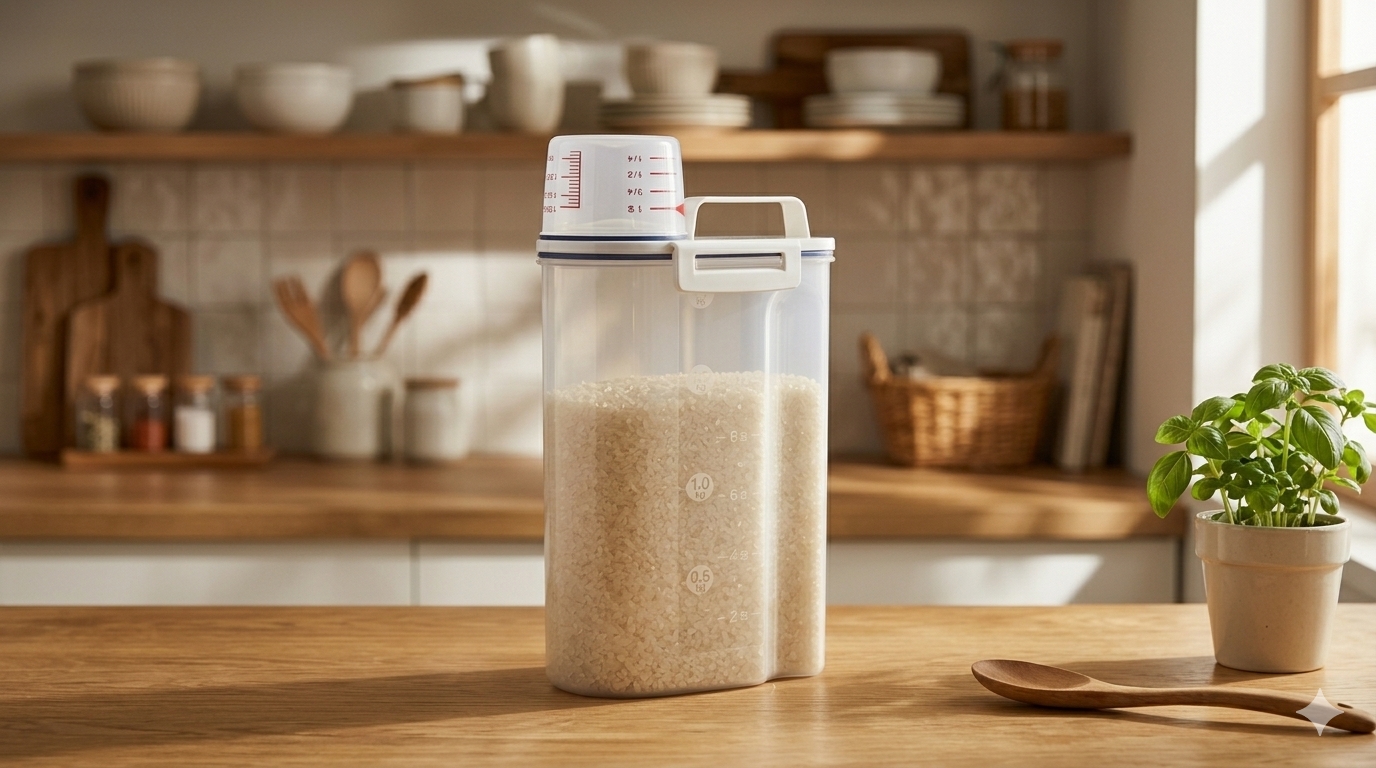
If you only want one: the Asvel 7509 Rice Container Bin with Pour Spout ($14.57) is our top pick — a compact, clear 2kg (4.4 lb) bin from an established Japanese housewares brand that fits neatly in a fridge door or pantry shelf and pours rice cleanly without spilling. For bigger households working through a 20+ lb bag at a time, the JapanBargain 1826 ($39.99) holds 22 lbs and rolls on two casters.
- What is a kome bitsu (Japanese rice storage container)?
- Comparison Table
- What to Look for When Buying a Rice Storage Container
- Product Reviews in Detail
- Which One Should You Buy?
- Capacity Guide
- Plastic, and Why Most Kome Bitsu Are Made From It
- Care and Maintenance
- Tips for Keeping Rice Fresh Longer
- Common Mistakes
- FAQ
- What You’ll Also Need
- Final Thoughts
What is a kome bitsu (Japanese rice storage container)?
A kome bitsu (米櫃, literally “rice chest”) is a dedicated container built for one job: keeping uncooked rice fresh between the day you buy it and the day you cook the last cup. In Japan, where rice is bought and eaten daily rather than occasionally, these containers have been refined for generations — traditionally carved from paulownia or cedar, and today more commonly molded from food-grade plastic with tight-fitting lids, built-in measuring cups, and sometimes a pour spout so you never have to dip a scoop into the bag itself.
The basic idea is simple: rice keeps best when it’s shielded from moisture, light, heat, and pests, and a bag clipped shut in a cupboard does a mediocre job of any of that. A purpose-built container does it much better, and — unlike a generic plastic bin — a kome bitsu is usually sized and shaped specifically around how rice is measured and poured in a Japanese kitchen.
🏆 Best Choice: Asvel 7509 Rice Container Bin with Pour Spout →
Comparison Table
| Product | Price | Capacity | Best For |
|---|---|---|---|
| Asvel 7509 Pour-Spout Bin | $14.57 | 2 kg / 4.4 lb | Best overall — everyday countertop or fridge use |
| JapanBargain 1826 | $39.99 | 10 kg / 22 lb | Best for large households and bulk-bag storage |
| JapanBargain 3193 (Pearl Metal) | $15.99 | 2 kg / 4.4 lb | Best budget pick for small kitchens |
What to Look for When Buying a Rice Storage Container
- A tight-fitting, easy-to-reseal lid. The main job of any kome bitsu is keeping air, moisture, and pests out between uses — a loose or fiddly lid defeats the purpose.
- Capacity that matches how you actually buy rice. If you buy small 2–5 lb bags, a compact fridge-door container is more practical than a large floor bin that sits mostly empty. If you buy 20+ lb bags, size up.
- Where it needs to live. Many Japanese households keep rice in the refrigerator to slow down oxidation and deter pantry pests, so a container that actually fits your fridge door or a shelf matters as much as total capacity.
- A built-in measuring cup or pour spout. These aren’t just convenience features — they reduce how much you’re handling the rice (and how many scoops or hands touch it), which helps keep it cleaner.
- Material and origin. Food-grade, BPA-free plastic is standard for this category. We’ve noted below where a listing explicitly states “Made in Japan” versus where only the brand’s Japanese origin is established but the specific listing doesn’t repeat a country-of-manufacture claim.
- Dishwasher-safe construction if you want to actually wash the container between refills rather than just wiping it out.
Product Reviews in Detail
Disclosure: As an Amazon Associate I earn from qualifying purchases.
Asvel 7509 Rice Container Bin with Pour Spout
Asvel (also styled ASVEL) is a Japanese housewares brand best known for compact storage and kitchenware designed around small-kitchen living. This bin holds about 2 kg (4.4 lb) of dry rice, is made of clear BPA-free plastic, and includes a measuring cup that screws directly over the pour spout — so you tip the container, fill the cup to the line, and pour straight into your rice cooker’s inner pot without ever touching the rice by hand. At 10,000+ ratings and a 4.6-star average on Amazon, it’s by a wide margin the most reviewed product in this category we found. The listing itself doesn’t repeat a “Made in Japan” line in its bullet points, though Asvel is an established Japanese kitchenware manufacturer.
Pros: Compact enough for a fridge door or narrow cabinet shelf; pour spout with attached measuring cup means minimal mess; extremely high review volume with a strong average rating; inexpensive.
Cons: Small capacity if you buy rice in bulk — you’ll be refilling it often from a larger bag; the listing doesn’t state country of manufacture explicitly, only the brand’s Japanese origin.
Bottom line: For most households cooking rice a few times a week, this is the size and format that actually gets used daily rather than left in a cupboard.
JapanBargain 1826 Rice and Pantry Storage Container (22 lb)
This is the container to reach for if you’re buying rice in large bags rather than small ones. It holds 22 lbs (10 kg) of raw rice, measures roughly 14″ deep by 9″ wide by 13″ tall, and sits on two caster wheels so you can roll a nearly full bin out from under a counter rather than lifting it. The listing states it’s “Made in Japan with High Quality,” includes a measuring cup and a small hanging container for leftover portions, and is explicitly dishwasher safe. JapanBargain also sells an 11 lb version of the same design for households in between the two sizes.
Pros: Large capacity suits a 20 lb rice bag in one go; casters make it easy to move when full; clear body lets you see remaining rice at a glance; explicit Made in Japan claim on the listing.
Cons: Too large to fit in most refrigerators, so it’s a pantry or cabinet solution rather than a cold-storage one; overkill if you only cook rice occasionally.
Bottom line: The practical choice for a household that goes through rice quickly and would rather refill a bin twice a year than a small container every few weeks.
JapanBargain 3193 Clear Rice Container (Pearl Metal)
Sold under the JapanBargain storefront but manufactured by Pearl Metal (パール金属), a long-established Japanese kitchenware and metalware maker, this is a smaller clear container holding about 4.4 lbs of rice. It’s a simpler design than the Asvel bin — no pour spout or attached measuring cup — just a durable BPA-free plastic body with a snap-on lid, and the listing states “Made in Japan” directly.
Pros: Lowest price of the group at this capacity; backed by Pearl Metal, a genuine long-running Japanese kitchenware manufacturer; explicit Made in Japan claim.
Cons: No pour spout or built-in scoop, so you’ll want your own measuring cup; fewer reviews than the Asvel bin, though the ones it has skew positive (4.4 stars).
Bottom line: A good no-frills option if you want a genuine Japan-made container without paying for the pour-spout convenience features.
Which One Should You Buy?
- Cook rice most days and want a fridge-door or shelf option: the Asvel 7509 — small footprint, pour spout, and by far the most-reviewed option we found.
- Buy rice in 20+ lb bags: the JapanBargain 1826 — it’s sized for that, and the casters mean you’re not hauling a full 22 lb bin by hand.
- Want the lowest price with a genuine Made in Japan claim: the JapanBargain 3193 / Pearl Metal container.
Capacity Guide
| Container Capacity | Roughly Equivalent To | Good Fit For |
|---|---|---|
| 2 kg / 4.4 lb | A standard small retail rice bag | 1–2 people, fridge or shelf storage |
| 5 kg / 11 lb | A mid-size bag | Small households buying every few weeks |
| 10 kg / 22 lb | A large bulk bag | Larger households or infrequent shopping trips |
Plastic, and Why Most Kome Bitsu Are Made From It
Traditional wooden kome bitsu — typically paulownia or cedar — are still made in Japan and prized for their natural moisture-regulating properties, but they’re difficult to find in stock through US retailers, which is part of why every container in this guide is food-grade plastic. Modern polypropylene and similar plastics used in these containers are lightweight, don’t absorb odors or moisture themselves, and are easy to wipe out or run through a dishwasher, which is a meaningful practical advantage over an untreated wood box that needs to stay fully dry to avoid mold. The tradeoff is that plastic doesn’t actively regulate humidity the way cedar or paulownia is described as doing — it simply keeps outside air, light, and pests out, which for most home cooks is the part that matters most day to day. It’s also why I personally prefer plastic for my own kome bitsu — being able to actually wash it out and let it dry completely every time I refill it makes it much easier to keep genuinely clean than an untreated wood box would be.
Care and Maintenance
Empty the container fully before adding a new bag of rice rather than topping off over old rice sitting at the bottom — this is the single most common way rice goes stale unevenly, since the older rice at the bottom keeps aging while fresh rice sits on top. Wash the container with warm soapy water and let it dry completely before refilling; several of the containers above are listed as dishwasher safe, but check the specific listing before doing that regularly, since repeated high heat can wear down some plastics faster than hand washing. If you store your container in the refrigerator, keep it in a dedicated spot rather than moving it in and out, since condensation from temperature swings is one of the more common ways moisture gets into an otherwise sealed container.
Tips for Keeping Rice Fresh Longer
- Store in a cool spot — a refrigerator or a cool pantry shelf away from the stove or direct sunlight slows the rate at which rice’s natural oils turn rancid.
- Keep the lid fully seated after every use — even a slightly open container lets in humidity that plastic containers otherwise keep out.
- Don’t mix old and new rice in the same container without using up the older portion first.
- Buy only what you’ll use in a reasonable window — a smaller container that gets refilled more often generally keeps rice fresher than a huge bin that sits half-full for months.
- Use a natural insect deterrent for long-term storage — dried chili pepper or wasabi-based rice-bin repellent packets (sold in Japan as 米唐番/kome-touban style products) are a common way to keep weevils out of a bin that takes a while to empty. I use one myself for exactly this reason — mine sits inside a plastic kome bitsu tucked in a cabinet under the counter, and between the sealed container and the repellent packet, my rice has stayed fresh, tasty, and safe to eat over a long stretch of time. These packets are widely available from Japanese import retailers and Amazon.co.jp; at the time of writing we couldn’t confirm a matching listing on Amazon.com. A widely-documented substitute that is easy to find on Amazon.com: tucking a few dried bay leaves (about $20.99) into the container. Bay leaves contain eucalyptol, a compound that pantry pests including weevils are widely reported to avoid, and the scent doesn’t transfer into the rice itself. It’s a general pantry trick rather than a Japan-specific product, but it’s real, well-documented, and something we could actually verify is sold on Amazon.com.
Common Mistakes
The most common mistake is buying a container sized for how much rice you’d like to store rather than how quickly you actually go through it — a 22 lb bin that takes six months to empty doesn’t keep rice fresher than a smaller one refilled monthly. The second is leaving a bag of rice, container and all, next to the stove or a sunny window, where heat and light both accelerate the rice oils breaking down. The third is skipping the wash between refills; residual rice dust and starch left in the bottom of a container can attract pantry pests even when the lid seals well.
FAQ
Do I need to refrigerate rice?
It’s not required, but many Japanese households store rice in the refrigerator specifically because cooler, stable temperatures slow oxidation and make it harder for pantry pests like rice weevils to take hold. A cool, dry pantry shelf works too if fridge space is tight — the container mattering more than the exact temperature, as long as it’s out of heat and direct light.
Can pantry bugs really get into rice?
Yes — rice weevils and similar pantry pests can infest improperly sealed bags and containers, which is part of why a container with a genuinely tight lid is worth the small cost over just clipping the original bag shut.
How long does uncooked rice actually last in one of these containers?
This varies by rice type and storage conditions, so we won’t put a specific number on it — white rice generally keeps well for an extended period when stored cool, dry, and sealed, while brown rice (with its intact bran layer and natural oils) tends to go rancid faster and benefits even more from refrigeration.
Is plastic safe for long-term food storage?
The containers in this guide are described as food-grade and BPA-free by their listings. As with any plastic food container, avoid exposing it to high heat beyond what the manufacturer states is safe (for example, most aren’t meant for the microwave).
What’s the difference between a “kome bitsu” and a generic storage bin?
Mainly the details: kome bitsu are shaped and sized around how rice is bought and measured in Japan, often include a built-in measuring cup calibrated to standard rice-cooker cup sizes, and in several cases here are explicitly manufactured in Japan by companies with long histories in Japanese kitchenware.
Can I use these containers for something other than rice?
Yes — several listings mention they also work well for pet food, flour, or other dry pantry goods, though if you plan to use one for both rice and something else, it’s worth having a dedicated container for each rather than switching contents in the same one.
What You’ll Also Need
A container is only as good as the rice you put in it. East and Else Premium Japanese Sushi Rice (Koshihikari) (about $18.99 for 2.2 lb) is genuinely grown and milled in Japan — the listing states “100% Japan-Grown, Product of Japan” directly — and at a 4.5-star average across 41 ratings, it’s a solid way to fill whichever container above you end up buying. Koshihikari also happens to be my own favorite variety and the one I reach for most often at home.
A rice storage container solves half the problem — the other half is getting rice out of the bag and rinsed without a mess. The Inomata Rice Washing Bowl with Side and Bottom Drainers ($11.99) is a Made in Japan plastic bowl designed specifically for rinsing rice before cooking, with drainage built into the sides and bottom so you can wash and drain in the same vessel rather than juggling a colander. It’s one of the more reviewed rice-adjacent products on Amazon, with over 14,000 ratings at a 4.7-star average.
Final Thoughts
None of these three containers is complicated, and that’s really the point — a good kome bitsu just keeps rice sealed away from air, moisture, and pests between the times you actually cook it. The Asvel 7509 is our overall pick for most kitchens because its size fits how most people actually buy and store rice, and its review count on Amazon is hard to ignore. The JapanBargain 1826 makes more sense if you’re buying in bulk, and the JapanBargain 3193 is a solid, genuinely Made in Japan option if price is the deciding factor. Two of the three (the JapanBargain 1826 and the JapanBargain 3193) carry explicit “Made in Japan” claims on their listings; the Asvel bin’s listing doesn’t repeat that claim, though Asvel itself is an established Japanese housewares brand.
コメント