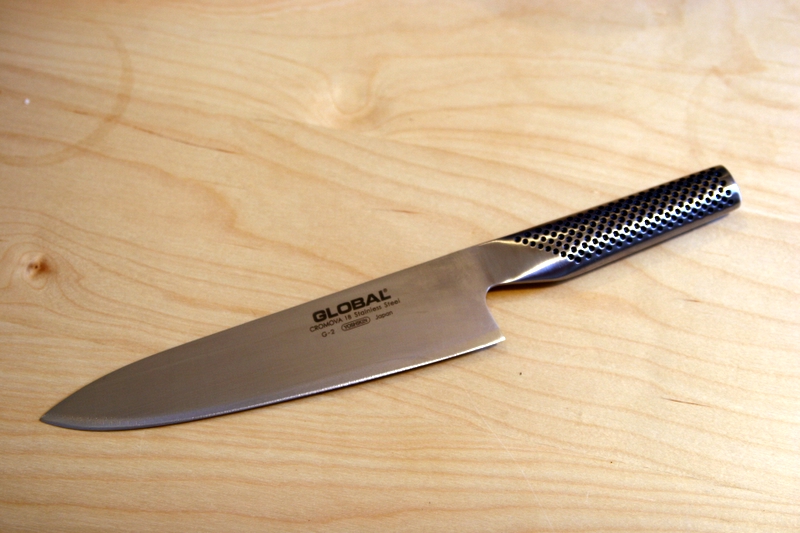
If you want one all-stainless Japanese knife that looks as good as it cuts, our starting recommendation is the GLOBAL G-2 8″ Chef’s Knife ($115.46) — the brand’s best-known model and the one most home cooks reach for first. If you already lean toward a Japanese-style rocking motion instead of a Western chef’s knife grip, the GLOBAL G-80 7″ Hollow Ground Santoku ($149.95) is our pick instead.
- Who Is GLOBAL?
- 4 GLOBAL Knives Worth Knowing
- What to Know Before You Buy GLOBAL
- GLOBAL Knives in Detail
- What It’s Actually Like to Use
- Which GLOBAL Knife Should You Start With?
- Caring for GLOBAL Stainless Steel
- Common Mistakes to Avoid
- Frequently Asked Questions
- Are GLOBAL knives actually made from a single piece of steel?
- Is GLOBAL steel prone to rusting?
- Are GLOBAL knives suitable for left-handed cooks?
- Why does GLOBAL recommend a whetstone instead of a honing steel?
- What’s the difference between the G-2 chef’s knife and the G-80 santoku?
- Can I put GLOBAL knives in the dishwasher?
- What You’ll Also Need
- Final Thoughts
Who Is GLOBAL?
GLOBAL is a Japanese kitchen knife brand owned and manufactured by Yoshida Metal Industry Co., Ltd. (known as Yoshikin), a company founded in 1954 in Tsubame, Niigata Prefecture — a region with a long history of metalworking and tableware manufacturing. Yoshikin originally made Western-style hollow-handled table knives before introducing its own molybdenum/vanadium steel alloy knives in 1960, a steel that sharpens like carbon steel but resists rust far better.
In 1983, Yoshikin brought in Japanese industrial designer Kōmin Yamada to design a knife that combined that steel with a new all-stainless, one-piece-look construction. The result launched internationally in 1985 as GLOBAL, and it’s been in continuous production since — worn smooth by decades of use in professional and home kitchens alike. Anthony Bourdain namechecked GLOBAL knives in Kitchen Confidential, and chefs including Ludo Lefebvre and Michel Roux Jr. have used them professionally.
One popular claim worth correcting: GLOBAL knives are often described as “forged from a single piece of steel.” In reality, each knife is stamped from a sheet of CROMOVA 18 stainless steel in three pieces — the blade and two handle halves — which are then TIG welded together so there’s no visible seam. The hollow handle is filled with fine sand afterward to balance the knife’s weight. It’s a clever piece of engineering, just not literally one continuous piece of metal.
4 GLOBAL Knives Worth Knowing
| Product | Price | Blade Length | Best For |
|---|---|---|---|
| GLOBAL G-2 Chef’s Knife | $115.46 | 8″ | Best Overall / All-Purpose |
| GLOBAL G-80 Hollow Ground Santoku | $149.95 | 7″ | Best for Japanese-Style Prep |
| GLOBAL 5.5″ Vegetable Knife (G-5) | $90.05 | 5.5″ | Best for Everyday Vegetable Prep |
| GLOBAL 3.5″ Paring Knife | $59.95 | 3.5″ | Best for Detail Work |
| GLOBAL G-80338 3-Piece Starter Set | $199.95 | Santoku 7″ + Cook’s Knife 5″ + Paring 3.5″ | Best for a Complete Starter Set |
What to Know Before You Buy GLOBAL
- The edge angle is sharper than European knives. GLOBAL blades are ground at roughly a 15° edge, noticeably shallower than the 20-22° typical of German brands like Wüsthof or Zwilling. That means a sharper edge that holds up longer, but a more delicate one — it’s not the knife to reach for on frozen food or bones.
- Sharpening method matters. Because of that thin edge, GLOBAL’s own guidance points toward whetstones or ceramic sharpening rods rather than the honing steel most European knife sets ship with — a standard honing steel can be too aggressive for the thinner edge.
- Weight and balance are part of the design. The sand-filled hollow handle is deliberately balanced against the blade, which is part of why these knives feel lighter in hand than their size suggests — this isn’t just a byproduct of the stainless construction.
- Decide chef’s knife vs. santoku first. The G-2 uses a Western chef’s knife profile (curved edge, rocks and pushes through cuts); the santoku uses a flatter Japanese profile suited to an up-and-down chopping motion. They’re not interchangeable preferences — try to know which motion you actually use before choosing.
- Hand wash only. None of the models in this guide are described as dishwasher-safe; GLOBAL’s own care guidance calls for hand washing and dry storage in a block or on a magnetic rack.
GLOBAL Knives in Detail
Disclosure: As an Amazon Associate I earn from qualifying purchases.
GLOBAL G-2 8″ Chef’s Knife — Best Overall
The G-2 is GLOBAL’s flagship model and one of the best-known Japanese chef’s knives sold in the US, with a 4.8-star average across more than 3,100 ratings. It’s an 8-inch Western-profile chef’s knife made from molybdenum/vanadium stainless steel, with the dimpled all-stainless handle GLOBAL is known for. It’s a genuine all-purpose knife — the one to reach for on most cutting board tasks, from slicing proteins to chopping vegetables.
Pros:
- The most established GLOBAL model, with a large and consistently positive review base
- Genuinely all-purpose — covers most everyday cutting tasks in one knife
- Lightweight relative to its blade size thanks to the balanced handle
Cons:
- Not the cheapest entry point into the brand
- The thin edge isn’t suited to bones or frozen food
Bottom line: If you’re buying exactly one GLOBAL knife, this is the one most owners land on.
GLOBAL G-80 7″ Hollow Ground Santoku — Best for Japanese-Style Prep
The G-80 swaps the chef’s knife’s curved edge for a flatter santoku profile with hollow-ground indentations along the blade, which are meant to help food release rather than stick to the knife as you cut. It carries the same 4.8-star average as the G-2, across roughly 500 ratings. If you already cook with an up-and-down chopping motion rather than rocking a blade through cuts, this profile will likely feel more natural than the chef’s knife.
Pros:
- Flatter profile suits chopping-motion prep better than a curved chef’s knife edge
- Hollow-ground blade helps reduce food sticking to the sides
- Same strong rating average as the G-2
Cons:
- More expensive than the G-2 despite a shorter blade
- Less versatile than a chef’s knife if you also do a lot of rock-chopping
Bottom line: Choose this over the G-2 if your knife technique is already santoku-style, not as an upgrade to it.
GLOBAL 5.5″ Vegetable Knife (G-5) — Best for Everyday Vegetable Prep
This smaller vegetable knife uses the same molybdenum/vanadium steel and lightweight balance as the G-2, sized down for prep work that doesn’t need a full 8-inch blade. The listing describes it as precision-balanced specifically for chopping vegetables and general prep, and it carries a 4.8-star average across roughly 525 ratings.
Pros:
- Comfortable size for everyday vegetable prep without a full-size chef’s knife
- Same steel and construction quality as the larger models
- More affordable than the G-2 or G-80
Cons:
- Too small to be your only knife if you regularly work with larger cuts of protein
- Stock can run limited — check availability before counting on it
Bottom line: A sensible second knife once you already own a full-size chef’s knife or santoku.
GLOBAL 3.5″ Paring Knife — Best for Detail Work
The smallest knife in this lineup, built for paring, peeling, and coring rather than board work. It shares the same molded all-stainless handle design as the larger GLOBAL knives, just scaled down, and holds a 4.8-star average across roughly 730 ratings — the largest review base of any product here besides the G-2.
Pros:
- Inexpensive way to try GLOBAL’s construction and balance before committing to a full-size knife
- Well suited to fine, close-up work a chef’s knife is too large for
- Strong, well-established rating history
Cons:
- Not a substitute for a larger knife on bigger cutting tasks
Bottom line: A low-risk way to add GLOBAL to a kitchen that already has a main chef’s knife from another brand.
GLOBAL G-80338 3-Piece Starter Set — Best for a Complete Starter Set
Sold directly through GLOBAL’s official Amazon store, this set bundles the G-80 7″ hollow ground santoku featured above with a 5″ cook’s knife and a 3.5″ paring knife, all in matching CROMOVA 18 stainless steel construction. It’s a straightforward way to outfit a kitchen with three core GLOBAL knife types in a single purchase rather than selecting and checking out each one separately. As with every GLOBAL listing, treat marketing language describing the blades as “a single piece of steel” the way we address in the Who Is GLOBAL section above — it’s a fused three-piece construction, not literal one-piece forging.
Pros:
- Covers three knife types — santoku, cook’s knife, and paring knife — in one purchase
- Sold directly through GLOBAL’s own official Amazon store
- Simpler than researching and checking out three separate listings
Cons:
- Much smaller review base (12 ratings) than the individually sold knives in this guide
- Doesn’t include a full-size 8″ chef’s knife — the G-2 still needs to be bought on its own if you want one
Bottom line: If you’re starting a GLOBAL collection from scratch and don’t already own any of these three knives, this set is a convenient way in.
What It’s Actually Like to Use
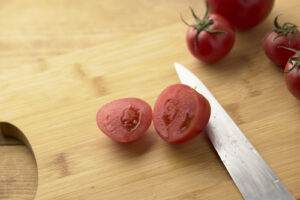
In our own kitchen, a GLOBAL knife has made quick work of tasks that used to feel fiddly. Breaking down whole aji and saba (Japanese horse mackerel and mackerel) went more easily and enjoyably than it had with any knife we’d used before — slices came out thin and even without extra effort. Tomatoes slice thin and clean without tearing or squashing, and chicken skin separates cleanly instead of dragging. Day-to-day care has stayed simple in practice, not just on paper: wash and dry it right after use, and when the edge starts to feel less sharp, a few passes with a sharpener brings it back — no special ritual required.
Which GLOBAL Knife Should You Start With?
- Want one knife that does almost everything? The G-2 chef’s knife is the standard starting point.
- Already prefer a Japanese-style chopping motion? Go with the G-80 santoku instead of the chef’s knife, not in addition to it as a first purchase.
- Mostly doing vegetable prep, not larger cuts of protein? The 5.5″ vegetable knife covers that at a lower price than the full-size models.
- Want to try the brand before spending on a full-size knife? The 3.5″ paring knife is the least expensive way in.
- Starting a GLOBAL collection from scratch? The G-80338 3-piece set covers a santoku, cook’s knife, and paring knife in one purchase.
Caring for GLOBAL Stainless Steel
GLOBAL’s edge is ground shallower than most European knives, which is a major part of why it stays sharp — and also why it needs different care. Whetstones and ceramic sharpening rods are the recommended tools; a standard steel honing rod, the kind that ships with many European knife sets, can be more aggressive than this edge needs and may do more harm than good over time. Hand wash and dry the knife promptly rather than letting it sit wet or go through a dishwasher cycle, and store it in a block, sheath, or on a magnetic strip rather than loose in a drawer where the edge can knock against other utensils.
Common Mistakes to Avoid
- Using a European honing steel on a GLOBAL edge. The thinner 15° edge doesn’t respond to honing steel the way a 20°+ German edge does — use a ceramic rod or whetstone instead.
- Reaching for a chef’s knife on bone or frozen food. The thin, hard edge that makes GLOBAL knives sharp also makes them more prone to chipping on hard impacts.
- Assuming “one-piece” means dishwasher-safe. The all-stainless look doesn’t change the hand-wash-only care instructions that come with every model in this guide.
- Buying the santoku expecting it to feel identical to a chef’s knife. The flatter profile changes the cutting motion — it’s worth handling one in person or checking reviews for grip fit if you’ve never used a santoku before.
Frequently Asked Questions
Are GLOBAL knives actually made from a single piece of steel?
Not literally. Each knife is stamped from a sheet of CROMOVA 18 stainless steel in three pieces — the blade and two handle halves — which are TIG welded together so there’s no visible seam, then the hollow handle is filled with sand for balance. The “seamless” look is real; the “single piece of steel” description commonly used to describe it isn’t quite accurate.
Is GLOBAL steel prone to rusting?
No more than other quality stainless steel — it’s not a special rust risk compared to a typical kitchen knife. That said, any knife left wet or exposed to acidic food residue for extended periods can develop spotting over time, so drying it promptly after washing is good practice regardless of brand.
Are GLOBAL knives suitable for left-handed cooks?
Yes. The blades are ground symmetrically (double-beveled), so they work the same for right- and left-handed use, unlike some traditional single-beveled Japanese knives that are handedness-specific.
Why does GLOBAL recommend a whetstone instead of a honing steel?
GLOBAL’s edge angle is thinner than most European knives, and a standard honing steel is calibrated for thicker, more obtuse edges. Using one on a GLOBAL blade can be more aggressive than the edge needs. A ceramic sharpening rod or whetstone is the gentler, more appropriate option.
What’s the difference between the G-2 chef’s knife and the G-80 santoku?
The G-2 has a curved Western chef’s knife profile suited to a rocking cutting motion; the G-80 has a flatter santoku profile suited to an up-and-down chopping motion, plus hollow-ground indentations meant to reduce food sticking to the blade. Neither is strictly “better” — it comes down to which cutting motion you already use.
Can I put GLOBAL knives in the dishwasher?
The listings for every model in this guide call for hand washing rather than dishwasher use. Dishwasher heat and detergent can dull the edge and affect the handle over time, so hand washing and prompt drying is the safer routine regardless of what any single listing states.
What You’ll Also Need
Because GLOBAL’s edge is thinner than most European knives, a standard honing steel isn’t the right sharpening tool. GLOBAL sells its own Global 2-Stage Handheld Knife Sharpener ($59.95) directly through its official Amazon store — a coarse stage restores a dulled edge, and a fine stage polishes it afterward, with no whetstone technique required. To use it, draw the blade through the coarse stage a few times first if the edge feels noticeably dull, then finish with several light passes through the fine stage; a few strokes per side is usually enough to bring the edge back.
If you’d rather use a third-party option, the Minosharp 3 Sharpener ($44.98) is a hand-held ceramic sharpener also marketed for GLOBAL knives, with three color-coded wheels for rough, medium, and fine sharpening. It uses a small water reservoir to keep the ceramic wheels wet while you work — fill it, then draw the blade down through whichever wheel matches how dull the edge is, a few passes per side, moving to the finer wheel once the edge feels restored.
Final Thoughts
GLOBAL’s reputation rests on a real, documented pedigree: a Niigata-based knife maker, a design collaboration dating to 1983, and decades of use by home cooks and professional chefs alike. The G-2 chef’s knife remains the sensible starting point for most people, with the santoku, vegetable knife, and paring knife as logical next additions depending on how you actually cook. Just go in with accurate expectations on two points: these knives aren’t literally forged from one piece of steel, and their thin, sharp edge asks for a whetstone or ceramic rod rather than the honing steel that comes with most European knife blocks.
コメント