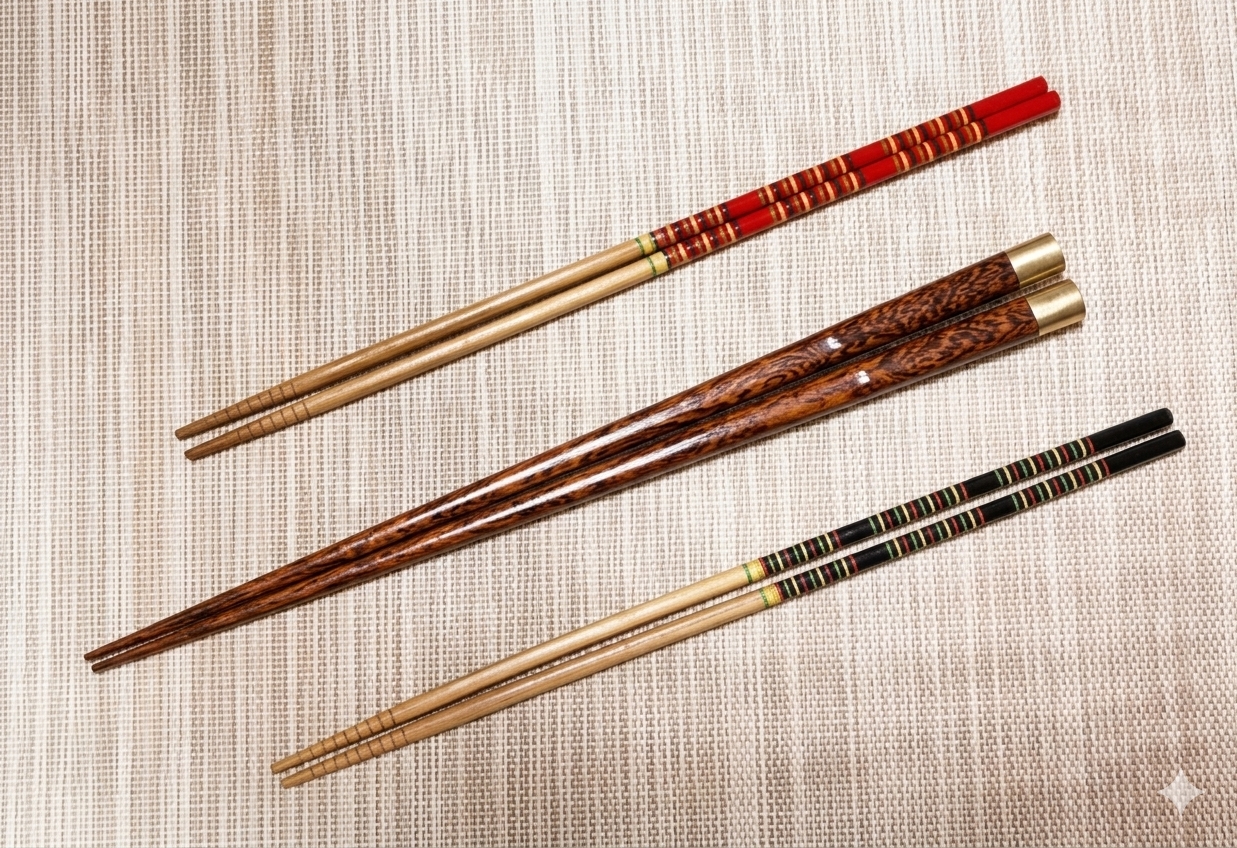
If you just want one reliable pair: the Tanaka Hashi Bamboo Saibashi ($6.70) is made in Japan, has 170 ratings at 4.7 stars, and covers the basics — frying, hot pot, plating — at a price where owning a second pair isn’t a big deal. Below we compare it against a premium stainless-steel pair, an artisan smoked-bamboo pair, and a tong-style pair that’s easier to learn if you’re not confident with chopsticks yet.
- What Are Saibashi, and Why Are They Longer Than Regular Chopsticks?
- Comparison Table
- What to Look for When Buying Saibashi
- The Saibashi, Reviewed
- Which One Should You Buy?
- Bamboo vs. Stainless Steel vs. Tong-Style: What’s the Real Tradeoff?
- Caring for Your Saibashi
- Common Mistakes
- FAQ
- What You’ll Also Need
- Final Thoughts
What Are Saibashi, and Why Are They Longer Than Regular Chopsticks?
Saibashi (菜箸) are Japanese cooking chopsticks — longer and typically sturdier than the chopsticks you’d eat with, built for reaching into a hot pot, turning food in oil, or plating a dish without getting your hand near the heat. Where table chopsticks tend to run 21–24 cm, saibashi are usually 30 cm (about 12 inches) or longer, with some frying-specific versions stretching past 15 inches specifically to keep your hand well clear of hot oil.
They show up in a few different materials. Bamboo and wood are the traditional choice — lightweight, heat-resistant, and gentle on nonstick cookware. Stainless steel is a newer, more durable alternative that can go in the dishwasher without concern. And a smaller category of “saibashi tongs” ditches the two-stick design entirely for a single spring-loaded pincer, trading a little of the traditional feel for something much easier to pick up if you didn’t grow up using chopsticks.
🏆 Best Choice: Tanaka Hashi Bamboo Saibashi →
Comparison Table
| Product | Price | Material / Size | Best For |
|---|---|---|---|
| Tanaka Hashi Bamboo Saibashi | $6.70 | Bamboo wood, 13″ | Best Overall / Value |
| Shimomura Kihan Stainless Steel | $28.00 | 18-8 stainless steel, 11.8″ | Best Premium / Dishwasher-Safe |
| Morikuru Susu-maru Smoked Bamboo | $17.99 | Smoked bamboo, 11.8″ | Best Traditional / Artisan |
| Yoshikawa EAtoCO Tong-Style | $28.99 | Stainless steel tong, 9.8″ | Best for Beginners |
What to Look for When Buying Saibashi
- An explicit country-of-manufacture claim. As with most Japanese kitchen tools sold on Amazon, some listings use “Japanese-style” language or a Japan-sounding brand name without stating where the product is actually made — check the listing itself, not just the branding.
- Length. Longer (13″+) pairs are better suited to deep frying or a tall stockpot; something closer to 10–12″ is easier to control for everyday stirring and plating.
- Material. Bamboo and wood are lightweight, heat-resistant, and safe to use on nonstick coatings; stainless steel is more durable and dishwasher-safe but can scratch delicate nonstick surfaces if you’re not careful.
- Two-stick vs. tong-style. Traditional saibashi are two separate sticks, same as eating chopsticks but longer; tong-style saibashi are a single hinged tool that’s much easier to pick up without prior chopstick experience, at the cost of some of the traditional feel and precision.
- What’s actually included. Some listings bundle a rest or holder, others are the chopsticks alone — check before assuming.
The Saibashi, Reviewed
Disclosure: As an Amazon Associate I earn from qualifying purchases.
Tanaka Hashi Bamboo Saibashi
This is the pair with the most track record in our lineup: 170 ratings at 4.7 stars, at a price low enough that it’s easy to keep a spare in the drawer. “Made in Japan” is stated directly in the listing title. At 13 inches, it’s on the longer end for general cooking use — long enough for shallow frying and hot pot without the length getting unwieldy for everyday stirring and plating.
Pros:
- “Made in Japan” stated directly on the listing
- Strongest review history of the four, by a wide margin
- Lowest price, making it easy to buy a backup pair
Cons:
- Bamboo needs to be hand-washed and dried, not run through the dishwasher
- Only one length/style option, unlike the stainless or tong-style picks
Bottom line: the pair most people should start with — proven, cheap enough to not think twice about, and long enough for most home cooking tasks.
Shimomura Kihan Stainless Steel Cooking Chopsticks
Shimomura is a brand we’ve verified as a genuine Japanese kitchenware maker in other reviews on this site. This listing’s product details include a specific “Country of Manufacture: Japan” field — a more concrete claim than branding alone. Made from 18-8 stainless steel at 11.8 inches, it’s built to be more durable and easier to sanitize than a wood or bamboo pair, at the cost of the lighter, more heat-insulated feel bamboo offers. At 4.5 stars, it has far fewer ratings (2) than the Tanaka Hashi pair, so treat that rating as a small sample.
Pros:
- Explicit “Country of Manufacture: Japan” listed in the product details
- Stainless steel is dishwasher-safe and more durable long-term than bamboo
- From a brand this site has verified in other reviews
Cons:
- Very few reviews at time of writing
- Metal chopsticks can scratch nonstick cookware if used carelessly, and conduct more heat than bamboo
Bottom line: worth it if you want something dishwasher-safe and don’t mind the tradeoffs of metal over bamboo.
Morikuru Susu-maru Smoked Bamboo Saibashi
This pair uses a traditional smoking process (susu-dake) rather than dye or artificial coating to get its dark finish, according to the listing, and the seller markets it as “designed for professional kitchen use” — that’s the seller’s own positioning, not something we independently verified. “Made in Japan” is stated directly in the listing, under the Morikuru brand. At 11.8 inches and a rounded profile, it’s built along more traditional lines than the flatter, more angular Tanaka Hashi pair.
Pros:
- “Made in Japan” stated directly on the listing
- Traditional smoking process for the finish, rather than dye, per the listing
- 4.6-star rating
Cons:
- More expensive than the Tanaka Hashi pair for a similar bamboo cooking chopstick
- The “professional kitchen use” claim is the seller’s own marketing language, not an independently verified standard
Bottom line: a solid pick if you want a more traditional look and finish and don’t mind paying more for it.
Yoshikawa EAtoCO Tong-Style Saibashi
Yoshikawa is a Japanese kitchenware brand we’ve also verified in other reviews on this site. This is a genuinely different design from the other three: instead of two separate sticks, it’s a single piece of hinged 18-0 stainless steel that operates like a small pair of tongs. “Made in Japan” is listed directly in the product details. At 9.8 inches, it’s the shortest option here, and with 149 ratings at 4.2 stars it has a real, if slightly more mixed, review history.
Pros:
- “Made in Japan” stated directly in the product details
- Much easier to pick up and use precisely if you’re not confident with two-stick chopsticks
- Stainless steel construction, dishwasher-friendly
Cons:
- Lowest average rating of the four
- Shortest length here, so less reach into a deep pot than the other options
- Loses some of the traditional two-stick feel and technique
Bottom line: the pick if traditional chopstick technique isn’t something you want to deal with, and you’d rather have a tool that grips like tongs.
Which One Should You Buy?
- Want the most proven, budget-friendly option: Tanaka Hashi Bamboo Saibashi.
- Want something dishwasher-safe and more durable long-term: Shimomura Kihan Stainless Steel Cooking Chopsticks.
- Want a more traditional look and finish, and don’t mind paying more: Morikuru Susu-maru Smoked Bamboo Saibashi.
- Not confident with chopstick technique, or want an easier grip: Yoshikawa EAtoCO Tong-Style Saibashi.
Bamboo vs. Stainless Steel vs. Tong-Style: What’s the Real Tradeoff?
Bamboo and wood saibashi are the traditional choice for a reason: they’re light, they don’t conduct heat into your hand the way metal can, and they won’t scratch a nonstick pan. Their downside is that they need to be hand-washed and dried rather than run through a dishwasher, and like any wood kitchen tool, they’ll eventually wear out with heavy use.
Stainless steel saibashi solve the durability and dishwasher problem, but they conduct more heat and can scratch delicate nonstick coatings if you’re not careful with them — something to keep in mind if most of your cookware is nonstick.
Tong-style saibashi, like the Yoshikawa pick above, are a different category entirely. They trade some of the control and traditional feel of two-stick chopsticks for something that’s much more approachable if you didn’t grow up using chopsticks — there’s no technique to learn, you just squeeze.
Caring for Your Saibashi
Bamboo and wood (Tanaka Hashi, Morikuru)
- Hand wash and dry promptly rather than leaving them soaking or running them through the dishwasher.
- Avoid prolonged high heat contact (e.g., resting them directly in oil for extended periods) beyond normal cooking use.
Stainless steel (Shimomura, Yoshikawa)
- Dishwasher-safe per the listings, though hand washing will help preserve any finish longer.
- Be mindful of scratching nonstick cookware — use a silicone-tipped utensil instead for delicate coated pans if you’re concerned.
Common Mistakes
- Using eating chopsticks for frying. Standard table chopsticks are shorter and put your hand closer to hot oil than a proper pair of saibashi.
- Leaving bamboo saibashi wet or soaking. This can lead to warping, cracking, or mold over time.
- Using metal saibashi carelessly on nonstick cookware. A firm scrape can scratch the coating; a lighter touch or a silicone-tipped tool avoids this.
- Buying a pair too short for the job. If you’re deep frying in a tall pot, a short pair puts your hand closer to the oil than you’d like.
FAQ
Can I just use regular chopsticks for cooking?
You can for light tasks, but standard table chopsticks are shorter, which puts your hand closer to heat when frying or working over a hot pot. Saibashi’s extra length exists specifically to keep some distance between your hand and the heat source.
Are wooden or bamboo saibashi safe for nonstick pans?
Yes — bamboo and wood are generally considered gentler on nonstick coatings than metal utensils, which is one reason they remain popular for cooking chopsticks even though metal options exist.
Can saibashi go in the dishwasher?
Only the stainless steel pairs in this guide are marketed as dishwasher-safe. The bamboo and wood pairs should be hand washed and dried promptly.
What length should I buy?
For general stovetop cooking and plating, 11–13 inches covers most tasks. If you’re specifically deep frying in a tall pot, a longer pair (13 inches or more) keeps your hand further from the oil.
Is a tong-style saibashi as good as traditional chopsticks?
It depends on what you’re optimizing for. A tong-style tool like the Yoshikawa pick is easier to use precisely without chopstick experience, but it doesn’t offer quite the same fine control or traditional feel that experienced users get from a two-stick pair. Neither is objectively “better” — it’s a real preference and skill-level tradeoff.
Do the sticks in a pair really need to match exactly?
Yes — saibashi, like eating chopsticks, are sold and used as a matched pair, and mixing pairs (different lengths, weights, or textures) makes them harder to use precisely.
What You’ll Also Need
A chopstick rest or holder keeps a pair off the counter between uses, which matters more for a longer, oil-coated pair of saibashi than it does for table chopsticks. If you’re using bamboo or wood saibashi for frying specifically, it’s also worth having a heat-safe rest nearby rather than resting them directly across a hot pan.
Final Thoughts
All four pairs here carry a specific “Made in Japan” claim on their own listing, spanning bamboo, stainless steel, and a tong-style design. The Tanaka Hashi Bamboo Saibashi is the easy recommendation for most people — 170 ratings at 4.7 stars, at a price where it’s not a big deal to own a couple of pairs. The Shimomura and Morikuru options serve more specific preferences (dishwasher-safe durability and a more traditional smoked finish, respectively), while the Yoshikawa tong-style pair is worth a look if two-stick chopsticks have never quite clicked for you. Whichever you pick, the main thing saibashi solve for is distance from the heat — so match the length to what you’re actually cooking, not just to whichever pair looks nicest.
コメント