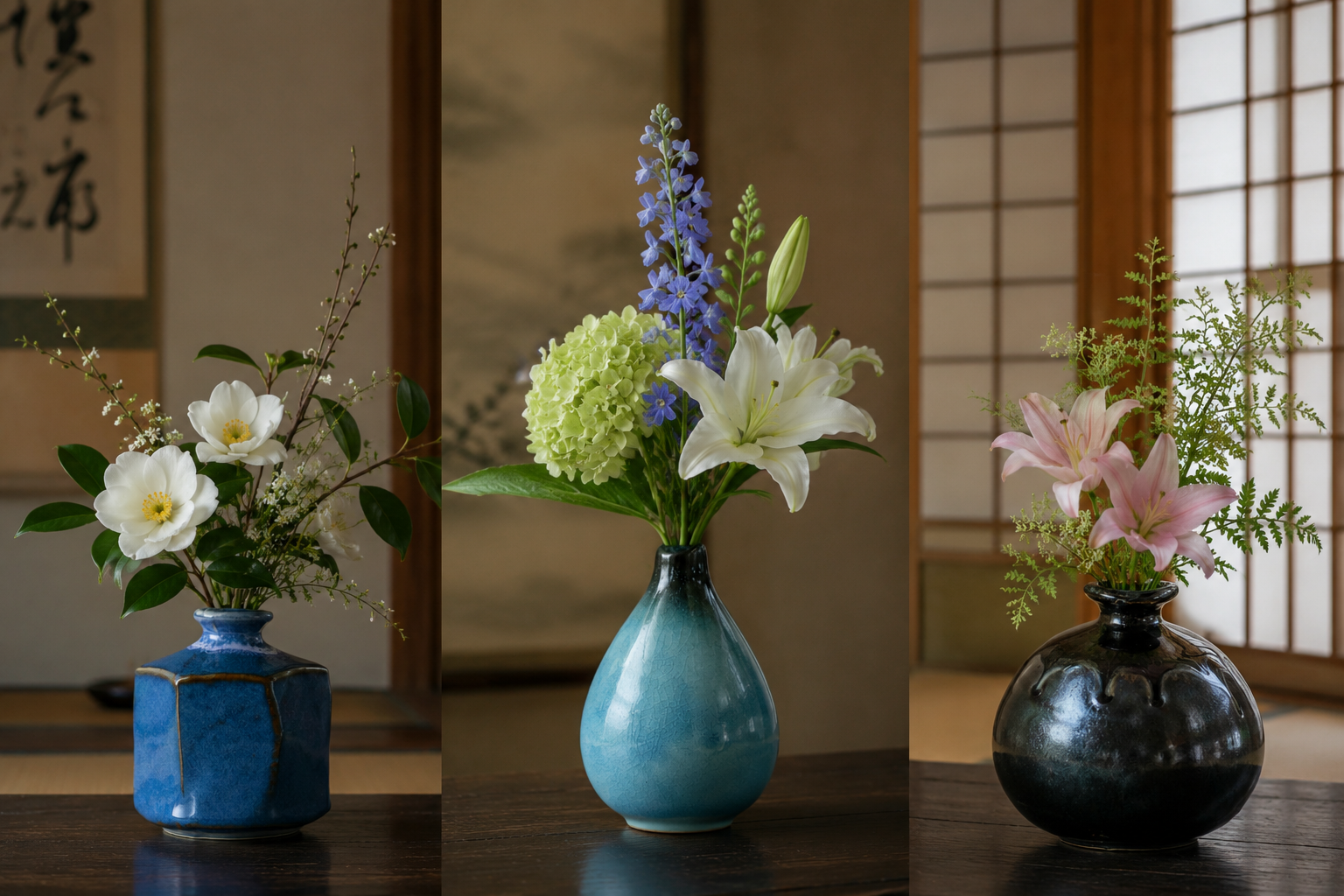
Quick answer: For most people, the Hexagon Shaped Blue vase is the easiest place to start — a genuine, handpainted Mino ware bud vase made in Toki, Gifu Prefecture, typically selling for around $33. Read on for the full comparison, the 1,300-year history and techniques behind Mino ware, and how to arrange and care for a single-stem vase like this.
- What Is Mino Ware (Minoyaki)?
- Comparison at a Glance
- What to Look for When Buying a Bud Vase
- A Few Minoyaki Bud Vases Worth Picking Up
- A Brief History: From Ash Glazes to the Momoyama Golden Age
- Why Choose a Bud Vase (No Kenzan Required)?
- How to Arrange a Single Stem (Ichirin-Ichiyo)
- How to Care for a Mino Ware Vase
- FAQ
- Final Thoughts
What Is Mino Ware (Minoyaki)?
Mino ware is a Japanese pottery tradition from the Tono region of Gifu Prefecture — the towns of Tajimi, Toki, Mizunami, and Kani — with a documented history stretching back over 1,300 years to the 7th century, when early sueki stoneware was fired in hillside anagama kilns. It’s genuinely the backbone of Japanese ceramics in a practical sense: Mino ware accounts for more than half of Japan’s ceramic production by volume today, used everywhere from everyday home kitchens to high-end restaurants.
What makes it distinct from many other Japanese pottery regions is that it doesn’t have one single signature look. Mino ware is often described as being defined by its lack of a single defining characteristic — it spans everything from rustic, imperfect tea ceremony pieces to sleek modern tableware, which is part of why it’s remained so widely produced and adaptable for well over a millennium.
Comparison at a Glance
| Vase | Price | Shape | Best For |
|---|---|---|---|
| Hexagon Shaped Blue | Around $33 | Hexagonal, faceted | Best overall, classic Japanese blue |
| Drop Shaped SkyBlue | Around $33 | Rounded, teardrop | Softer, more organic look |
| Bottle Shaped Metallic Black | Around $33 | Tall, bottle-form | Modern, minimalist interiors |
What to Look for When Buying a Bud Vase
- Made in Japan, with the specific region named — “Japanese-style” ceramics manufactured elsewhere are common; look for the actual production city (Toki, Tajimi, Mizunami)
- A single, narrow opening — confirms it’s built for a stem to hold itself in place, no kenzan needed
- Handpainted glaze, not printed pattern — genuine Mino ware glazing means each piece varies slightly, which is part of the appeal rather than a flaw
- Size relative to what you’ll display — these small bud vases are built for one or two stems, not a full arrangement
A Few Minoyaki Bud Vases Worth Picking Up
Disclosure: As an Amazon Associate I earn from qualifying purchases.
All three of these come from the same maker, Wazakura, working with artisans in Toki, Gifu Prefecture — same clay, same 1,300-year Mino ware tradition, same handpainted glazing process. The honest truth is that the differences between them come down almost entirely to shape and color, not quality or function, so think of this less as a head-to-head comparison and more as a small, curated set of options depending on the mood you’re going for.
Hexagon Shaped Blue
A classic shape and glaze that works in almost any room. See current pricing and customer photos →
The faceted hexagon shape gives it a bit more visual presence on a shelf than a plain round vase would — the angled sides catch natural light a little differently throughout the day, which is a small detail but a nice one. The blue glaze is about as close to a “goes-with-anything” choice as this trio gets. If you only want to buy one and move on, this is the one most people land on.
Drop Shaped SkyBlue
For something a little softer and more textured. Check today’s price on Amazon →
This one leans into a rounder, more organic silhouette, and the crackled glaze gives it a bit more visible texture up close than the smoother hexagon finish. It reads a little less “designed” and a little more like something you’d find tucked into a quiet corner of a tea room.
Bottle Shaped Metallic Black
For a more modern, minimalist look. See today’s reviews and photos on Amazon →
The tall, narrow bottle form and metallic black glaze feel noticeably more contemporary than the two blue vases above, which makes this the one to reach for if your space leans sleek or monochrome rather than rustic.
Any of the three would look good on a shelf — which one you’ll actually be happy with mostly just comes down to which color and shape you find yourself drawn to.
A Brief History: From Ash Glazes to the Momoyama Golden Age
Mino ware’s roots go back to the late Kofun period, when potters produced unglazed sueki stoneware. By the Heian period (794–1185), artisans had developed ash glazes from plant material, producing some of Japan’s earliest glazed ceramics. Larger, more efficient ogama kilns appeared during the Muromachi period (1336–1573), allowing for more consistent firing.
The real turning point came during the Azuchi-Momoyama period (1573–1603), when the rise of the tea ceremony — and the patronage of figures like Oda Nobunaga and tea master Sen no Rikyu — pushed Mino potters toward real artistic innovation. This is when the styles most associated with Mino ware today were born: Shino, Oribe, Kiseto, and Setoguro. Oribe in particular takes its name from the tea master Furuta Oribe, whose taste for bold, asymmetrical, deep-green glazed pieces shaped the aesthetic for centuries after. Shino ware, with its thick, milky-white glaze and distinctive reddish “hi-iro” scorch marks from firing, is considered one of the earliest white-glazed pottery styles in Japan.
These Momoyama-era techniques nearly faded into obscurity until the 20th century, when potter Toyozo Arakawa rediscovered old Mino kiln sites and revived the historical Shino and Setoguro glazing methods. In 1955, he became the first person ever designated a Living National Treasure under Japan’s Important Intangible Cultural Property system, specifically for this work — a reminder that the vase on your shelf is connected to a fairly serious lineage of craft revival.
Why Choose a Bud Vase (No Kenzan Required)?
Ikebana, the Japanese art of flower arranging, often uses a kenzan (a pin frog that holds stems upright in a wide, shallow vessel) for structured, multi-stem arrangements. But a huge part of the tradition is actually simpler than that: a single narrow-necked bud vase, holding one or two stems, needs no kenzan at all — the narrow opening does the job of holding the stem in place on its own. This reflects a core ikebana principle, ichirin-ichiyo (“one flower, one leaf”), the idea that a single well-chosen bloom, given room to be appreciated, can say more than a full bouquet.
How to Arrange a Single Stem (Ichirin-Ichiyo)
- Choose one flower (and optionally one leaf or small stem) rather than a full bunch — the empty space around it is part of the arrangement, not a gap to fill.
- Cut the stem at an angle under running water, which helps the flower absorb water more efficiently.
- Trim the stem length so the flower sits at a height that feels proportionate to the vase, rather than towering over it or disappearing into it.
- Fill the vase with fresh water and place the stem in, adjusting the angle slightly until it feels balanced rather than perfectly centered — asymmetry is part of the aesthetic.
- Change the water every one to two days, and re-cut the stem slightly each time you do, which noticeably extends how long the flower stays fresh.
How to Care for a Mino Ware Vase
Hand wash rather than dishwasher, especially for handpainted pieces where repeated hot cycles can dull the glaze over time. Rinse and dry the inside fully after each use, since standing water left for extended periods can lead to mineral buildup or, in rare cases, hairline cracking in glazed stoneware. Keep it out of direct, prolonged sunlight if the glaze color matters to you, as some pigments can fade gradually with UV exposure. Because each piece is handmade, treat small variations in glaze tone or a slightly uneven rim as part of the piece’s character rather than a manufacturing flaw.
FAQ
Do I need a kenzan (flower frog) for these vases?
No — these are narrow-necked bud vases designed to hold one or two stems on their own. A kenzan is for wider, shallow vessels used in structured ikebana arrangements, which is a different style of vase entirely.
Can these vases hold water safely?
Yes, genuine Mino ware stoneware is glazed and fired to be watertight for everyday flower and water use.
What’s the difference between Mino ware and other Japanese pottery like Tokoname or Shigaraki?
They’re all real, distinct regional traditions with their own clay, glazes, and history — Mino ware (Gifu) is known for its glaze diversity, while Tokoname (Aichi) is associated with reddish unglazed clay, and Shigaraki (Shiga) is known for rustic, natural ash-glaze effects. None is objectively “better”; they simply come from different regions with different techniques.
Why does the glaze color look slightly different in every photo?
Handpainted glazes genuinely shift in tone depending on the angle and light they’re viewed in, and no two handmade pieces are perfectly identical — this is normal for authentic Mino ware, not a listing inconsistency.
Are these vases only for flowers?
Not necessarily — many people use small bud vases like these for single dried stems, branches, or even as a small standalone decorative object on a shelf when empty.
Final Thoughts
A single-stem bud vase is one of the simplest ways to bring genuine Japanese craftsmanship into a home, without needing to learn formal ikebana technique first. All three of these vases carry the same 1,300-year Mino ware tradition, just in different shapes and moods. The Hexagon Shaped Blue is the easiest all-around choice, but the right one really comes down to which shape and glaze fits the room you’re picturing it in.
コメント