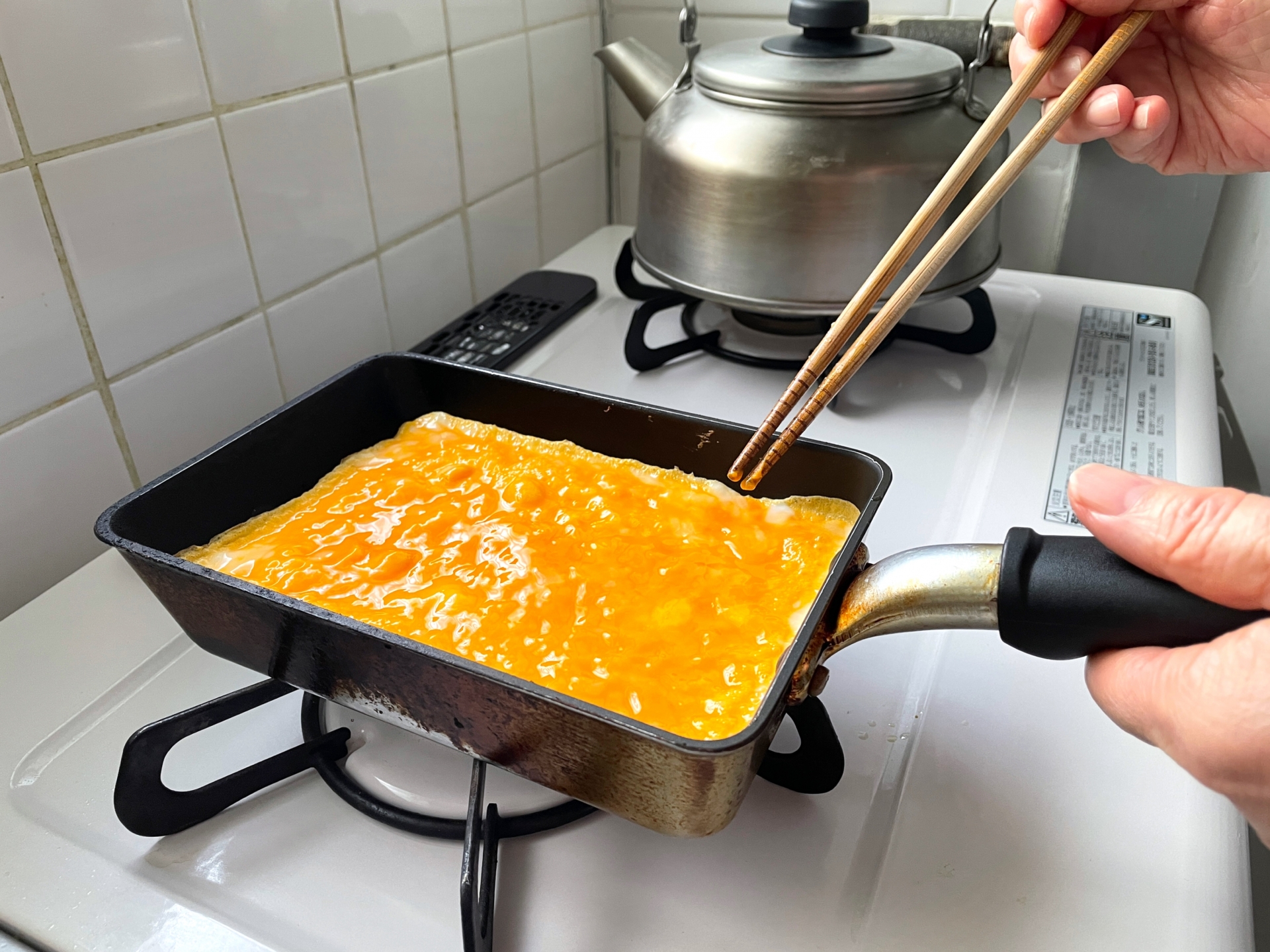
There isn’t one tamagoyaki pan that’s best for everyone. For most beginners, a lightweight Japanese pan with a non-stick coating is the easiest place to start — it’s forgiving, cheap, and needs no seasoning. If you care about the professional-style texture a copper pan gives and don’t mind the higher price and hand care, that’s the upgrade. And if you want a pan built to outlast a lifetime of breakfasts, Iwachu’s Nambu cast iron is the traditional choice. The right pick mostly comes down to your cooktop, how often you actually make tamagoyaki, and how much maintenance you’re willing to do.
Prices, ratings, and review counts below were checked on Amazon on September 11, 2026, with delivery set to a US address, and may change.
- The Short Answer
- What Is a Tamagoyaki Pan, and Why Does the Shape Matter?
- Quick Comparison
- How We Chose These Pans
- The 6 Best Tamagoyaki Pans
- Kotobuki Tamagoyaki Pan — Best Overall
- TIKUSAN Copper Tamagoyaki Pan — Best Premium / Best for Serious Cooks
- Iwachu Nambu Ironware Tamagoyaki Pan — Best Traditional
- TakumiJAPAN Takumi MGEG-M — Best for Induction
- HIBINO Carbon Steel Tamagoyaki Pan — Best Low-Maintenance
- Wahei Freiz Tsubame Sanjo CS-013 — Best Compact
- Which Tamagoyaki Pan Should You Buy?
- Copper vs. Cast Iron vs. Non-Stick
- What Size Tamagoyaki Pan Do You Need?
- Are Tamagoyaki Pans Worth Buying?
- How to Make Tamagoyaki With Your New Pan
- FAQ
- Final Thoughts
The Short Answer
- Choose a non-stick pan if this is your first tamagoyaki pan or you want the easiest cleanup — the Kotobuki Tamagoyaki Pan.
- Choose copper if texture matters more than price and you cook on gas or an electric coil — the TIKUSAN Copper Tamagoyaki Pan.
- Choose Iwachu cast iron if you want traditional cookware that can last for decades and don’t mind the extra weight and seasoning.
- Choose an induction-compatible model if induction is your only cooktop — copper pans generally aren’t compatible with standard induction burners.
What Is a Tamagoyaki Pan, and Why Does the Shape Matter?
Tamagoyaki is the layered, slightly sweet rolled omelette you’ve probably seen in a bento box or on top of a piece of nigiri. The dish takes its name from the pan it’s cooked in: a rectangular (not round) skillet that makes it possible to roll the egg into neat, even layers as you pour and set each one. You can technically make tamagoyaki in a round pan, but the corners make rolling awkward and the layers come out uneven — the rectangular shape isn’t a gimmick, it’s what makes the technique work.
🏆 Best Choice: Kotobuki Tamagoyaki Pan →
Quick Comparison
| Pan | Best For | Material | Induction | Price |
|---|---|---|---|---|
| Kotobuki Tamagoyaki Pan | Best Overall — everyday cooking | Non-stick coated iron | No | $19.99 |
| TIKUSAN Copper Tamagoyaki Pan | Best Premium — serious cooks | Copper (tin-lined) | No | $110.99 |
| Iwachu Nambu Ironware 24017 | Best Traditional — long-term use | Cast iron | Yes | $61.00 |
| TakumiJAPAN Takumi MGEG-M | Best for Induction | Iron (magma plate) | Yes | $36.99 |
| HIBINO Carbon Steel Egg Pan | Best Low-Maintenance | Carbon steel | Yes | $63.99 |
| Wahei Freiz Tsubame Sanjo CS-013 | Best Compact | Iron (resin coated) | Yes | $38.13 |
How We Chose These Pans
We started from Amazon’s own listing data rather than hands-on testing: manufacturer specifications, the product listing’s own bullet points, and patterns across verified owner reviews. For each pan, we checked whether the listing states “Made in Japan” or a specific “Country of Manufacture/Origin,” rather than assuming a Japanese-sounding brand name means Japanese manufacture. We also confirmed current price, stock status, induction compatibility (a genuine limitation for copper pans, since copper alone doesn’t work on standard induction burners), and Amazon review volume and rating at the time of writing. We excluded several popular “Japanese-style” pans from well-reviewed but non-Japanese brands, since this site’s focus is specifically on verified Japan-made craftsmanship rather than Japanese-inspired design.
The 6 Best Tamagoyaki Pans
Disclosure: As an Amazon Associate I earn from qualifying purchases.
Kotobuki Tamagoyaki Pan — Best Overall
Kotobuki’s pan is the one that best matches how tamagoyaki is actually made in most Japanese homes day to day: a lightweight iron pan with a non-stick coating, no seasoning required, and a low price that makes it an easy first purchase. The listing states “Made in Japan” directly. It’s not induction-compatible, so gas or electric coil cooktops are required.
Manufacturer: Kotobuki | Made in Japan: Stated on listing | Material: Iron with non-stick coating | Capacity: 0.25 liters | Induction: No | Price: $19.99 | Amazon reviews: 3.7★ (327 ratings)
Pros: Lowest price of the group; non-stick coating means no seasoning and easy cleanup; light enough for beginners to maneuver while rolling.
Cons: Not induction-compatible; the 3.7-star average is the lowest of the pans in this guide, with some reviewers noting the coating wears with heavy use over time — reasonable for the price, but worth knowing going in.
Verdict: The pan we’d hand a first-time tamagoyaki cook, and the one closest to what an ordinary Japanese kitchen actually uses.
TIKUSAN Copper Tamagoyaki Pan — Best Premium / Best for Serious Cooks
Copper’s high thermal conductivity is the main reason serious cooks reach for it: it heats and cools faster and more evenly than iron, which translates to more consistent layers when you’re pouring and rolling egg in quick succession. This TIKUSAN pan is tin-lined copper with a wooden lid, explicitly listed as Made in Japan, and comes in several sizes — we’re covering the 7.1-inch (18×18cm) version. It’s the most-reviewed premium option we found in this category at 101 ratings.
Manufacturer: TIKUSAN | Made in Japan: Stated on listing | Material: Copper (tin-lined), wooden lid | Size: 7.1×7.1 in (18×18cm) | Induction: No | Price: $110.99 | Amazon reviews: 4.5★ (101 ratings)
Pros: Fast, even heat conduction that owner reviews consistently credit for fluffier, more consistent layers; comes with a matching wooden lid; highest review rating among the pricier options.
Cons: By far the most expensive pan here; copper needs periodic re-tinning over the long run and isn’t induction-compatible; only a few units in stock at any given time, so availability can be tight.
Verdict: The pan worth the splurge if you already know you love making tamagoyaki and want the texture upgrade.
Iwachu Nambu Ironware Tamagoyaki Pan — Best Traditional
Iwachu is a real Nambu ironware (nanbu tekki) maker based in Iwate Prefecture — the same craft tradition behind the cast-iron kettles Japan is famous for. The listing specifies the body’s country of origin as Japan, with the wooden handle sourced from either China or Japan depending on the batch. Unlike the copper pan above, this one is explicitly induction-compatible, which is one of cast iron’s real advantages if you’re not ready to give up the traditional material for an IH cooktop.
Manufacturer: Iwachu | Made in Japan: Body confirmed Japan; handle China or Japan depending on batch | Material: Cast iron, wood handle | Size: 7.1×5.9 in inner (18×15cm) | Induction: Yes | Price: $61.00 | Amazon reviews: 4.6★ (742 ratings)
Pros: Real cast iron holds and distributes heat more evenly than thin aluminum or coated pans; improves with age and seasoning, much like a cast-iron skillet; works on induction; the highest review count of any pan in this guide.
Cons: Needs seasoning before first use and periodic reseasoning after; heavier than the coated or carbon steel options, which matters when you’re flipping and rolling; hand wash only, no dishwasher.
Verdict: If you want a pan that can genuinely last for decades and don’t mind the seasoning routine and extra weight, this is the traditional choice — but it’s a long-term investment pick, not the easiest starting point.
TakumiJAPAN Takumi MGEG-M — Best for Induction
If induction is the only cooktop in your kitchen, this is the most straightforwardly “induction-first” pan in the group: the listing states “Country of Manufacture: Japan” directly and lists induction compatibility as a headline feature rather than an afterthought. It’s made from an iron “magma plate” with a natural beechwood handle attached via die-cast aluminum hardware.
Manufacturer: TakumiJAPAN (タクミジャパン) | Made in Japan: Stated on listing (“Country of Manufacture: Japan”) | Material: Iron (magma plate), beech wood handle | Weight: ~0.62 kg | Induction: Yes | Price: $36.99 | Amazon reviews: 4.1★ (34 ratings)
Pros: Explicit, listing-stated Made in Japan claim; built specifically around induction compatibility; mid-range price; also available in several larger sizes from the same maker if you want a bigger cooking surface.
Cons: Fewer reviews than the more established brands here, so the track record is thinner; bare iron surface still needs basic seasoning and care, unlike the non-stick coated options.
Verdict: The pan to reach for if your kitchen is induction-only and you don’t want to gamble on whether a “compatible” claim actually holds up.
HIBINO Carbon Steel Tamagoyaki Pan — Best Low-Maintenance
HIBINO’s pan is carbon steel rather than cast iron, which the listing describes as roughly 30% lighter than a standard carbon steel pan of similar size — a real difference when you’re lifting and tilting a pan through dozens of rolls. It ships with a food-safe protective coating that lets you start cooking without an initial seasoning step, and the coating is described as wearing off gradually while the steel builds its own seasoning over time. The wooden handle detaches, which both keeps it comfortable to hold and lets the pan go in the oven. The listing states “Made in Japan” and specifies “Nippon Steel–certified carbon steel.”
Manufacturer: HIBINO | Made in Japan: Stated on listing | Material: Carbon steel, detachable wood handle | Size: 6.1×5.9 in (15.5×15cm), also available in a 20cm round | Induction: Yes (also gas, electric, ceramic) | Price: $63.99 | Amazon reviews: 4.1★ (35 ratings)
Pros: Meaningfully lighter than cast iron by the manufacturer’s own figures; no mandatory initial seasoning; detachable handle allows oven use and easier storage; works across every common cooktop type.
Cons: Priced close to the Iwachu cast iron pan without cast iron’s decades-long reputation; still needs the same basic dry-and-oil care as any bare-metal pan once the factory coating wears down; a newer listing with fewer reviews than Iwachu or Kotobuki.
Verdict: A strong pick if you want cast-iron-style seasoning benefits without the weight or the mandatory break-in period.
Wahei Freiz Tsubame Sanjo CS-013 — Best Compact
Wahei Freiz is a housewares maker based in Tsubame-Sanjo, Niigata — a region with a long history of Japanese metalworking, and a brand that shows up elsewhere in Japanese kitchenware for its consistency. This is the smallest pan in our lineup at 5.5×7.1 inches, built from resin-coated iron with a natural wood handle, and the listing states “Country of Manufacture: Japan” directly. It’s a reasonable choice if you’re cooking single portions or have limited storage space.
Manufacturer: Wahei Freiz | Made in Japan: Stated on listing (“Country of Manufacture: Japan”) | Material: Iron with silicone resin coating, wood handle | Size: 5.5×7.1 in (14×18cm) | Induction: Yes | Price: $38.13 | Amazon reviews: 4.1★ (55 ratings)
Pros: Compact size suits single portions or a small kitchen; resin coating adds non-stick performance to a real iron body; induction-compatible; established Tsubame-Sanjo maker.
Cons: Smaller cooking surface means smaller tamagoyaki rolls; stock on this specific size has been limited — check current availability before counting on it, and note the maker also sells an 18×18cm size at a different price point.
Verdict: Worth a look if you’re cooking for one or two and don’t need a full-size pan.
Which Tamagoyaki Pan Should You Buy?
- Beginner making tamagoyaki for the first time: Kotobuki — cheap, forgiving, no seasoning.
- Induction cooktop is all you have: TakumiJAPAN Takumi MGEG-M, or Iwachu if you want cast iron specifically.
- Cooking on gas and want the best texture: TIKUSAN Copper.
- Serious about tamagoyaki and want a lifetime pan: Iwachu Nambu Ironware.
- Want cast-iron-style seasoning without the weight: HIBINO Carbon Steel.
- Cooking single portions or short on storage space: Wahei Freiz CS-013.
- Budget is the deciding factor: Kotobuki, by a wide margin.
Copper vs. Cast Iron vs. Non-Stick
Copper conducts and releases heat faster than any other material here, which is why cooks chasing the fluffiest, most evenly-cooked layers tend to prefer it — the tradeoff is price, hand care, and no induction compatibility. Cast iron (and carbon steel, which behaves similarly) holds heat well once it’s hot and, with seasoning, builds its own natural non-stick surface over time; it’s heavier and needs a genuine seasoning routine, but rewards that care with a pan that can last decades. Non-stick coated iron is what most Japanese households actually reach for day to day: it needs no seasoning, cleans up in seconds, and is the cheapest way in, though the coating itself has a finite lifespan compared to bare metal that’s been properly seasoned.
What Size Tamagoyaki Pan Do You Need?
| Size | Good For |
|---|---|
| 13×18 cm (5×7 in) | Single portions, compact kitchens, one or two eggs at a time |
| 15×18 cm (6×7 in) | The most common size — standard bento-portion rolls |
| 18×18 cm (7×7 in) | Larger rolls or slightly thicker tamagoyaki, still easy to store |
Are Tamagoyaki Pans Worth Buying?
If you only make tamagoyaki once or twice a year, an ordinary non-stick skillet and a bit of extra folding care will get you an edible result — you don’t strictly need a dedicated rectangular pan. Where a real tamagoyaki pan earns its keep is if you make it regularly: the rectangular shape genuinely does make rolling even layers easier, and once you’re used to the shape, going back to a round pan feels like a downgrade. If you’re not sure you’ll keep making it, the $19.99 Kotobuki is a low-risk way to find out.
How to Make Tamagoyaki With Your New Pan
Whisk 3 eggs with 1 tablespoon of dashi (or water), 1 teaspoon of soy sauce, 1 teaspoon of sugar, and a pinch of salt until just combined — don’t overbeat, or you’ll get too much foam. Heat your pan over medium-low heat and wipe it with an oil-soaked paper towel. Pour in a thin layer of egg mixture, just enough to coat the bottom, and let it set for about 15–20 seconds. Starting from the far edge, roll the egg toward you into a log using chopsticks or a spatula. Push the roll back to the far edge, oil the empty pan again, and pour in another thin layer, lifting the existing roll slightly so the new egg flows underneath it. Repeat the roll. Continue adding, setting, and rolling thin layers until you’ve used all the egg mixture, then slide the finished roll onto a bamboo sushi mat and gently press it into a neat rectangular shape while it’s still warm. Let it rest a minute before slicing.
Variation — Dashimaki Tamago: Use a higher ratio of dashi to egg (about 2 tablespoons of dashi per egg) and skip the sugar for a savory, custardy version that’s more delicate and slightly harder to roll — worth trying once you’re comfortable with the basic technique.
FAQ
Do I really need a rectangular pan for tamagoyaki?
Not strictly, but it’s what makes rolling even layers straightforward. A round pan works in a pinch; the corners just make the rolling technique more awkward.
Is copper safe to cook eggs in directly?
The TIKUSAN pan and similar copper tamagoyaki pans are tin-lined specifically so the food doesn’t contact bare copper, which can react with acidic foods. As with any tin lining, avoid high, prolonged heat that could damage the lining.
Can I use a tamagoyaki pan for anything besides tamagoyaki?
Yes — several listings mention using these pans for small pancakes, grilled sandwiches, or pan-searing small portions of meat or vegetables, though the rectangular shape is specifically optimized for rolling eggs.
Why isn’t my copper or cast iron pan working on my induction stove?
Induction cooktops need a magnetic base to generate heat. Copper alone isn’t magnetic, so copper pans generally won’t heat on induction unless they have a magnetic base layer bonded in, which the TIKUSAN pan in this guide does not. Cast iron and most carbon steel are naturally magnetic and typically work fine.
How do I season a cast iron or carbon steel tamagoyaki pan?
Heat the pan, wipe it with a thin layer of oil using a paper towel, and repeat this a few times before first use, then continue wiping it with oil after each wash while it’s still warm. Avoid soap on well-seasoned pans; hot water and a soft sponge are usually enough.
Can these pans go in the dishwasher?
Generally no. Bare cast iron and carbon steel should be hand washed to protect the seasoning, and even the non-stick coated Kotobuki pan is best hand washed to extend the coating’s life, though check your specific listing for the manufacturer’s guidance.
What’s the difference between tamagoyaki and dashimaki tamago?
Tamagoyaki generally refers to the broader category of rolled Japanese omelette, often lightly sweetened; dashimaki tamago specifically uses a higher ratio of dashi stock to egg for a softer, more savory, custard-like result. Both use the same pan and rolling technique.
Final Thoughts
None of these six pans is objectively “the best” — they’re built for different cooktops, budgets, and maintenance tolerances. The Kotobuki is our overall pick because it matches how most people actually cook tamagoyaki day to day: cheaply, without a seasoning ritual, and without worrying about induction compatibility one way or the other. If you already know you want the upgrade in texture or longevity, the TIKUSAN copper and Iwachu cast iron pans are both genuinely Made in Japan and each earn their higher price in a different way. All six pans listed here carry an explicit Made in Japan or Country of Manufacture: Japan claim on their listing, with the one caveat that Iwachu’s wooden handle is sourced from either China or Japan depending on the batch — the cast iron body itself is confirmed Japan-made.
コメント