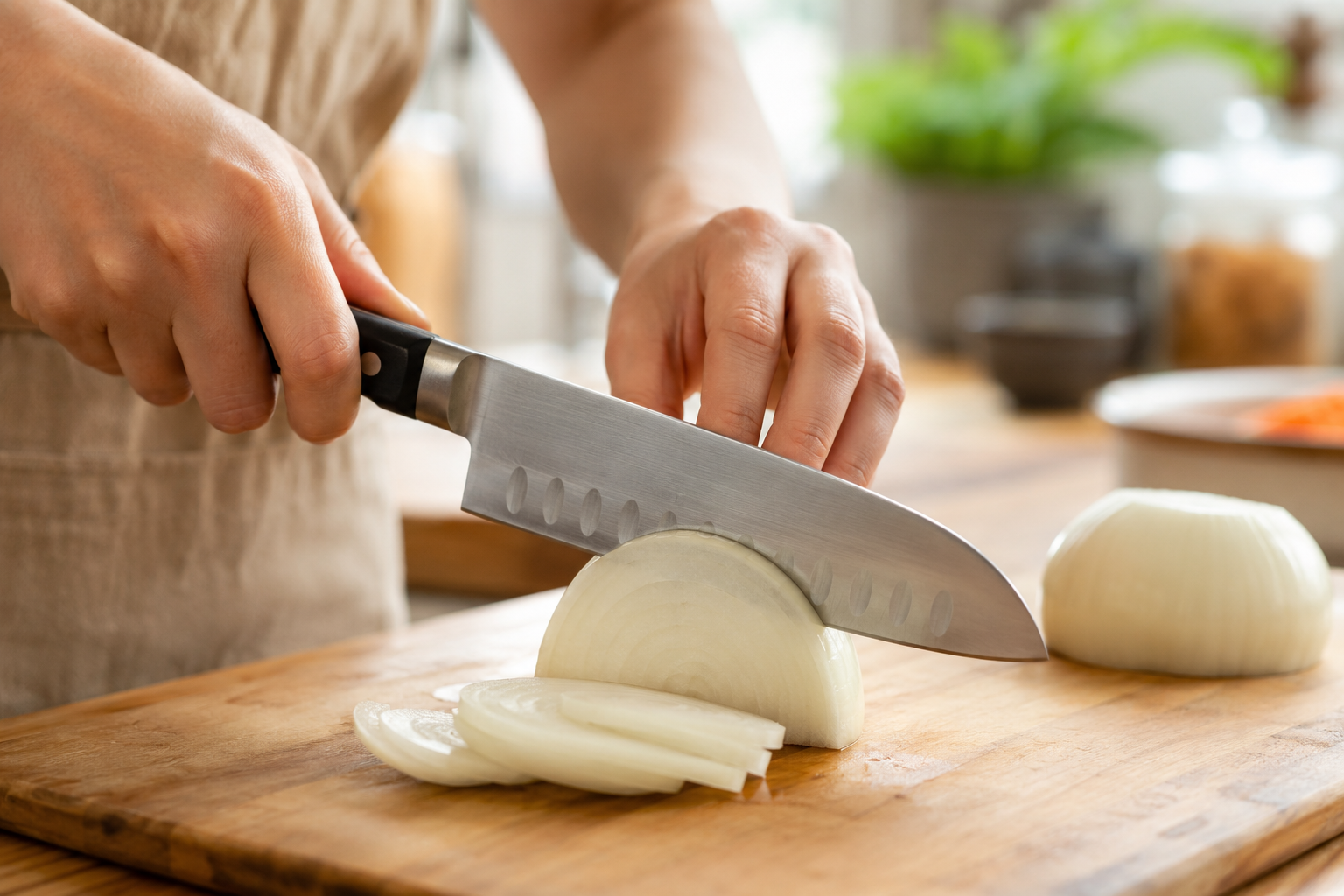
Quick answer: For most home cooks, the MAC Superior Santoku is the best place to start — a genuine Made-in-Japan santoku with a real edge advantage over Western knives at a similar price, typically selling in the $50s (prices on Amazon fluctuate often, so treat these as a guide rather than a guarantee). This guide focuses on the $50–$130 range specifically, where Japanese steel and geometry start to meaningfully outperform Western knives at the same price — not the $20 imports that borrow the shape without the substance.
Is a Japanese Knife in This Price Range Actually Worth It?
This is worth answering honestly before recommending anything. A lot of home cooks already own a basic santoku-shaped knife — often an inexpensive one bought without paying much attention to the brand — and don’t necessarily notice a dramatic difference from a Western knife in daily use. That’s a completely reasonable experience, and it points to something real: at the very low end (roughly under $30), the difference between a generic “Japanese-style” knife and a decent Western one is often smaller than the marketing suggests.
Where the difference becomes genuinely noticeable is especially from around $80 upward, within this guide’s broader $50–130 range. In that range, you’re paying for real Japanese steel (VG-10 or similar), sharpened to the narrower angle that Japanese knives are known for, from manufacturers with a real track record. At this tier, a Japanese santoku will typically hold a finer edge longer and cut with less resistance than a Western knife at the same price — the gap that’s harder to see at $20 becomes obvious at $100.
What Is a Santoku, and Why Choose One?
Santoku translates to “three virtues,” referring to its ability to handle meat, fish, and vegetables equally well. It emerged in Japan in the 1940s as a general-purpose knife, shorter and flatter than a Western chef’s knife (typically 6.5–7 inches versus 8), with a rounded tip better suited to a straight push-cut than the rocking motion a curved Western blade encourages. If you’re only going to own one Japanese knife, this is the one most people recommend starting with — it’s more forgiving to learn on than a single-bevel traditional knife, while still giving you the sharper angle and harder steel that define Japanese cutlery.
Two of the three knives here come from Seki, a city in Gifu Prefecture with over 700 years of bladesmithing history, dating back to when the region’s swordsmiths took advantage of its access to quality iron sand, charcoal, and water. When sword demand declined, that same metalworking expertise shifted into kitchen cutlery, which is part of why Seki remains one of the two production centers (alongside Sakai) most associated with Japanese knives today.
Comparison at a Glance
| Knife | Steel | Hardness (HRC) | Blade Length | Made In | Price |
|---|---|---|---|---|---|
| MAC Superior | High-carbon stainless | ~58 | 6.5 in | Seki, Japan | ~$50s* |
| Tojiro DP | VG-10 core, stainless-clad | ~60 | 6.7 in | Niigata, Japan | ~$100–130* |
| MAC Professional | High-carbon stainless | ~58 | 6.5 in | Seki, Japan | ~$120–130* |
*Prices fluctuate frequently on Amazon, sometimes by $20–30 in either direction within weeks — treat these as a general guide and check the current price before buying.
What to Look for When Buying a Santoku in This Range
- Actual steel type stated — VG-10, AUS-8, or a named high-carbon stainless, not just “Japanese steel”
- Country of origin, as one signal among several — “Made in Japan” isn’t a guarantee of quality on its own, but combined with a stated steel type and a manufacturer with a real track record, it’s a useful data point. Heat treatment, grind quality, and quality control matter just as much as where the knife was physically made
- Blade length that suits your hand — 6.5 inches is easier to control for most home cooks; 7 inches gives a bit more length for larger produce
- Handle material — Western-style handles (like these three) need less special care than traditional Japanese wa-handles
Product Reviews in Detail
Disclosure: As an Amazon Associate I earn from qualifying purchases.
MAC Superior Santoku — Best Overall
This is the one most people should start with in this price range. See today’s Amazon price and owner reviews →
MAC is a well-regarded Seki, Japan manufacturer, and this Superior-line santoku is sub-zero tempered, a process several knife retailers and MAC’s own materials describe as improving edge retention over standard tempering. Owners across multiple retailer review pages consistently describe it as thin and light in the hand — noticeably lighter than a typical German-style chef’s knife — gliding through onions and other produce with very little resistance rather than the crushing feel a duller or thicker blade can have. That lighter build also makes it easier to maintain a sharp edge on a whetstone than a thicker, harder blade would be.
Pros:
- Lowest price of the three while still being a genuine step up from entry-level knives
- Made in Seki, one of Japan’s historic cutlery-making regions
- Well-reviewed for sharpness straight out of the box
Cons:
- Simpler finish than the Tojiro or MAC Professional — you’re paying for the steel and edge, not the appearance
Bottom line: If you just want to know whether stepping up from a basic knife is worth it, this is the cheapest genuine way to find out.
Tojiro DP Santoku — Best Edge Retention
Choose this one if you want the steel to be the star of the show. Compare current pricing on Amazon →
The standard Tojiro DP line (not to be confused with Tojiro’s separate Damascus-finished models) uses a VG-10 steel core clad in two layers of plain stainless steel, hardened to around 60 on the Rockwell scale — hard enough to hold an edge well, without being so hard that it becomes difficult to sharpen at home. According to Tojiro’s own product materials and multiple specialty knife retailers, it won a Good Design Long Life Design Award decades ago and has remained one of Tojiro’s most consistently recommended knives since. Reviewers across several retailer pages describe onions and tomatoes slicing cleanly with very little resistance — the kind of edge that stays noticeably keener, longer, than the softer steels used in cheaper knives.
Pros:
- VG-10 core steel holds a fine edge longer than the softer steels used in cheaper knives
- Long, well-documented track record rather than a newer, unproven line
- Triple-riveted handle feels substantial without being heavy
Cons:
- Price has risen noticeably over the past few years, per multiple knife retailers and forums, narrowing the value gap versus the MAC Superior
Bottom line: The one to choose if you want the steel quality without spending on premium fit and finish.
MAC Professional Santoku — Best for Sticky Foods
Choose this one if sticking is your specific, recurring frustration. Read recent owner reviews on Amazon →
This is MAC’s Professional line, distinguished from the Superior by the small dimples ground into the blade face. Those dimples reduce the surface area of food touching the blade, which noticeably cuts down on potatoes, cucumbers, and similarly starchy or wet vegetables sticking to the knife mid-cut.
Pros:
- Dimples genuinely reduce food-sticking compared to a flat blade face
- Same reputable Seki manufacturing as the Superior line, with a step up in finish
- Sub-zero tempered steel for better edge retention
Cons:
- The most expensive of the three here, and the dimples are a specific benefit rather than a universal upgrade
Bottom line: Choose this one specifically if sticking is your main frustration with your current knife — otherwise the Superior does most of the same job for less.
Which One Should You Buy?
- Just want to see if the price jump is worth it? → MAC Superior
- Want the best edge retention for regular home cooking? → Tojiro DP
- Constantly annoyed by food sticking to your blade? → MAC Professional
How to Care for a Santoku in This Price Range
Hand wash and dry immediately — none of these are dishwasher-safe, and prolonged moisture is the main threat to the blade and any wood in the handle. Use a wooden or plastic cutting board rather than glass or stone, which will dull the edge quickly regardless of how good the steel is. A honing rod isn’t the right tool for these; a whetstone is the standard way to maintain a Japanese edge, since the steel is harder and thinner than what honing rods are designed to realign. Most owners only need to sharpen a knife in this range a few times a year with regular home use, far less often than a softer Western blade.
FAQ
Santoku vs. chef’s knife — what’s the actual difference?
A Western chef’s knife is longer, curved, and heavier, built for a rocking cutting motion. A santoku is shorter, flatter, and lighter, built more for a straight push-cut. Neither is strictly better — it depends on which motion feels natural to you.
Santoku vs. gyuto — which should I get?
A gyuto is essentially the Japanese equivalent of a Western chef’s knife: longer, with more curve for rocking cuts. If you already cook with a rocking motion and like it, a gyuto may suit you better than a santoku.
VG-10 vs. AUS-8 — does it matter?
VG-10 (used in the Tojiro here) is generally harder and holds an edge longer than AUS-8, but AUS-8 is easier to sharpen and more forgiving for beginners. Neither is a wrong choice; it’s a tradeoff between edge retention and ease of maintenance.
Can I cut through bones with a santoku?
No — these are thin-bladed knives built for precision cutting, not the impact of chopping through bone. Use a cleaver or the spine-heavy deba style knife for that instead.
Will these rust?
All three use stainless steel, so surface rust is unlikely with normal drying habits, though no stainless knife is entirely rust-proof if left wet for extended periods.
Is a $100 santoku really better than a $30 one?
In terms of steel hardness and edge retention, generally yes — but the difference is most noticeable in how long the edge lasts and how it feels slicing, not necessarily in day-one sharpness, which cheaper knives can also achieve out of the box.
Do I need a whetstone to own one of these?
Eventually, yes, if you want to maintain the edge properly. You don’t need one on day one, but a pull-through sharpener or honing rod isn’t well-suited to these steels long-term.
Can a santoku replace my Western chef’s knife entirely?
For most home tasks, yes. Where it’s more limited is very large produce (whole squash, big melons) where a longer chef’s knife or gyuto has an edge, literally, due to blade length.
Are these knives left- or right-handed?
All three in this guide have a symmetrical double-bevel edge, so they work equally well for either hand — this isn’t the case for every Japanese knife, so it’s worth checking before buying a single-bevel style.
Do I need a full knife set, or is one santoku enough?
One good santoku genuinely covers most home cooking. A paring knife for small tasks and a bread knife for, well, bread are the two most common additions people make afterward, rather than buying a full block set upfront.
Final Thoughts
If you’ve been using an inexpensive santoku-shaped knife for years without feeling a strong reason to upgrade, that’s a fair starting point — the difference genuinely isn’t dramatic at the very low end. It shows up more clearly from around $80 upward, where the steel and edge geometry actually do the job Japanese knives are known for. The MAC Superior is the easiest, least expensive recommendation for most buyers, while the Tojiro DP remains the better choice if maximum edge retention is your priority over price — if your current knife crushes tomatoes before it cuts them, either one is the kind of upgrade you’ll notice at your very next meal.
コメント