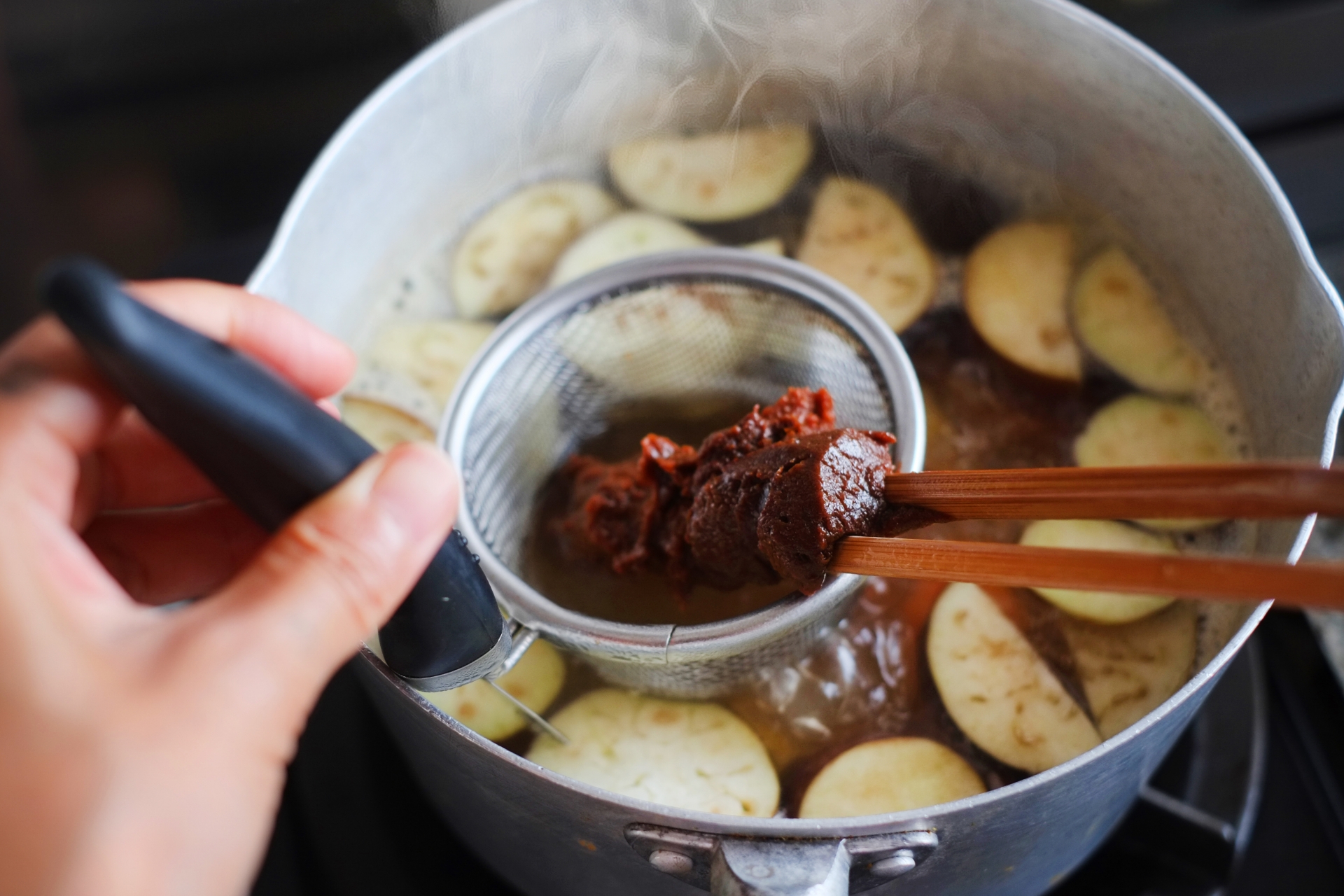
If you just want the answer: the Shimomura 29343 Miso Strainer “Meijin” ($16.15) is our top pick — a fine-mesh, dishwasher-safe misokoshi with a pot-edge hook, made in Japan, and the highest-rated option in this guide at 4.8 stars.
- What Is a Misokoshi, and Why Bother With One?
- Comparison Table
- What to Look for When Buying a Miso Strainer
- The 4 Best Japanese Miso Strainers, Reviewed
- Which One Should You Buy?
- Sizing Guide
- A Quick Note on the Material: What Is 18-8 Stainless Steel?
- Care and Maintenance
- How to Use a Miso Strainer (and a Simple Miso Soup)
- Common Mistakes to Avoid
- FAQ
- What You’ll Also Need
- Final Thoughts
What Is a Misokoshi, and Why Bother With One?
A misokoshi (味噌漉し) is a small mesh strainer, usually stainless steel, built for one job: dissolving miso paste evenly into hot dashi or water without leaving lumps or grit behind. You scoop a spoonful of miso into the mesh basket, dunk it in the pot, and press or swirl it with a spoon (or the muddler that some sets include) until the paste has worked its way through the mesh and the basket is left holding back the coarser bits of soybean and koji.
You can make miso soup without one — plenty of home cooks just mash the paste against the side of a bowl or whisk it in directly. But a dedicated strainer solves two problems at once: it breaks up clumps faster than a spoon or whisk alone, and its mesh keeps larger undissolved solids out of the finished broth, so you get a smoother, more consistent bowl of soup. It’s also a small, inexpensive tool, which makes it an easy way to notice the difference a purpose-built kitchen tool makes over improvising with what’s already in the drawer.
Comparison Table
| Product | Price | Material / Size | Best For |
|---|---|---|---|
| Shimomura Meijin | $16.15 | 18-8 stainless, 3.6″ basket, dishwasher safe | Best Overall |
| Pearl Metal C-3741 Set | $14.99 | 18-8 stainless mesh + polypropylene-handle ladle | Best Value |
| Nagao Tsubamesanjo Miso Trap Muddler | $16.89 | 18-8 stainless, 6.3″ compact muddler | Best for Solo Servings |
| TIKUSAN Large with Wooden Muddler | $27.99 | 18-8 stainless mesh + wooden muddler, 10.2″ long | Best for Families / Multi-Use |
What to Look for When Buying a Miso Strainer
- Mesh fineness. A finer mesh dissolves miso more thoroughly and leaves less soybean pulp behind, but no small hand strainer will filter out 100% of solids — some owners of even well-reviewed strainers note a bit of pulp still gets through, so don’t expect restaurant-clarity broth from any of these.
- Basket vs. muddler style. Larger pot-hook baskets (like the Shimomura or TIKUSAN) are built to sit in a full pot and free up your hands; compact muddler-style tools (like the Nagao) are sized for stirring miso into a single mug or bowl and are easier to store in a drawer.
- Dishwasher safety. Check the listing before assuming — some of these are explicitly dishwasher safe, others explicitly are not (especially any with a wooden handle), and some listings simply don’t say either way, in which case hand washing is the safer default.
- Size vs. your pot and household. A strainer sized for a large stockpot can feel oversized and awkward in a small saucepan for one or two servings, and vice versa — a couple of reviewers on both ends of the size range mention this mismatch.
- Included accessories. Some sets bundle a matching ladle or wooden muddler, which is convenient but also affects price — decide whether you actually need the extra piece or already have a spoon that works fine.
- Made in Japan vs. Japanese-style imports. Several of the most common search results for “miso strainer” are generic imported strainers marketed with Japanese terminology but without a confirmed Japan manufacturing origin. All four picks below explicitly state Made in Japan on their listings.
The 4 Best Japanese Miso Strainers, Reviewed
Disclosure: As an Amazon Associate I earn from qualifying purchases.
Shimomura 29343 Miso Strainer “Meijin” — Best Overall
Shimomura is a long-running Japanese kitchenware maker, and this misokoshi is the most straightforward, well-rounded option in this guide. It’s a single-piece 18-8 stainless steel basket, about 3.6 inches in diameter with a 6.9-inch handle, with a hook built into the handle so it can rest on the edge of a pot while the miso dissolves. The listing states it’s dishwasher safe and made in Japan.
It’s also the highest-rated pick here, at 4.8 out of 5 stars across 23 ratings, and the reviews are consistent: owners describe it as sturdy, well made, and easy to clean. One 3-star review is worth flagging honestly: that reviewer found the mesh wasn’t fine enough to trap all the soybean pulp, and preferred a finer tea-strainer mesh for that specific purpose — a useful data point if you strongly dislike any texture in your miso soup, though most reviewers didn’t raise this as an issue.
Pros: highest owner rating in this comparison; dishwasher safe; simple one-piece design with no extra parts to lose; hook rests securely on pot edges.
Cons: at least one reviewer found the mesh too coarse to catch all soybean solids; no included muddler or ladle.
Bottom line: for most people making miso soup a few times a week, this is the strainer to start with — it does the one job well and doesn’t add anything you don’t need.
Pearl Metal C-3741 Miso Strainer Set with Ladle — Best Value
Pearl Metal (パール金属) is a well-established Japanese housewares brand, and this set pairs an 18-8 stainless steel mesh strainer with a matching ladle with a heat-resistant polypropylene handle (rated to 212°F/110°C per the listing). At $14.99, it’s the cheapest of the four picks and the only one that includes a ladle rather than requiring you to supply your own spoon.
This is the newest-to-market pick of the four in terms of U.S. review history — at the time of our research it had no U.S.-based reviews yet, only reviews from Japanese buyers (translated, these are positive: reviewers call it convenient and well made, though one noted the strainer felt a bit large for a two-person pot of soup). We’re including it on the strength of the brand, the verified Made in Japan claim, and the value of the bundled ladle, but note that it has a shorter U.S. track record than the other three picks.
Pros: lowest price of the four; includes a matching ladle, so no extra utensil to buy; heat-resistant handle rated to 212°F.
Cons: very few U.S. reviews at time of writing; one Japanese reviewer felt it ran a little large for a small pot; dishwasher safety isn’t stated on the listing, so hand washing is the safer bet.
Bottom line: if you want a strainer and ladle in one order without paying extra, this is the pick — just go in knowing the U.S. review history is thin so far.
Nagao Tsubamesanjo Miso Trap Muddler — Best for Solo Servings
This is a different shape than the other three: instead of a basket that hooks over a full pot, it’s a compact 6.3-inch stainless steel muddler designed to strain and dissolve a single serving of miso directly into a mug or individual bowl. It’s manufactured in Tsubame City, Niigata Prefecture — a region with a metalworking history stretching back roughly 400 years and still responsible for a large share of Japan’s stainless steel flatware and kitchen tools.
It’s also the most-reviewed product in this guide by a wide margin, with 518 ratings and a 4.4-star average. Reviewers, including several original Japanese-language reviews, describe it as making solo miso soup meaningfully more convenient than mashing paste with a spoon or chopsticks, and easy to clean. A few reviewers, including one 3-star review, mention wishing the handle were a bit thicker or the tool a bit bigger to grip — worth knowing if you have larger hands.
Pros: most-reviewed product in this comparison; compact and easy to store in a drawer; genuinely useful for cooking a single serving rather than a full pot; made in Tsubame City, a region known for stainless steel craftsmanship.
Cons: not sized for straining a full pot of soup for a family; a few reviewers wanted a thicker handle; the listing doesn’t specify dishwasher safety.
Bottom line: if you’re usually making miso soup for one or two servings at a time rather than a full pot, this compact muddler fits that use case better than the larger basket-style strainers.
TIKUSAN Miso Strainer and Muddler, Large Size — Best for Families / Multi-Use
TIKUSAN’s set pairs a larger stainless steel mesh basket (about 4.8 x 3.5 inches, with a 6.7-inch handle) with an included wooden muddler and a hook for hanging on the pot edge. At $27.99, it’s the most expensive pick here, but it’s also the largest capacity and comes with the muddler included rather than requiring you to use a spare spoon. A smaller version is available from the same listing for $25.99 if the large size looks like more than you need.
Reviews are positive overall (4.4 stars across 87 ratings), with multiple reviewers specifically praising it for making miso soup easier and calling out that the larger size doubles as a strainer for noodles like udon or somen — a genuine bonus use the listing itself calls out. The main complaint, echoed by more than one reviewer, is that the large size can feel oversized for smaller pots; one reviewer specifically said they wished they’d bought the small version instead. The listing also states it is not dishwasher safe, which makes sense given the wooden muddler.
Pros: largest mesh basket of the four, good for bigger batches of soup for a family; included wooden muddler; doubles as a noodle strainer per both the listing and reviewer experience; hook design for hands-free use.
Cons: priciest of the four; not dishwasher safe; more than one reviewer found the large size too big for smaller pots (the $25.99 small version may suit those cases better).
Bottom line: worth the extra cost if you’re cooking for a household rather than yourself, or want one tool that handles both miso and draining noodles — just size down if your pots run small.
Which One Should You Buy?
- Want the safest all-around pick? Go with the Shimomura Meijin — highest rating, dishwasher safe, no extra parts.
- Want the lowest price, with a ladle included? The Pearl Metal C-3741 set covers both a strainer and a ladle for under $15.
- Cooking mostly single servings? The Nagao muddler is sized and priced for exactly that.
- Cooking for a family, or want to double it as a noodle strainer? The TIKUSAN large set has the most capacity and the most bundled features.
Sizing Guide
| Product | Basket / Head Size | Handle Length | Weight |
|---|---|---|---|
| Shimomura Meijin | 3.6″ diameter x 2.8″ height | 6.9″ | ~3.9 oz |
| Pearl Metal C-3741 | 3.5″ wide | 9.8″ total length | ~2.5 oz (strainer only) |
| Nagao Miso Trap Muddler | 1.4″ wide | 6.3″ total length | 0.6 oz |
| TIKUSAN Large | 4.8″ x 3.5″ basket | 6.7″ (10.2″ total incl. hook) | ~4.6 oz |
If your household regularly cooks a full pot of soup for three or more people, the TIKUSAN’s larger basket will dissolve miso faster simply because more surface area is in contact with the broth at once. If you’re usually making one or two bowls, the smaller Shimomura or Nagao tools are easier to maneuver and store.
A Quick Note on the Material: What Is 18-8 Stainless Steel?
All four strainers in this guide use 18-8 stainless steel for the mesh or body, a very common grade for Japanese kitchen tools. The name refers to its composition: roughly 18% chromium and 8% nickel, alongside iron and a small amount of carbon. The chromium content is what gives stainless steel its corrosion resistance, and the added nickel improves durability and shine and helps the metal resist pitting over repeated use. It’s considered safe and non-reactive for food contact, which is why it shows up so often in strainers, flatware, and cookware. It’s a step below 18-10 stainless (used in some higher-end flatware), which has slightly more nickel and correspondingly better long-term corrosion resistance, but 18-8 is a solid, standard choice for everyday kitchen tools like these.
Care and Maintenance
Rinse mesh strainers promptly after use — miso left to dry in the fine mesh is much harder to fully clean out than paste that’s still damp. A soft brush (an old toothbrush works well) helps work residue out of the mesh weave.
For the Shimomura Meijin, the listing states it’s dishwasher safe, so routine cleanup can go straight in the machine. For the Pearl Metal set and the Nagao muddler, the listings don’t explicitly confirm dishwasher safety, so hand washing is the more cautious default, particularly for the Pearl Metal ladle’s polypropylene handle, which the listing rates for heat only up to 212°F. For the TIKUSAN set, the listing explicitly states it is not dishwasher safe, and the included wooden muddler should be hand washed and dried promptly rather than left to soak, which is standard care for any wood-handled kitchen tool to prevent cracking or warping over time.
How to Use a Miso Strainer (and a Simple Miso Soup)
Using any of these tools follows roughly the same steps:
- Bring your dashi (or water, if you’re not using dashi) to a simmer, then turn the heat down low or off entirely. Miso is commonly recommended to be added off or near the end of heat rather than kept at a rolling boil, since prolonged boiling is generally described as dulling some of its aroma and flavor.
- Scoop roughly 1 tablespoon of miso paste per serving into the strainer basket or muddler.
- Lower the strainer into the broth and use the back of a spoon, or the included muddler, to press and swirl the miso through the mesh until it’s fully dissolved.
- Lift the strainer out, add any remaining ingredients (tofu, wakame, scallions), and warm through gently without returning to a hard boil.
Simple miso soup for 2: 3 cups dashi, 2–3 tablespoons miso paste (to taste), 1/2 cup cubed soft tofu, 1 tablespoon dried wakame (rehydrated in water), sliced scallion to finish. Heat the dashi, strain in the miso off the boil, add the tofu and wakame, and warm through before serving.
Common Mistakes to Avoid
- Boiling the soup hard after the miso goes in. A vigorous, sustained boil is generally described as cooking off some of miso’s aroma; a gentle simmer or even just off the heat is usually enough to warm it through.
- Letting miso dry in the mesh. Dried miso paste is much harder to scrub out of fine mesh than a quick rinse right after use.
- Using a strainer sized for the wrong batch size. As reviewers on both the compact Nagao and the large TIKUSAN noted, a mismatch between strainer size and pot size makes the tool more awkward, not less.
- Skipping the muddler or spoon. Simply dunking the mesh basket without actively pressing or swirling the miso through it will dissolve the paste far more slowly.
FAQ
Do I really need a dedicated miso strainer, or can I just use a whisk?
You can absolutely make miso soup with a whisk or the back of a spoon against a bowl. A misokoshi mainly helps by dissolving the paste faster and more evenly, and by keeping larger undissolved solids out of the final broth — a convenience rather than a strict requirement.
Is it safe to let miso soup boil?
Yes, it’s not a food-safety issue — the concern is flavor, not safety. A hard, sustained boil is commonly described as dulling some of miso’s aroma, so most recipes recommend adding it near the end of cooking, off or near the heat.
Will a miso strainer filter out all the soybean solids?
Not necessarily. Even well-reviewed strainers, including our top pick, have owner reviews noting some pulp still passes through a standard mesh. If you want zero texture in your soup, look for the finest mesh you can find, though some degree of solids passing through is normal.
What’s the difference between a strainer basket and a muddler like the Nagao?
Basket-style strainers (Shimomura, Pearl Metal, TIKUSAN) are sized to hook onto a pot and handle a full batch of soup. Muddler-style tools like the Nagao are smaller and meant for dissolving a single serving directly in a mug or individual bowl.
Can I use a miso strainer for anything besides miso?
Some of these are marketed for other uses too — the TIKUSAN listing specifically notes its larger size works for straining noodles like udon, and a fine mesh strainer can generally help dissolve other pastes or break up lumps in sauces.
Are these dishwasher safe?
It varies by product. The Shimomura Meijin’s listing states it is dishwasher safe. The TIKUSAN set’s listing explicitly states it is not, largely because of the wooden muddler. The Pearl Metal and Nagao listings don’t specify either way, so hand washing is the safer choice for those two.
Are all of these actually made in Japan?
Yes — all four products explicitly state Made in Japan (or, for the Nagao, “Country of Origin: Japan/Tsubame City”) on their Amazon listings, which is why we chose them over the many generic “Japanese-style” strainers also sold on Amazon.
What You’ll Also Need
A good strainer doesn’t help much without good miso to strain. Hikari Miso Additive-Free Red Koji Miso ($14.01, 750g) is a Product of Japan, made from organic soybeans with no added preservatives — a solid everyday miso to pair with any of the strainers above.
For serving, a set of Japanese-Style Soup Bowls, Made in Japan ($15.99 for a 4-pack) gives you dedicated, dishwasher- and microwave-safe bowls sized for miso soup and rice, rather than reaching for a mismatched everyday bowl.
Final Thoughts
All four strainers in this guide are made in Japan, use the same general grade of food-safe stainless steel, and do the core job — dissolving miso without lumps — well according to their owner reviews. Where they differ is size and extras: the Shimomura Meijin is the simplest, highest-rated, dishwasher-safe all-rounder; the Pearl Metal set is the cheapest and throws in a ladle, though with a shorter U.S. review history; the Nagao muddler is built for solo servings rather than a full pot; and the TIKUSAN large set is the one to reach for if you’re cooking for a household or want a tool that doubles as a noodle strainer. None of them require boiling water to test or complicated care — rinse promptly, hand wash anything with wood, and any of these four should hold up to regular use.
コメント