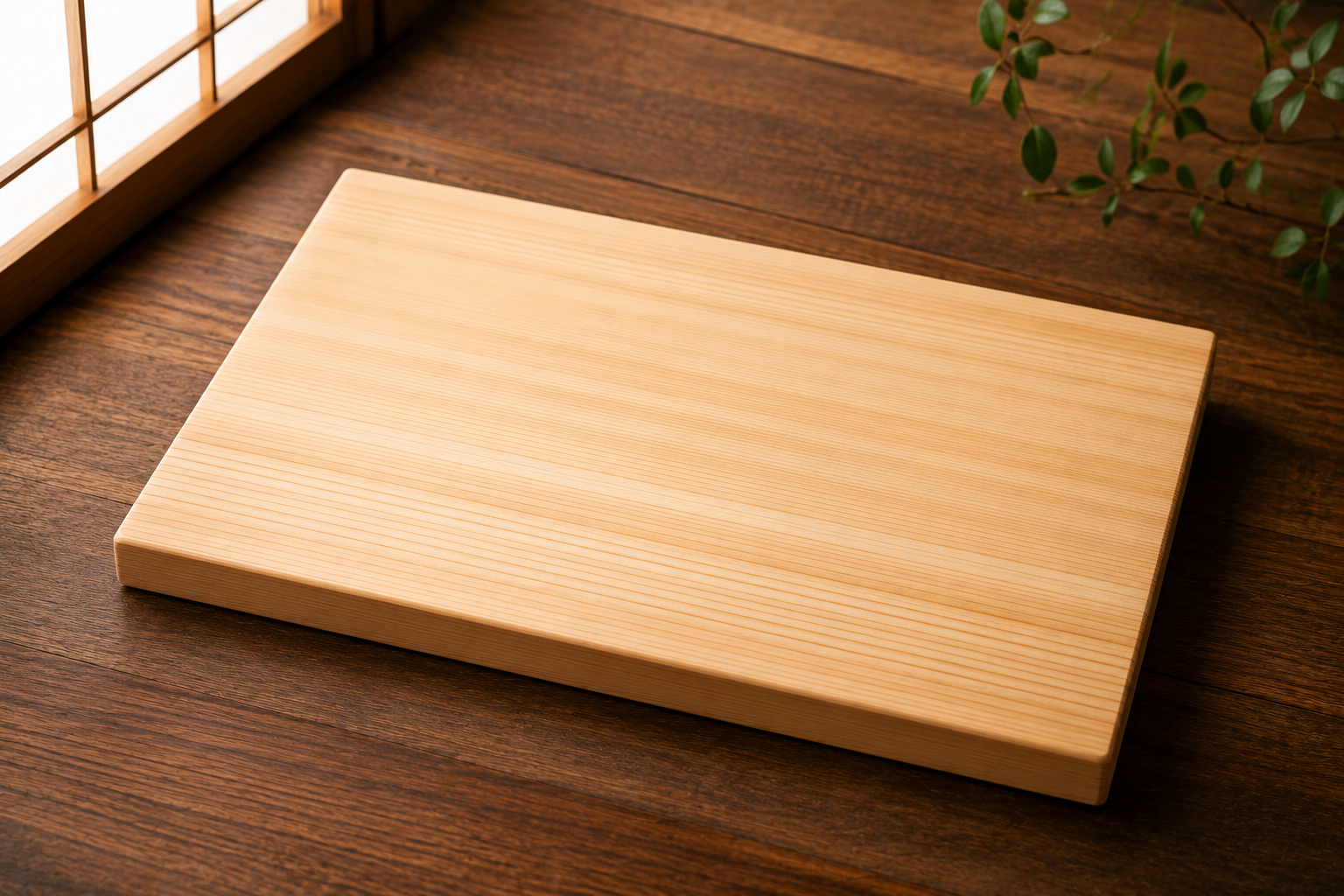
If you’ve only ever cut vegetables on a plastic board, a real Japanese wood cutting board changes the way food prep feels. Our top pick overall is the Daiwa Sangyo Hinoki Cutting Board (16.5 in / 42 cm, $48.77) — made by Daiwa Sangyo, a hinoki cutting board specialist that manufactures at its own factory in Nara Prefecture, gentle enough on knife edges that it’s easy to see why professional Japanese kitchens have used hinoki and ginkgo boards for generations. This is also the board we personally use in our own kitchen, with a full hands-on review coming soon. We also researched a premium anti-warp option, a trusted sustainably-certified brand, and a rarer ginkgo-wood pick for anyone curious about a wood traditionally valued by Japanese professionals.
- Why We Recently Switched From Plastic to Wood
- How We Chose
- Comparison Table
- What Makes Hinoki and Ginkgo Different From Other Wood?
- Wood vs. Plastic — and Who Actually Uses Wood in Japan
- A Note on “Made in Japan” and Manufacturing Quality
- What to Look For When Buying a Japanese Cutting Board
- Product Reviews
- Which One Should You Buy?
- How to Prevent a Wooden Cutting Board From Warping
- How to Care for a Hinoki or Ginkgo Cutting Board
- Frequently Asked Questions
- Do I need to oil a hinoki cutting board?
- Are wood cutting boards actually more hygienic than plastic?
- Why is ginkgo wood harder to find than hinoki?
- Is bamboo a good alternative to hinoki or ginkgo?
- How long should a hinoki cutting board last?
- Can I put a hinoki cutting board in the dishwasher?
- Why does my board have dark spots or stains?
- Final Thoughts
Why We Recently Switched From Plastic to Wood
We recently switched our own kitchen over to a wood cutting board after reading research estimating how many plastic particles may be released during chopping. A 2023 study from North Dakota State University, published in the peer-reviewed journal Environmental Science & Technology, estimated that regular chopping on polyethylene or polypropylene cutting boards could expose a person to roughly 7–50 grams of microplastic particles a year, depending on the board and the assumptions used, with individual knife strokes releasing anywhere from dozens to a few hundred particles in the researchers’ testing. Researchers haven’t confirmed what that means for long-term health, but the estimate was enough to make us pay closer attention to what we cut on. Since switching, we’ve noticed our own board takes far fewer visible knife marks than our old plastic one did, and it’s held up better than we expected — though that’s one household’s experience with one board, not a controlled test of the four picks below.
How We Chose
We started by requiring that a board be explicitly listed as made in Japan on its own Amazon product page, not just marketed with a Japanese-sounding name. One exception is noted below: for the Evernew ginkgo pick, we could confirm the manufacturer’s identity but not an explicit country-of-manufacture statement on the listing itself, and we’ve flagged that clearly in its review. From there we compared wood species, construction (one-piece vs. glued, anti-warp cores), size, and price against manufacturer specifications and patterns in verified-owner reviews. None of these four boards has been tested side by side in our own kitchen, so this guide is based on listing research and review patterns rather than hands-on comparison — we’ve noted that distinction in each review below.
Comparison Table
Prices, ratings, and stock status were checked at the time of publication and can change — always confirm current details on the Amazon listing before buying.
| Product | Price | Material / Size | Best For |
|---|---|---|---|
| Daiwa Sangyo Hinoki Cutting Board | $48.77 | Hinoki cypress / 16.5″ x 9.4″ | Best overall, everyday use |
| Yoshihiro Anti-Twist Core Hinoki Board | $134.99 | Hinoki cypress with maple anti-warp core / X-Large | Best premium / professional-grade |
| Shun Cutlery Hinoki Board | $89.95 | Hinoki cypress, FSC certified / 17.75″ x 11.75″ | Best trusted brand / sustainably certified |
| Evernew Ginkgo Cutting Board | $41.65 | Ginkgo wood / 11.7″ x 8.3″ | Best compact ginkgo pick |
What Makes Hinoki and Ginkgo Different From Other Wood?
Japanese chefs judge a cutting board mainly on one quality: haatari (刃当たり), or how the board feels against the blade. Ginkgo wood is one of the most highly regarded traditional cutting-board woods among Japanese chefs, prized for a soft, uniform grain that absorbs the impact of a blade and springs back to protect the edge. Its fibers can also swell slightly with moisture, which is said to make fine knife marks less noticeable over time — a different mechanism from the wood actually “healing,” and one that depends on how well the board is cared for. Hinoki cypress isn’t quite as prized as ginkgo for blade-feel alone, but it’s considered an excellent all-around choice, balancing knife-friendliness, hygiene, durability, and a distinctive cypress scent at a more accessible price than ginkgo.
Both differ meaningfully from harder materials. Bamboo is technically a grass rather than a wood, and its silica content makes it harder than it looks, so it can dull a fine edge faster than a soft hardwood like hinoki or ginkgo does — though it’s still considerably gentler on knives than genuinely hard surfaces like glass or ceramic. Cheaper, unspecified “wood” cutting boards sold without a named species often use denser, less elastic timber that doesn’t offer the same cushioning, so they can feel harder on the blade and are more prone to warping if the wood wasn’t properly dried before milling.
Wood vs. Plastic — and Who Actually Uses Wood in Japan
It might be surprising, but by several accounts, plastic cutting boards are common in Japanese households day to day, largely for convenience — even though hinoki and ginkgo carry strong associations with traditional Japanese cooking. Professional cooks are a different story — the general consensus among chefs is that wood is the better material, because hard surfaces like plastic and bamboo damage knife edges over time. Some professional kitchens have also moved to hybrid boards (like Hasegawa’s wood-core, rubber-surfaced designs) that combine a wood core’s blade-friendliness with a cleanable, bacteria-resistant surface.
Beyond the microplastic research above, plastic boards also tend to have a shorter practical lifespan. The FDA’s general guidance is to replace any cutting board once it becomes hard to clean or develops deep cuts, and because plastic can’t be resurfaced, that point tends to arrive sooner — commonly cited guidance suggests every 1–3 years for typical use, or as often as every 6–12 months for boards used heavily with raw meat, poultry, or fish, though this varies by household. A well-maintained hardwood board can often be sanded back and kept in service for considerably longer.
A Note on “Made in Japan” and Manufacturing Quality
We don’t have a specific side-by-side study comparing Japan-made and China-made hinoki or ginkgo boards, so we won’t claim one definitively outperforms the other across the board. What we can say, from researching other Japanese kitchenware categories for this site, is that “Japanese-style” branding doesn’t always mean Japanese manufacturing or even the wood species advertised — we’ve found real examples of mislabeled country-of-origin claims in other tool categories. Wood species selection and drying (kiln-drying wood to a stable moisture content before milling) directly affect how prone a board is to warping or cracking, so verifying the actual listed country of manufacture and wood species on a product’s own page — rather than trusting a brand name alone — is worth the extra minute before buying.
What to Look For When Buying a Japanese Cutting Board
- Country of manufacture, verified on the listing itself. Check the actual product details, not just the title or brand name.
- Wood species named specifically. “Hinoki,” “ginkgo (icho),” or a specific hardwood is a better sign than a generic “Japanese wood” description.
- One-piece construction vs. glued/laminated. A single piece of wood has no glue joints to fail, though laminated anti-warp cores (like Yoshihiro’s maple core) are a deliberate engineering trade-off, not a defect.
- Size relative to your counter and stove. Large hinoki boards can be heavy and awkward in a small kitchen; measure your prep space first.
- Whether you’re prepared for wood-specific care. No dishwasher, no prolonged soaking, dry upright — if that’s a dealbreaker, a hybrid rubber-surfaced board may suit you better than solid wood.
Product Reviews
Disclosure: As an Amazon Associate I earn from qualifying purchases.
Daiwa Sangyo Hinoki Cutting Board — Best Overall
This is the board we personally use in our own kitchen, and a full hands-on review is coming soon. Daiwa Sangyo Co., Ltd. is a hinoki cutting board specialist that manufactures at its own factory in Nara Prefecture — the identical 42 cm (16.5″) size is sold on Amazon Japan explicitly labeled “Made in Japan,” though the Amazon.com listing itself is sparse on detail and doesn’t repeat that claim directly, so check the current listing yourself if that matters to you. At 16.5″ x 9.4″ x 0.8″ thick and 2.2 lbs, it’s sized for most everyday prep without being unwieldy.
Pros:
- Made by Daiwa Sangyo, a hinoki specialist manufacturing at its own factory in Nara Prefecture
- The board we actually use day to day — a full hands-on review is on the way
- Sized for most everyday chopping and prep at 16.5″ x 9.4″, and lightweight at 2.2 lbs
Cons:
- The Amazon.com listing itself doesn’t repeat the “Made in Japan” statement that the same size carries on Amazon Japan — only the manufacturer’s name and origin are independently confirmed
- Stock has run low at times — check current availability before buying
- Fewer Amazon.com reviews so far than some of the other picks here
Bottom line: Our pick for a reason beyond the spec sheet — it’s the board actually in daily use in our own kitchen, with a deeper review to follow.
Yoshihiro Anti-Twist Core Hinoki Cutting Board — Best Premium / Professional-Grade
Yoshihiro is a well-known name among Japanese knife enthusiasts, and this X-Large board is built specifically to solve wood’s biggest weakness: warping. A maple anti-twist core runs through the hinoki, engineered to resist the twisting and warping that can affect solid wood boards over time. The listing states it’s “proudly made in Japan,” and it also notes that hinoki naturally contains a good amount of resin, which can periodically seep from the wood depending on temperature and humidity — that’s a normal characteristic of the material, not a defect, and it washes off easily. We haven’t tested this board directly against the others in this guide, but its construction and consistently strong reviews make it the clearest “buy it for the long haul” option here. Some reviewers do note it’s a significant investment compared to a standard hinoki board.
Pros:
- Maple anti-twist core specifically engineered to resist warping
- “Proudly made in Japan” per the listing
- X-Large size suits serious home cooks and small professional kitchens
Cons:
- Meaningfully more expensive than a standard hinoki board
- Natural resin seepage can occur — expected, but worth knowing in advance
Bottom line: If minimizing warping risk is your top priority, this is the strongest option in the guide — though no wood board is entirely warp-proof.
Shun Cutlery Hinoki Cutting Board — Best Trusted Brand / Sustainably Certified
Shun is an established Japanese cutlery brand, and this board stands out here mainly because its own listing explicitly confirms hinoki wood, made-in-Japan origin, and Forest Stewardship Council (FSC) certification — backed by a size chart across every size offered. The FSC certification is a genuine differentiator here — it’s a third-party guarantee that the wood came from responsibly managed forests, which none of the other boards in this guide advertise. At 17.75″ x 11.75″, it’s a comfortably large working surface. Reviews describe mixed durability results over the long term (some owners report it lasting years with care, others less so), and note that hinoki’s light color shows stains more easily than darker woods — a characteristic of the material rather than this board specifically.
Pros:
- FSC-certified sustainable sourcing, confirmed on the listing
- Made in Japan and hinoki wood explicitly confirmed across all sizes
- Recognizable, established brand with a strong quality reputation
Cons:
- Stains more visibly than darker woods, as is typical for hinoki
- Reviews show mixed results on long-term warping
Bottom line: A good pick if third-party sourcing certification and brand trust matter as much to you as the board itself.
Evernew Ginkgo Cutting Board — Best Compact Ginkgo Pick
Ginkgo (icho) is one of the traditional woods most valued by professional Japanese chefs for blade feel, but it’s genuinely hard to find outside Japan — most ginkgo boards we found on Amazon.com were out of stock at the time of writing. This one from Evernew, a real outdoor-gear manufacturer based in Niigata, Japan, was in stock. Its Amazon listing names Evernew as the manufacturer, which tells us the company itself is genuinely Japanese — but unlike our other three picks, the listing doesn’t carry an explicit “Made in Japan” or country-of-manufacture statement in its title, bullets, or product details, and it has a noticeably smaller review base than the other three boards here. (A manufacturer’s name and nationality is not the same thing as a confirmed country of manufacture, and we want to be precise about that distinction rather than blur it.) At 11.7″ x 8.3″ x 0.3″, it’s compact — closer to a prep or bar board than a primary cutting surface — which makes sense given ginkgo’s rarity and cost. We’re including it because ginkgo boards are hard to find in stock in the US at all, not because we can verify its origin as confidently as the other three picks — treat that as an open question to check for yourself on the current listing before buying.
Pros:
- Ginkgo wood — a material highly valued by professional Japanese chefs for blade feel
- Manufacturer (Evernew) is a genuine Japanese company based in Niigata
- Most affordable board in this guide
Cons:
- Small size — better suited to light prep than large cutting jobs
- Limited review history compared to the other picks here
- No explicit “Made in Japan” or country-of-manufacture statement in the listing itself — only the manufacturer’s name is confirmed
Bottom line: Worth trying if you’re curious about ginkgo specifically and don’t need a large working surface, but verify the current listing’s origin details yourself given the gap noted above.
Which One Should You Buy?
- Want one solid, everyday hinoki board: Daiwa Sangyo Hinoki Cutting Board
- Want to never worry about warping: Yoshihiro Anti-Twist Core Hinoki Cutting Board
- Care about sustainable sourcing and brand trust: Shun Cutlery Hinoki Cutting Board
- Want to try ginkgo, a wood traditionally valued by Japanese professionals: Evernew Ginkgo Cutting Board
How to Prevent a Wooden Cutting Board From Warping
Warping shows up repeatedly in owner reviews across this category, including a few of the boards above, so it’s worth calling out specifically. Wood warps when one side absorbs or loses moisture faster than the other, so the fixes are mostly about keeping both sides in balance:
- Wet both sides of the board evenly before use, not just the side you’ll be cutting on.
- Avoid leaving one side sitting in water or a wet sink for extended periods while the other stays dry.
- After washing, dry the board standing upright with air able to reach both faces, rather than laying it flat on a countertop.
- Keep the board away from direct sunlight, radiators, and dishwashers — uneven heat is one of the most common causes of warping.
- Thinner boards are generally more warp-prone than thick ones, so handle them a little more carefully around moisture and heat.
How to Care for a Hinoki or Ginkgo Cutting Board
Hinoki (a softwood) is naturally rich in its own oils, so — unlike a Western maple or walnut butcher block — oiling isn’t part of standard hinoki care. We haven’t found the same specific guidance published for ginkgo, so treat the no-oil routine below as hinoki-specific unless your board’s manufacturer says otherwise. Here’s the routine that Japanese hinoki brands actually recommend:
- Before first use: if there’s visible resin (yani) on a new board, pour boiling water over it to remove it — the resin itself is mildly antibacterial and a sign of healthy wood, not a flaw.
- Before each use: wet both sides of the board with water and wipe off the excess. This forms a barrier that reduces staining and odor absorption from food.
- Washing: scrub along the grain with a brush or sponge soon after use. For meat or fish, use cold water rather than hot — hot water can cause proteins to set into the wood, making stains harder to remove.
- After washing: traditional hinoki care recommends pouring hot water evenly over the board afterward to help sanitize the surface and speed drying. Check your specific board’s care instructions first, though, especially for laminated or anti-warp constructions like the Yoshihiro board above, where the manufacturer may recommend a gentler routine.
- Drying: wipe off excess water and dry the board standing upright in a well-ventilated spot, out of direct sunlight (direct sun and dishwasher heat are both common causes of warping and cracking).
- Dark stains: scrub with coarse salt, or rub with the squeezed pulp of a lemon and let sit for a few minutes before rinsing. Stubborn stains can sometimes be sanded out with fine sandpaper on solid one-piece boards — check the manufacturer’s instructions first, especially on thin or laminated boards.
- Avoid: dishwashers and dryers, chlorine bleach (causes discoloration), and leaving the board soaking in water for extended periods (causes black stains, cracking, and warping).
Frequently Asked Questions
Do I need to oil a hinoki cutting board?
Generally, no. Unlike oil-hungry hardwoods such as maple or walnut, hinoki is naturally rich in its own oils, so routine oiling isn’t part of standard care for hinoki boards. Always follow your specific board’s manufacturer instructions, since recommendations can vary by wood species and construction — including for ginkgo.
Are wood cutting boards actually more hygienic than plastic?
It’s more nuanced than a flat “wood is cleaner” claim. Plastic boards develop deep knife grooves that are hard to clean and can’t be resurfaced, and recent research has found that plastic boards shed microplastic particles into food during chopping. Wood boards develop knife marks too, but many solid wood boards can be sanded or planed to renew the surface rather than being replaced outright — a wood board that’s left wet or improperly cleaned can still harbor bacteria, so care habits matter for either material.
Why is ginkgo wood harder to find than hinoki?
Ginkgo is one of the traditional woods most valued by professional Japanese chefs for its blade feel, but it’s less widely cultivated for cutting boards and largely stays within the Japanese domestic market — several listings we checked for this guide were out of stock in the US at the time of writing.
Is bamboo a good alternative to hinoki or ginkgo?
Not ideally, for knife-friendliness. Bamboo is technically a grass with a high silica content, making it harder than it looks and more likely to dull a blade over time compared to a soft hardwood like hinoki or ginkgo — though it’s still far gentler on knives than genuinely hard surfaces like glass or ceramic.
How long should a hinoki cutting board last?
With proper care — hand washing, upright drying, no dishwasher — a well-maintained wood board can often be kept in good condition for many years, since surface stains or light scratches can be sanded out rather than requiring a full replacement. The FDA’s general guidance is to replace any cutting board once it becomes difficult to clean or develops deep cuts.
Can I put a hinoki cutting board in the dishwasher?
No. The heat and water pressure of a dishwasher or dryer can cause the board to crack or warp. Hand washing and air drying is the only recommended method.
Why does my board have dark spots or stains?
This is typically surface staining from food, moisture, or extended contact with water rather than a sign of a defective board. Coarse salt or lemon pulp scrubbing usually lightens it, and stubborn spots can be sanded out.
Final Thoughts
Three of the four boards in this guide were explicitly listed as made in Japan at the time of review; the fourth (Evernew) is made by a confirmed Japanese manufacturer but didn’t carry an explicit country-of-manufacture statement on its own listing, which we’ve flagged clearly in its review above. Marketplace details like price and stock can change, so always double-check the current listing before buying. We don’t have hands-on, side-by-side testing of these four boards to report; this guide is based on manufacturer specifications, listing details, and patterns across verified-owner reviews, and we’ve flagged that distinction throughout rather than overstating our own experience. What we can speak to directly is our own recent switch from plastic to wood at home, prompted by the research above — it’s been a genuinely easy change to live with, and the boards here represent a reasonable range of ways to make that same switch, from an everyday hinoki board to a rarer taste of ginkgo.
コメント