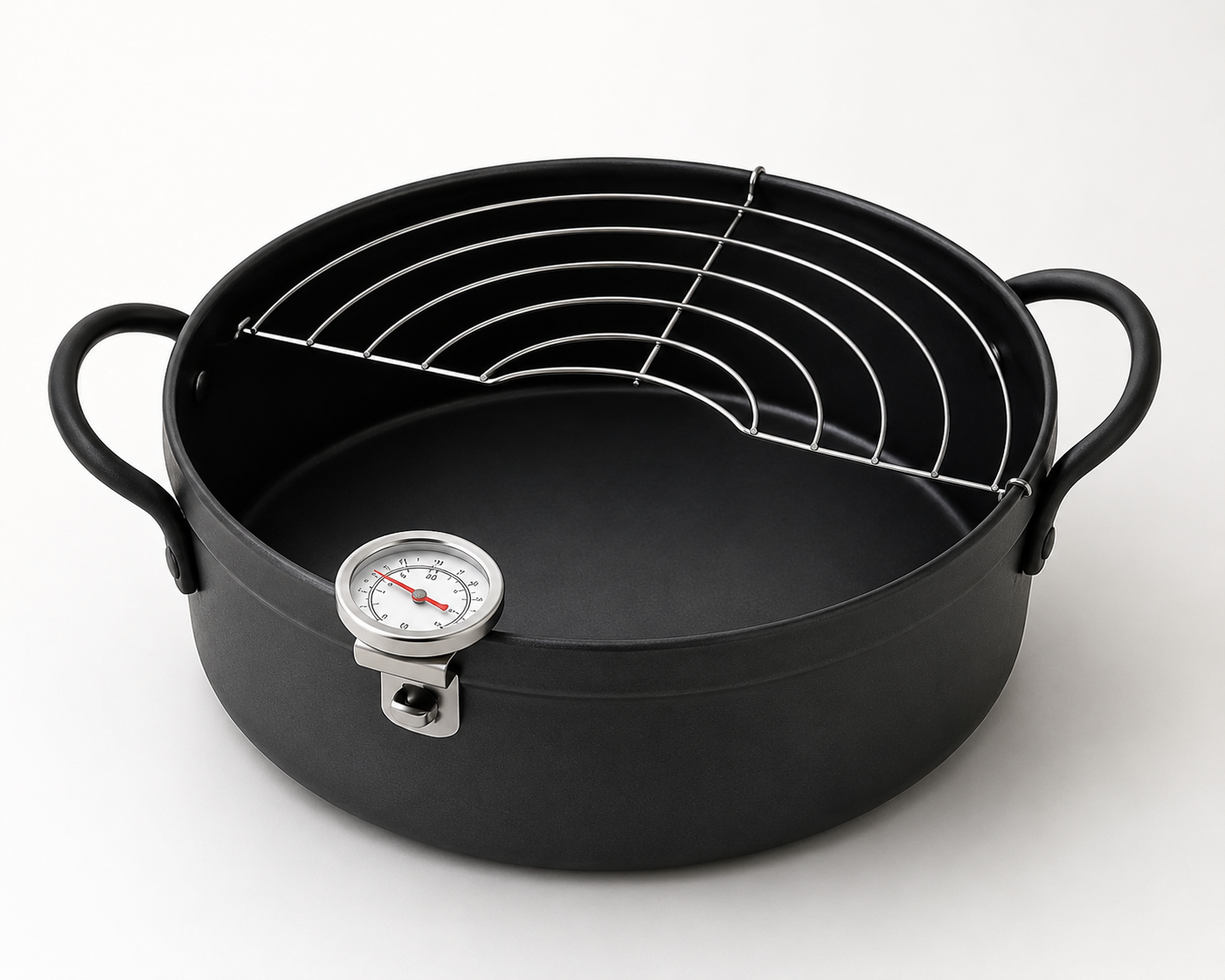
Quick answer: For most people, the Wahei Freiz TM-9090 Tsubamesanjo Tempura Pot is the best all-around choice — a solid 24cm iron pot with a built-in thermometer and a clever oil-draining wire in the lid, priced around $55. Read on for the full comparison, a buying guide, and practical tips for lighter, crisper homemade tempura.
This comparison is based on manufacturer specifications, product listings, and patterns in verified owner reviews rather than hands-on testing.
- What Is a Tempura Pot, and Why Not Just Use a Regular Pot?
- Comparison at a Glance
- What to Look for When Buying a Tempura Pot
- Product Reviews in Detail
- Which One Should You Buy?
- Sizing and Capacity Guide
- Induction (IH) vs. Gas Compatibility
- Material Matters: Weight and Finish
- How to Care for Your Pot
- How to Use a Tempura Pot: The Basics
- Common Mistakes (and What’s Actually Going Wrong)
- FAQ
- Recipes to Try in Your Tempura Pot
- What You’ll Also Need
- Final Thoughts
What Is a Tempura Pot, and Why Not Just Use a Regular Pot?
A tempura pot (天ぷら鍋, tenpura-nabe) is a purpose-built Japanese deep-frying pot designed for small-batch home frying — tempura, karaage, tonkatsu, croquettes, and similar dishes. Most are made from iron or cast iron rather than thin stainless steel, because thick metal holds heat steadily instead of dropping in temperature every time you drop in a piece of food.
You can technically fry in any deep pot, but a dedicated tempura pot solves a few specific problems: the narrower diameter uses less oil than a wide stockpot, the tall sides contain splatter better, and several models — including two in this guide — come with a wire rack or lid-mounted drain that lets you rest fried food right over the pot instead of setting up a separate tray and rack.
Comparison at a Glance
| Product | Price | Material / Size | Best For |
|---|---|---|---|
| Wahei Freiz TM-9090 | Around $55 | Iron (silicone coating), 24cm / 3.2L | Best overall |
| Iwachu Nambu Ironware Tempura Pot | Around $100 | Cast iron, 24cm / ~1.9L | Heaviest, most substantial |
| Pearl Metal HB-1891 | Around $35 | Iron (silicone coating), 22cm / 3.2L | Best value |
| Yoshikawa SH9160 | Around $19 | Iron (ceramic-type coating), 24cm / 3.2L | Best budget / beginner |
What to Look for When Buying a Tempura Pot
- Material and coating: Uncoated cast iron holds heat the longest but needs seasoning and careful drying. Coated iron (silicone, resin, or ceramic-type finishes) is lower-maintenance but the coating can wear over years of use — several owner reviews across these products mention coating flaking eventually, so treat coated pots gently and skip metal utensils.
- A thermometer, if you’re new to frying: Oil temperature is one of the most important variables in good tempura. A built-in thermometer makes it much easier to monitor; if your pot doesn’t have one, budget for a separate clip-on or instant-read thermometer.
- An oil-draining lid or rack: A wire rack or lid-mounted drain lets you rest fried food directly over the pot instead of setting up a separate tray, and it also means less oil pooling on your counter.
- Induction compatibility: Not every tempura pot works on induction (IH) cooktops — check this before buying if that’s your only heat source.
- Made in Japan, not just “Japanese-style”: A number of tempura pots sold on Amazon are generic imports styled after the Japanese original. Every pot in this guide is either explicitly labeled Made in Japan on its listing, or made by a documented, long-established Japanese workshop (see the Iwachu review below for that distinction).
- Capacity relative to your household: A too-large pot wastes oil and takes longer to heat; a too-small one limits how much you can fry at once. See the sizing section below.
Product Reviews in Detail
Disclosure: As an Amazon Associate I earn from qualifying purchases.
Wahei Freiz TM-9090 Tsubamesanjo Tempura Pot — Best Overall
Check the latest price on Amazon →
This one comes from Wahei Freiz, a Tsubame-Sanjo (Niigata Prefecture) manufacturer — Tsubame-Sanjo is one of Japan’s best-known metalworking regions, historically for cutlery and now for a wide range of kitchenware. The listing states the pot’s country of manufacture as Japan, and it’s sold through a Japan-based seller on Amazon. The body is iron with a silicone baked-on coating, the hood (lid) is iron with a baked coating, and the mesh insert is chrome-plated iron.
At 4.2 stars across roughly 2,800 ratings, it’s the most-reviewed pot in this comparison, and the reviews consistently call out the same feature: a wire built into the underside of the lid that lets you drain fried food’s excess oil back into the pot before moving it to a paper towel. Several Japanese-language reviews specifically praised this detail as the reason they repurchased the brand.
Pros:
- Oil-draining wire in the lid is a genuinely useful, well-reviewed feature — no separate rack needed
- Comes with a built-in thermometer for tracking oil temperature
- Works on both induction and gas
- Large sample of owner reviews (2,800+) with a solid 4.2-star average
Cons:
- Not dishwasher safe, and one reviewer noted the coating can degrade if it goes in one too often
- A couple of reviewers mentioned the lid can knock against the thermometer when opening and closing
- One reviewer reported the thermometer’s plastic cover melted after roughly a dozen uses — worth keeping an eye on heat exposure near the gauge
Bottom line: It has the largest review sample and the most complete feature set of the four pots in this guide.
Iwachu Nambu Ironware Tempura Pot — Heaviest & Most Substantial
Check the latest price on Amazon →
Iwachu is a real Nambu ironware (nanbu tekki) maker based in Iwate Prefecture, with over a century of history in the same craft tradition behind Japan’s famous cast-iron kettles — and the same brand behind the cast-iron tamagoyaki pan we’ve covered previously on this site. Its Amazon listing doesn’t carry an explicit “Made in Japan” label the way the other three pots do, but Iwachu’s reputation as a leading Nambu ironware workshop is why it’s included here.
The listing describes the material simply as cast iron and doesn’t specify a surface treatment. Iwachu’s standard, full-size tempura pots are generally treated as bare cast iron in this style — hand-wash with a natural-bristle brush (no soap under normal use), dry over heat immediately afterward, and rub a little oil into the cooking surface before frying to build a seasoned patina over time — but this isn’t confirmed for this exact listing. Follow the printed English care card that ships in the box for your specific unit rather than assuming either routine applies.
Two things to know before buying: it’s not induction-compatible per the listing, so it’s a gas-only pick, and unlike the other three pots here it doesn’t come with a thermometer or lid — a simpler, more traditional vessel, not a kitted-out set. It’s also the heaviest, most substantial option in this guide.
Its rating (4.5 stars) comes from a small pool of reviews — about a dozen at the time of writing — so treat that number as a positive early signal rather than a large-sample guarantee the way you would with the Wahei Freiz.
Pros:
- Substantial cast-iron construction holds and radiates heat evenly, which matters for consistent frying temperature
- From an established Nambu ironware workshop with a long craft history
- Simple, no-frills vessel with fewer parts (no thermometer clip, no lid hinge) that could eventually wear out
Cons:
- Not induction-compatible per the listing — gas or electric coil only
- No lid or thermometer included, so budget for those separately if you want them
- Noticeably more expensive than the other three options
- Treated as bare cast iron rather than a coated, wipe-clean surface, so it needs occasional re-oiling and thorough drying after washing to avoid rust — a bit more upkeep than the other three pots here
Bottom line: If you prioritize heavy cast-iron construction and Iwachu’s manufacturing heritage, and you’re comfortable following the manufacturer’s own care instructions, this is the one — as long as you’re not relying on induction.
Pearl Metal HB-1891 Tempura Pot — Best Value
Check the latest price on Amazon →
Made in Tsubame-Sanjo, Niigata, this is an iron pot with a silicone resin coating, a wide pour spout designed to prevent drips, and a chrome-plated mesh insert for draining oil. It’s SG Mark certified — a Japanese product safety certification — and works across gas, induction, and halogen heat sources.
At 3.9 stars from roughly 200 ratings, it’s the most mixed of the four in terms of feedback. Most reviewers are happy with it for the price, but a handful of owners — in both the U.S. and Japan — reported the black coating starting to flake or wear away on the inside after months of use, which is worth factoring in if you plan to use it heavily.
Pros:
- Lowest price of the three “full-size” (22–24cm) pots in this guide
- Works on gas, induction, and halogen cooktops
- Wide spout genuinely helps when pouring out used oil
- SG Mark safety certification
Cons:
- Several owner reviews mention the interior coating flaking or wearing over time
- No thermometer or lid included
- Lower average rating than the other three pots in this guide
Bottom line: A reasonable middle-ground pick if the Wahei Freiz is more than you want to spend, with the caveat that coating longevity is a real, reviewer-reported weak point.
Yoshikawa SH9160 Deep Frying Pot — Best Budget / Beginner
Check the latest price on Amazon →
Yoshikawa is a long-running Japanese cookware brand, and this is their entry-level tempura pot: hammered iron, made in Japan, sold directly by Amazon Japan. It’s the simplest of the four — no lid, no thermometer, just the pot and an included oil-draining net — and by far the cheapest.
Reviews are generally positive (4.2 stars from 325 ratings), with Japanese reviewers specifically liking its size for a household of two. One U.S. reviewer did report the coating wearing off and the pot rusting after a single wash, which lines up with the general rule for iron cookware: dry it immediately and thoroughly, every time.
Pros:
- By far the most affordable made-in-Japan option here
- Simple, no-frills construction with an included oil-draining net
- Works on both gas and induction
- Good size for cooking for one or two people, per multiple reviews
Cons:
- No lid or thermometer — you’ll want a separate thermometer if you’re new to frying
- At least one reviewer reported rust developing quickly when the pot wasn’t dried carefully
- Ships from Amazon Japan, so delivery windows can run longer than domestically-stocked items
Bottom line: The low-risk way to find out if you’ll actually use a tempura pot before spending more on one of the other three.
Which One Should You Buy?
- If you want one well-rounded pot with a thermometer and a genuinely useful oil-draining lid, get the Wahei Freiz TM-9090.
- If you want the heaviest, most substantial pot and don’t need induction compatibility, get the Iwachu Nambu Ironware.
- If you want a full-size pot for less money and don’t mind a coating that may wear over years of heavy use, get the Pearl Metal HB-1891.
- If you’re not sure tempura is going to become a regular thing in your kitchen, get the Yoshikawa SH9160 and find out cheaply.
Sizing and Capacity Guide
| Product | Diameter | Full Capacity | Best For |
|---|---|---|---|
| Iwachu Nambu Ironware | 24cm | 2 quarts (~1.9L) | Smaller batches, 1–2 people |
| Pearl Metal HB-1891 | 22cm | 3.2L | 1–2 people, everyday use |
| Wahei Freiz TM-9090 | 24cm | 3.2L | 2–4 people, family-size batches |
| Yoshikawa SH9160 | 24cm | 3.2L | 2–4 people, family-size batches |
None of these need to be filled to capacity — for most home tempura, you only need enough oil to reach 5–7cm (2–3 inches) deep, well below the rated full capacity of any of these pots.
Induction (IH) vs. Gas Compatibility
| Product | Induction (IH) | Gas |
|---|---|---|
| Wahei Freiz TM-9090 | Yes | Yes |
| Iwachu Nambu Ironware | No, per the listing | Yes |
| Pearl Metal HB-1891 | Yes | Yes |
| Yoshikawa SH9160 | Yes | Yes |
If induction is your only cooktop, the Iwachu is off the table — check that box first before falling for the cast-iron pitch.
Material Matters: Weight and Finish
These four pots don’t all share the same finish. The Wahei Freiz, Pearl Metal, and Yoshikawa are explicitly listed by their manufacturers as coated iron (silicone or ceramic-type baked-on finishes), so treat them like any coated cookware: avoid metal utensils, which can scratch or chip the finish over time, and none of them are listed as dishwasher-safe. The Iwachu is different — its listing simply says cast iron with no coating mentioned, and Iwachu’s own domestic guidance for this style of pot describes it as traditional bare cast iron that benefits from being lightly oiled before frying, the way you’d treat a cast-iron skillet, rather than a wipe-clean coated surface.
The bigger everyday difference between them is mass and construction, not just finish. Cast iron is inherently heavier and holds heat more steadily than the coated-iron pots here, which is useful when you’re dropping cold, wet batter into hot oil repeatedly — each addition drops the oil temperature, and more thermal mass helps limit how far it swings. How quickly the temperature actually recovers also depends on your burner output and how much oil is in the pot, not the pot alone. The Wahei Freiz, Pearl Metal, and Yoshikawa are lighter, quicker-heating, easier-to-handle pots for day-to-day use.
Owner reviews across the Wahei Freiz, Pearl Metal, and Yoshikawa pots mention coating flaking or wear eventually showing up, especially with metal utensils or dishwasher use — a reasonable risk to expect from any coated cookware over years of use, not a defect specific to one brand. The Iwachu doesn’t have a coating to wear off in the same way, but like any bare cast iron, it can rust if it isn’t dried and lightly re-oiled after washing.
How to Care for Your Pot
Care instructions vary by exact model, so when in doubt, follow the manufacturer’s own guidance rather than a one-size-fits-all rule. For the coated pots (Wahei Freiz, Pearl Metal, Yoshikawa): hand wash only, avoid metal utensils that can scratch or chip the finish, and dry the pot immediately and thoroughly after washing — several owner reviews across these products specifically mention rust or coating problems traced back to incomplete drying.
The Iwachu’s listing doesn’t spell out its exact surface treatment, but this style of Nambu ironware pot is generally treated as bare cast iron: wash with hot water and a natural-bristle brush rather than soap, dry immediately over medium heat on the stove rather than air-drying, and rub a thin coat of cooking oil over the interior before frying to build a seasoned, food-release surface — the same idea as seasoning a cast-iron skillet. If food sticks or the surface looks dry, it usually just needs more oil. Treat this as general guidance rather than a confirmed spec, and follow the printed English care card in the box for your exact unit.
How to Use a Tempura Pot: The Basics
- Fill the pot with oil to a depth of about 5–7cm (2–3 inches) as a general guideline — deep enough to fully submerge whatever you’re frying, without filling the pot to capacity. If your pot has a marked maximum fill line or a manufacturer-specified oil amount, follow that instead.
- Heat the oil gradually. Tempura is typically fried in the range of roughly 160–180°C (320–356°F), with vegetables and other sturdier items toward the lower end and delicate items like shrimp toward the higher end — a thermometer takes the guesswork out of this.
- Dip food in a thin, cold tempura batter (ice-cold water helps keep the coating light and crisp) and lower it gently into the oil.
- Fry in small batches — crowding the pot drops the oil temperature too much and results in greasy, soggy coating instead of a crisp one.
- Use the pot’s oil-draining rack or lid (if it has one), or a separate wire rack, to let excess oil drip off before serving.
Common Mistakes (and What’s Actually Going Wrong)
Tempura comes out greasy, not crisp: Usually the oil temperature was too low, or too much food was added at once and the temperature dropped and never recovered. A thermometer and smaller batches fix most of this.
The batter falls apart in the oil: The batter is usually overmixed. Tempura batter should stay lumpy and barely combined — overmixing develops gluten and makes the coating heavy instead of light and crisp.
Rust appears on an iron pot after just a few uses: Usually incomplete drying, though a damaged coating, prolonged soaking, or storing the pot somewhere humid can also contribute. Iron cookware, coated or not, needs to be dried immediately and completely after washing, not left to air dry.
Oil smokes or smells burnt: The oil is either too hot or has been reused too many times and has broken down. Frying oil can typically be reused a few times if strained and stored properly, but it should be replaced once it darkens noticeably or starts smoking below its normal frying temperature.
FAQ
Do I need a special pot for tempura, or can I use a regular deep pot?
You can fry in any sufficiently deep, heavy pot, but a dedicated tempura pot uses less oil thanks to its narrower diameter, and several models include a drain rack or lid that a generic stockpot won’t have.
Does a heavier pot make better tempura?
Not necessarily “better,” but a heavier pot like the Iwachu holds heat more steadily, which can help limit how much the oil temperature dips between batches — though how fast it actually recovers also depends on your burner output and how much oil is in the pot. Lighter pots like the other three here heat up faster and are easier to handle day-to-day, with the tradeoff that oil temperature can dip more when you add food.
What oil should I use for tempura?
A neutral, high-smoke-point oil is standard — vegetable, canola, rice bran, or a light sesame oil blend, since a neutral flavor lets the batter and food come through. Olive oil is another workable option, and some home cooks prefer it, including for health reasons: refined “light” or “extra light” olive oil has a smoke point around 230–240°C (445–465°F), comfortably above the 160–180°C tempura range, though it brings a slightly different flavor and heavier mouthfeel — it works well for karaage, where flavor matters less than in delicate tempura batter. How healthy any fried food ends up also depends on portion size, how often you fry, and how many times the oil gets reused, not just which oil you start with. Extra virgin olive oil is a poorer fit, since its lower smoke point (roughly 190–210°C) sits closer to frying temperature. Whatever you choose, avoid low-smoke-point oils, which break down and smoke at typical frying temperatures.
Is it safe to fry in an iron pot, or does the coating matter for food safety?
Iron cookware itself is safe to cook in. If a coating is flaking, though, it’s reasonable to stop using that pot for frying and either strip it back to bare metal (if it’s designed for that) or replace it, rather than continuing to cook with a deteriorating nonstick or resin surface.
Can I use these pots for anything besides tempura?
Yes — any of them work for other shallow-frying tasks like karaage (Japanese fried chicken), tonkatsu, croquettes, or general deep-frying. The Wahei Freiz’s listing specifically mentions it doubling as a small hot pot as well.
How much oil do I actually need?
Far less than the pot’s rated full capacity — 5–7cm (2–3 inches) of oil depth is enough for most home tempura frying, which is well under half of what any of these pots can technically hold.
Are any of these dishwasher safe?
No. All four are hand-wash only; none of the manufacturers list them as dishwasher-safe, and reviewers who tried anyway generally reported coating or rust problems as a result.
Why is my thermometer reading different from what my stove’s built-in sensor says?
Gas stoves with a frying-oil sensor and a pot-mounted thermometer are measuring in slightly different ways, so small discrepancies are normal — one owner review on the Wahei Freiz specifically noted this after comparing the two. If they’re off by a lot, trust the thermometer that’s actually sitting in the oil.
Recipes to Try in Your Tempura Pot
A tempura pot earns its keep well beyond tempura. Here are three simple recipes — one classic, one savory, one sweet — to get started with.
Ebi Tempura (Shrimp Tempura)
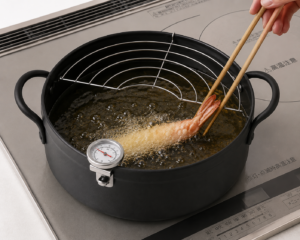
Ingredients (serves 2–3): 8–10 large shrimp, peeled and deveined, tails left on · 1 cup (120g) all-purpose flour, plus extra for dusting · 1 egg · 1 cup (240ml) ice-cold water · Oil for frying (see the oil FAQ above)
- Straighten the shrimp by making 3–4 shallow cuts along the belly and gently pressing to stop them curling as they fry. Pat dry.
- Heat the oil to 170–180°C (340–356°F).
- Whisk the egg into the ice-cold water. Add the flour all at once and stir with chopsticks just 3–4 times — the batter should stay lumpy. Don’t overmix.
- Lightly dust each shrimp with flour, dip in the batter, and lower gently into the oil.
- Fry 2–3 minutes until pale golden and crisp, turning once. Drain on the pot’s rack or a wire rack. Serve immediately with tentsuyu dipping sauce or salt.
Karaage (Japanese Fried Chicken)
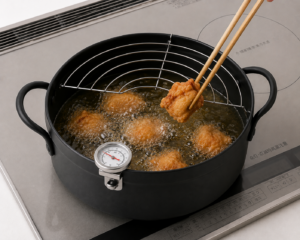
Ingredients (serves 2–3): 1 lb (450g) boneless chicken thigh, cut into bite-sized pieces · 1 tbsp soy sauce · 1 tbsp sake · 1 tsp grated ginger · 1 tsp grated garlic · Potato starch (katakuriko) or cornstarch, for coating · Oil for frying
- Marinate the chicken in soy sauce, sake, ginger, and garlic for at least 15 minutes (longer, even overnight, deepens the flavor).
- Heat the oil to about 160–170°C (320–338°F). Coat each piece of chicken thoroughly in potato starch, shaking off the excess.
- Fry in small batches for 3–4 minutes until just cooked through, then remove and rest for a couple of minutes.
- Raise the oil temperature to about 180°C (356°F) and fry the chicken again for 1–2 minutes, until deep golden and audibly crisp. This second fry is what gives karaage its shatter-crisp exterior.
- Drain well and serve with lemon wedges.
Churros
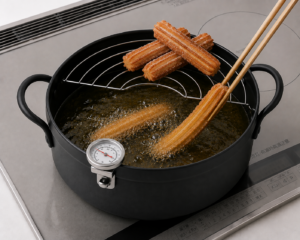
Ingredients (makes about 12): 1 cup (240ml) water · 2 tbsp sugar, plus extra (mixed with cinnamon) for coating · 1/2 tsp salt · 4 tbsp butter · 1 cup (120g) all-purpose flour · 2 eggs · Oil for frying
- Bring the water, sugar, salt, and butter to a boil in a saucepan. Remove from heat, add the flour all at once, and stir vigorously until it forms a smooth dough that pulls away from the sides.
- Let the dough cool for a few minutes, then beat in the eggs one at a time until fully incorporated and glossy.
- Heat the oil to about 180°C (356°F). Pipe the dough directly into the oil using a piping bag fitted with a large star tip, cutting each churro to length with scissors.
- Fry a few at a time for 2–3 minutes, turning occasionally, until deep golden brown.
- Drain briefly, then toss immediately in cinnamon sugar while still hot. See the oil pot and chopsticks in the section below for straining and handling the oil afterward.
What You’ll Also Need
A tempura pot alone will get you most of the way there, but a couple of inexpensive extras make the process meaningfully easier:
- Nagao Tsubamesanjo Oil Pot, made in Tsubame-Sanjo, Japan — a stainless steel pot with a built-in mesh filter for straining and storing used frying oil, so you’re not pouring hot oil into whatever container happens to be nearby.
- Tanaka Hashi Long Japanese Cooking Chopsticks (Saibashi), made in Fukui, Japan by a company established in 1948 — these 13-inch bamboo saibashi are the traditional tool for lowering food into hot oil and turning it while frying, and the extra length keeps your hand well clear of the pot. Rated 4.7 stars from about 170 reviewers, with several specifically praising how well they hold up to repeated use near the stove.
Final Thoughts
A tempura pot is a fairly small investment that makes a genuinely fussy cooking technique noticeably easier to get right at home. For most people, the Wahei Freiz TM-9090 is the best starting point — it’s made in Japan, has the largest review sample of the four, and its thermometer and oil-draining lid solve two of the most common frustrations with home deep-frying. If you prefer heavier cast-iron cookware and value Iwachu’s manufacturing heritage, the Nambu Ironware may justify its higher price — just don’t expect induction compatibility. And if you’re not sure this is going to become a regular part of your cooking, the Yoshikawa SH9160 is the lowest-priced entry point in this comparison.
コメント