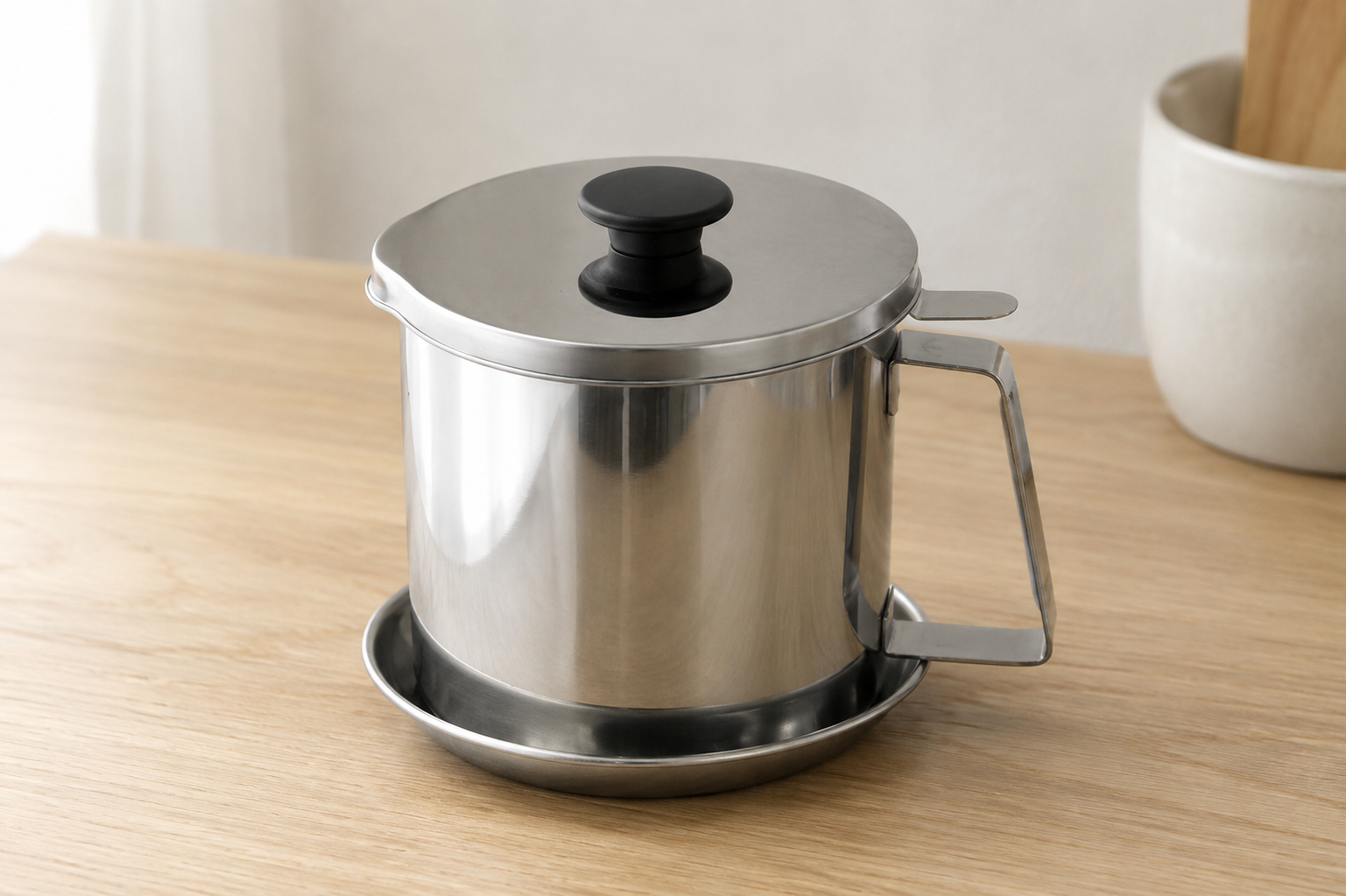
If you’re just here for the quick answer: the Nagao Tsubamesanjo Oil Pot ($46.35) is our top pick for most kitchens — an uncoated 18-8 stainless steel oil pot made in the Tsubame-Sanjo metalworking region of Niigata, with a mesh filter and matching saucer included. If you want something cheaper that still carries an explicit “Country of Manufacture: Japan” listing, the Wahei Freiz Ajido AD-540 ($16.41) is the value pick.
- What Is an Oil Pot, and Why Does It Matter?
- Comparison Table
- What to Look for When Buying an Oil Pot
- Product Reviews in Detail
- Which One Should You Buy?
- Sizing Guide: How Much Capacity Do You Actually Need?
- Stainless Steel vs. Enamel vs. Fluorine-Coated: What’s the Difference?
- Care and Maintenance
- How to Filter and Store Frying Oil the Right Way
- Common Mistakes to Avoid
- Frequently Asked Questions
- Is it safe to pour hot oil directly into an oil pot?
- How many times can I reuse filtered oil?
- Do I need an activated-carbon filter, or is mesh enough?
- Can I put my oil pot in the dishwasher?
- Is enameled (horo) oil pot better than stainless steel?
- Why does my oil pot’s spout drip even though the listing says it’s drip-resistant?
- What’s the difference between an oil pot and a tempura pot?
- What You’ll Also Need
- Final Thoughts
What Is an Oil Pot, and Why Does It Matter?
An oil pot — abura-koshiki (油こし器) or abura-ire (油入れ) in Japanese — is a small stainless steel or enameled container built specifically to filter and store cooking oil after frying, rather than to fry in. After tempura, karaage, or tonkatsu, the still-warm oil gets poured through a built-in strainer (a fine mesh, sometimes backed by a paper or activated-carbon filter) directly into the pot, which then doubles as clean, labeled storage for the next round of frying.
It’s a small piece of equipment, but it solves a real problem: home frying in Japan is generally built around reusing oil a handful of times rather than discarding it after a single batch, and doing that safely depends on filtering out food particles quickly while the oil is still warm and storing it away from light and heat. A dedicated oil pot with a tight-fitting lid and a built-in strainer makes that routine fast enough that people actually do it, instead of pouring hot oil into whatever jar happens to be on the counter.
Comparison Table
| Product | Price | Capacity / Filter Type | Best For |
|---|---|---|---|
| Nagao Tsubamesanjo Oil Pot | $46.35 | 1.1 L, stainless mesh filter | Best Overall |
| Wahei Freiz Ajido AD-540 | $16.41 | 1.1 L, stainless mesh filter | Best Value |
| Pearl Metal HB-2141 | $61.05 | 0.7 L, activated-carbon cartridge | Best for Extended Oil Reuse |
| Takehara Ligrante Oil Pot (Mocha) | $32.07 | 1.0 L, stainless mesh filter | Best Design / Gift Pick |
What to Look for When Buying an Oil Pot
- Filter type. A plain stainless mesh strainer catches fried debris and is easy to rinse out, but does nothing about odor or discoloration. An activated-carbon cartridge (used in the Pearl Metal pot below) adds an adsorption stage on top of the mesh, aimed at reducing odor and color carryover between fry sessions — useful if you fry fish and want to reuse the same oil for something milder later. Cartridges are a consumable you’ll need to replace periodically, so factor that into the ongoing cost.
- Body material and coating. Bare (uncoated) stainless steel has no non-stick surface to wear off, which matters because oil pots regularly receive oil straight from the fryer at a still-hot temperature. Fluorine (non-stick) coated interiors, like the Takehara pot below, make rinsing out fried residue faster but — like any non-stick coating — are worth cleaning gently rather than scrubbing with anything abrasive.
- Capacity. Most home oil pots run 0.7–1.2 L, enough for a typical wok or tempura-pot’s worth of frying oil. Check the “suitable filtration capacity” figure specifically, since it’s sometimes lower than the pot’s total volume.
- Spout and drip control. A double-lipped or “tornado” style spout is designed to stop oil from dribbling down the outside of the pot as you pour — check listing photos and reviews for complaints about dripping, since this varies a lot between otherwise similar-looking pots.
- Saucer or coaster. Some pots (Nagao, Takehara) include a small saucer or tray to sit the pot on, which catches the inevitable drip after pouring and keeps countertops and shelves cleaner.
- Handle and lid material. Handles and lid rings are often phenolic resin or nylon rather than metal, specifically so they stay cool enough to grip right after you’ve poured hot oil — confirm this in the listing if you plan to filter oil straight off the stove.
- “Made in Japan” vs. Japanese brand name. As with any import category, a Japanese brand name on the box isn’t the same as an explicit country-of-origin claim for that specific product. Check the listing’s own “Country of Origin” or “Country of Manufacture” field, not just the brand name, before assuming a product is Japanese-made.
Product Reviews in Detail
Disclosure: As an Amazon Associate I earn from qualifying purchases.
Nagao Tsubamesanjo Oil Pot — Best Overall
Nagao’s oil pot is made in the Tsubame-Sanjo area of Niigata Prefecture, a metalworking region the site has covered before in the context of kitchen scissors, vegetable peelers, and knives — the listing states the country of origin as “Japan/Tsubame Sanjo” outright, and names Frozotori Co., Ltd. as manufacturer with Nagao Co., Ltd. as distributor. The body is 18-8 stainless steel with no fluorine or Teflon coating; the brand’s own listing frames this as deliberate, arguing that a coating would eventually peel with repeated exposure to hot oil, whereas bare stainless has nothing to wear off. It ships with a matching saucer and an 18-8 stainless mesh (ami-type) filter, and the listing states all parts are dishwasher safe.
At 1.1 L capacity and roughly 411 g, it’s sized for a typical home batch of frying oil rather than restaurant volumes. Reviews (currently all from Japan, 4.3 stars across 61 ratings) are positive about the “just right” size and lack of dripping when pouring, though one reviewer described the steel as thinner than expected and noted a slightly rough edge on the mesh handle — worth knowing if you’re sensitive to that kind of finish.
Pros:
- Explicit “Made in Japan / Tsubame Sanjo” country-of-origin listing
- No coating to wear off — bare stainless is rated for hot oil straight from the pan
- Saucer and mesh filter both included
- All parts listed as dishwasher safe
Cons:
- One reviewer described the steel gauge as thinner than they expected
- Mesh-only filtration — no odor or color reduction stage
Bottom line: If you want a straightforward, well-sourced oil pot without paying for features you may not need, this is the safest starting point in the lineup.
Wahei Freiz Ajido AD-540 — Best Value
Wahei Freiz’s Ajido line is a budget-friendly entry with the same “Country of Manufacture: Japan” claim stated explicitly in the listing, at less than half the price of the Nagao pot above. The body is 18-8 stainless steel with a phenolic resin lid and handle parts, described in the listing as rustproof, and it includes a fine stainless mesh strainer.
It’s the most-reviewed product in this roundup by a wide margin — 4.1 stars across 253 ratings — and the top U.S. review (from a verified purchase) specifically calls out “Made in Japan not China” as the reason for buying it, suggesting country of origin matters to at least some of this pot’s actual buyers. Reviews from Japan flag two consistent points worth knowing before you buy: several mention the mesh strainer’s wire edges can catch or nick fingers during washing, and the handle is described as thin enough that some owners wrap it in cloth for a better grip.
Pros:
- Explicit “Country of Manufacture: Japan” listing
- Lowest price of the four, by a wide margin
- Rustproof stainless construction with a fine mesh strainer
Cons:
- Multiple reviewers mention the mesh strainer’s edges can be sharp when washing by hand
- Handle described as thin/hard to grip by at least one reviewer
- No saucer included
- Listing doesn’t state dishwasher-safe — treat as hand-wash unless you confirm otherwise
Bottom line: For anyone who just wants a reliable, genuinely Japan-made oil pot without spending $40+, this is the pick — just handle the strainer edge with a little care when cleaning it.
Pearl Metal HB-2141 — Best for Extended Oil Reuse
Pearl Metal (パール金属) is an established Tsubame-Sanjo, Niigata kitchenware manufacturer, and this pot’s title states “Made in Japan” twice; unlike the Nagao and Wahei Freiz listings above, though, its product-details section didn’t show us a separate, explicit “Country of Origin” field, so treat that claim as listing-stated rather than independently verified through a dedicated origin field.
What sets it apart is the filtration system: on top of a stainless mesh strainer, oil passes through a reusable non-woven cartridge containing activated carbon, pulp, and other adsorbent material, aimed at reducing odor and discoloration carryover between fry sessions rather than just catching solid debris. At 4.0 stars across 36 ratings, real owner reviews give a genuinely mixed but useful picture: several praise how much oil it can filter in one pass and how well it controls odor even after frying fish, but one reviewer described mold forming on the filter cartridge after oil took several days to fully drain through — a reminder that any filter-cartridge system needs to be used and dried according to the manufacturer’s instructions, not left sitting indefinitely.
Pros:
- Activated-carbon filtration stage on top of mesh straining, aimed at reducing odor/color carryover
- Deep filter bed lets a full batch of oil filter through in one pass, per owner reviews
- Established Tsubame-Sanjo manufacturer; “Made in Japan” stated in the listing title
Cons:
- Highest price in this roundup
- No separate “Country of Origin” field found on the listing beyond the title text
- Replacement cartridges are an ongoing cost
- At least one reviewer reported mold growth when oil was left to drain too long — needs prompt draining and drying
Bottom line: Worth the premium if you fry often enough that odor and color carryover between batches actually bother you — just don’t let oil sit in it for days at a time.
Takehara Ligrante Oil Pot (Mocha) — Best Design / Gift Pick
Takehara Seikan (竹原製缶/Takecan) states an explicit “Country of Origin: Japan” for this pot, and its own product description goes further, saying “from base processing to fluorine coating to pressing processing, all products are made in Japan.” The body is steel with a fluorine-resin interior coating and a heat-resistant exterior coating, paired with a phenolic-resin handle shaped with a thumb rest, and a stainless mesh strainer the brand calls a “Tornado filter,” designed to drain oil faster than a flat mesh disc.
This is also the only pot in the lineup available in more than one color (mocha brown reviewed here, also sold in pink), which — combined with the fluorine coating’s fast cleanup — makes it a reasonable gift pick for someone who cares how their countertop looks. The tradeoff: as of this check, it has zero customer reviews on the U.S. listing, so everything above is based on the manufacturer’s own description rather than verified owner experience.
Pros:
- Explicit “Country of Origin: Japan” stated in the listing, reinforced in the product description
- Fluorine coating and “Tornado filter” strainer aimed at faster cleanup and drainage than plain mesh
- Comes in two colors; includes a lid
Cons:
- Zero customer reviews at time of writing — no independent verification of real-world durability
- Non-stick coatings generally wear over time with repeated hot-oil use and abrasive cleaning, even if this specific listing doesn’t document that yet
- Mid-pack pricing without the review history to back it up
Bottom line: A stylish, well-sourced option if you’re drawn to the color and easy-clean coating — just go in knowing you’d be an early adopter rather than relying on a track record of reviews.
Which One Should You Buy?
- Want the safest all-around pick? Go with the Nagao Tsubamesanjo Oil Pot — uncoated stainless, explicit Tsubame-Sanjo origin, saucer included.
- On a budget, still want genuine Japan-made? The Wahei Freiz Ajido AD-540 is the cheapest option with an explicit “Country of Manufacture: Japan” listing and the deepest review history here.
- Fry often and want to cut down on odor carryover? The Pearl Metal HB-2141’s activated-carbon cartridge is built for that — just drain and dry it promptly after use.
- Buying as a gift, or just want it to look nice on the counter? The Takehara Ligrante’s color options and fluorine coating make it the most kitchen-decor-friendly pick, with the caveat that it’s unreviewed so far.
Sizing Guide: How Much Capacity Do You Actually Need?
| Household / Use Case | Suggested Capacity | Matches |
|---|---|---|
| 1–2 people, occasional frying | 0.6–0.7 L | Pearl Metal HB-2141 (0.7 L) |
| Typical household, regular tempura/karaage | 1.0–1.1 L | Nagao (1.1 L), Wahei Freiz (1.1 L), Takehara (1.0 L) |
| Larger batches or a deep tempura pot’s full oil volume | 1.2 L+ | Consider a larger stand-alone strainer/funnel setup instead |
Match the oil pot’s stated capacity to how much oil your frying pot or pan actually holds, not to how much you’d like to filter at once — most home tempura pots use well under a liter of oil per session, so oversizing mostly just takes up more shelf space.
Stainless Steel vs. Enamel vs. Fluorine-Coated: What’s the Difference?
The four pots above cover the two most common oil-pot body types sold for the Japanese kitchen: bare stainless steel (Nagao, Wahei Freiz, and the strainer/body of the Pearl Metal pot) and fluorine-coated steel (Takehara). A third common option — enameled steel, sometimes called horo (琺瑯) in Japanese cookware — is popular for its color options and the fact that it won’t pick up metallic odors over time, but we’re not including an enamel pick in this specific roundup: the one enamel oil pot we researched most closely, from Fuji Horo, lists its country of origin as Thailand despite being sold under a well-known Japanese brand name, so it didn’t meet this site’s Made-in-Japan standard even though the brand itself is Japanese.
Bare stainless has no coating to degrade, which is why Nagao’s own listing frames it as suited to pouring oil while still hot. Fluorine coatings (a category that includes what’s often marketed as “Teflon-style” non-stick) make wiping out fried residue faster and reduce how much oil clings to the interior wall between uses, but like any non-stick surface, they’re generally best treated gently — avoid metal utensils or abrasive scrubbers, since the coating is what’s doing the work of preventing sticking in the first place.
Activated carbon, used in the Pearl Metal pot’s filter cartridge, works differently from either body material — it’s a filtration stage, not a coating. Activated carbon is highly porous, and oil impurities and odor-causing compounds adsorb onto that surface area as the oil passes through, which is the same basic mechanism used in air and water carbon filters. It doesn’t change the pot’s own material, but it does mean the filter itself is a wearing part that needs periodic replacement, unlike a plain mesh strainer that just needs rinsing.
Care and Maintenance
Bare stainless pots (Nagao, Wahei Freiz): Rinse the mesh strainer promptly after each use so fried debris doesn’t dry onto it — several reviewers of the Wahei Freiz pot specifically mention the mesh wire edges, so consider using a sponge rather than fingers directly on the strainer. Nagao’s listing states all parts are dishwasher safe; the Wahei Freiz listing doesn’t make that claim, so hand-washing is the safer default there.
Activated-carbon cartridge pots (Pearl Metal): Let oil fully drain through the cartridge before storing — based on one detailed owner review we read, expect to replace the paper/pulp filter component roughly every 4–5 uses and the carbon cartridge itself after roughly 5–8 uses, though this will vary with how much you fry and how dirty the oil gets. Don’t let oil sit undrained in the filter for multiple days; at least one reviewer reported mold growth from doing exactly that.
Fluorine-coated pots (Takehara): Hand wash and avoid abrasive sponges or metal utensils on the coated interior, the same general care non-stick cookware needs elsewhere in the kitchen. The manufacturer markets the coating specifically for easy cleanup, but coatings in general last longer with gentler handling.
All types: Store the pot with its lid on, away from direct sunlight and stove heat, and label or date the oil if you’re tracking how many times it’s been reused — a common general guideline is to filter oil while it’s still warm (not at peak frying temperature) and to discard it after three to five uses, or sooner if it darkens noticeably or develops an off smell, though exact reuse limits depend heavily on what you fried in it.
How to Filter and Store Frying Oil the Right Way
- Let the oil cool until it’s warm but no longer hot enough to be dangerous to handle — filtering at peak frying temperature is a burn risk and can also warp plastic strainer parts.
- Pour the oil through the oil pot’s built-in strainer in one steady stream rather than all at once, giving the mesh (and carbon cartridge, if your pot has one) time to work instead of overflowing.
- Wipe the spout with a paper towel after pouring — several reviews across these listings mention drips at the spout even on pots designed to minimize them.
- Put the lid on and store the pot away from the stove, direct sunlight, and other heat sources.
- Rinse or replace the strainer/cartridge promptly rather than leaving oil sitting in it for days.
- Note when you filtered it, and plan to use it up or replace it within a handful of fry sessions rather than indefinitely.
Common Mistakes to Avoid
- Filtering oil while it’s still at frying temperature. Wait until it’s warm, not hot, both for safety and because some strainer parts (plastic lids, resin handles) aren’t rated for peak frying heat.
- Leaving oil sitting in a filter cartridge for days. As one Pearl Metal reviewer discovered, undrained oil sitting in a damp filter is exactly the kind of environment mold can grow in.
- Assuming a Japanese brand name means the product is made in Japan. As with the Fuji Horo enamel pot mentioned above, always check the listing’s stated country of origin, not just the brand.
- Reusing oil indefinitely. Oil that’s dark, thick, foamy when heated, or smells off should be discarded regardless of how few times you’ve technically used it.
- Scrubbing a coated interior with anything abrasive. This shortens the life of fluorine or non-stick coatings faster than gentle hand-washing.
Frequently Asked Questions
Is it safe to pour hot oil directly into an oil pot?
Manufacturers generally recommend letting oil cool to warm rather than pouring at peak frying temperature — this protects both you and parts like resin handles or plastic lid rings that aren’t rated for the highest oil temperatures. Bare stainless steel pots like the Nagao tend to tolerate hot pours better than coated or resin-heavy designs, per the brand’s own marketing, but “tolerates it better” isn’t the same as “designed for it.”
How many times can I reuse filtered oil?
This depends heavily on what you fried. Oil used for cleaner items like tempura batter can typically be reused several times, while oil used for heavily breaded or battered foods picks up more impurities and should be reused less. A common general guideline is three to five uses, or sooner if the oil darkens or smells off, though this isn’t a hard rule tied to any specific product here.
Do I need an activated-carbon filter, or is mesh enough?
Mesh alone catches solid food debris, which is enough for most home cooks who fry occasionally. An activated-carbon cartridge adds odor and color reduction on top of that, which matters more if you fry strong-smelling foods (like fish) and want to reuse the same oil for something milder afterward.
Can I put my oil pot in the dishwasher?
Only if the listing specifically says so — Nagao’s does; Wahei Freiz’s doesn’t mention it either way, so we’d treat that one as hand-wash only. Activated-carbon cartridges and their housings generally shouldn’t go in the dishwasher regardless of pot brand, since the filter media isn’t meant to get fully soaked and agitated.
Is enameled (horo) oil pot better than stainless steel?
Enamel has real advantages — it doesn’t pick up metallic odors and comes in more colors — but it’s heavier and can chip if dropped. We didn’t include an enamel pick in this roundup specifically because the model we researched most closely lists Thailand, not Japan, as its country of origin; if you want an enamel pot, verify the origin claim on whichever specific listing you’re considering.
Why does my oil pot’s spout drip even though the listing says it’s drip-resistant?
Drip-resistant spout designs reduce dripping, but reviews across multiple pots in this category (including some of the ones above) still mention a small amount of residual drip after pouring. Wiping the spout with a paper towel immediately after pouring is standard practice even with a well-designed pot.
What’s the difference between an oil pot and a tempura pot?
They’re different tools that are often used together: a tempura pot (see our separate guide to Japanese tempura pots) is what you actually fry in, while an oil pot is what you filter and store the oil in afterward. Some tempura pots include their own oil-drain rack, but a dedicated oil pot is built specifically for longer-term filtered storage.
What You’ll Also Need
If you’re setting up a home frying station, an oil pot pairs naturally with a Japanese tempura pot for the frying itself. A simple stainless spider strainer or fine mesh skimmer is also worth having on hand for lifting food out of the oil before you get to the filtering-and-storage stage covered in this guide — most kitchen supply retailers carry a basic one inexpensively, and it doesn’t need to be Japan-made to do its job well.
Final Thoughts
Of the four pots here, three carry an explicit, listing-stated Japan country-of-origin claim — the Nagao (Tsubame Sanjo specifically), the Wahei Freiz, and the Takehara — while the fourth, the Pearl Metal, states “Made in Japan” in its title without a separate origin field we could independently confirm. None of this is exotic equipment: an oil pot is a small, unglamorous purchase that mostly pays off in convenience — filtering and storing oil takes under a minute with the right tool, versus fishing a strainer and a jar out of separate cabinets each time. For most kitchens, the Nagao is the safest starting point; budget shoppers should look at the Wahei Freiz; and anyone frying often enough to care about odor carryover between batches should weigh the Pearl Metal’s activated-carbon cartridge against its higher price and the extra care that filter needs.
コメント