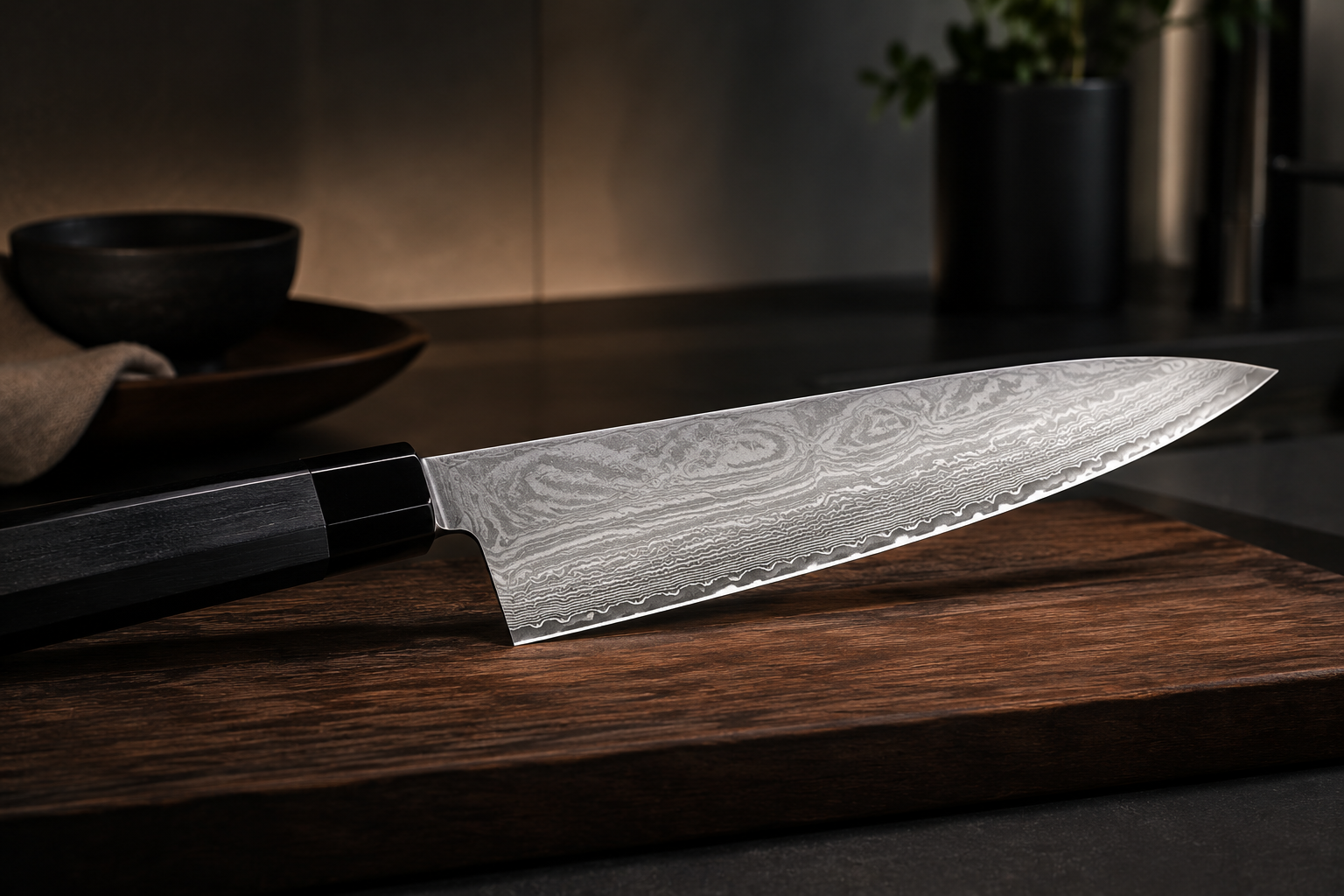
Quick answer: For most serious home cooks, the Yoshihiro VG10 Damascus Gyuto is the easiest recommendation — hand-forged, genuine Damascus-clad Japanese steel, typically selling for around $190. This guide picks up where our earlier $50–130 santoku guide left off, moving into genuinely premium territory ($139–$220) and comparing hammered Damascus construction against a plain, single-steel blade from an Edo-period maker.
- What Actually Changes at the Premium Tier?
- What Is Damascus Steel, and Does It Matter?
- Comparison at a Glance
- Matching a Knife to What You Actually Value
- What to Look for at This Price Range
- Product Reviews in Detail
- Which One Should You Buy?
- How to Care for a Premium Japanese Knife
- FAQ
- Who Should Skip These Knives?
- Final Thoughts
What Actually Changes at the Premium Tier?
If you’re only cooking once or twice a month, a $50–130 Japanese knife will probably make you just as happy, and you likely won’t put in enough hours with the knife to notice the difference in grind refinement. These knives make the most sense for people who cook often enough to actually feel the finer balance and edge geometry — not for someone hoping a nicer knife alone will make them a better cook.
What Is Damascus Steel, and Does It Matter?
If you’re shopping for a Japanese knife, it’s easy to assume that more Damascus layers automatically means a better knife. In reality, the core steel does the actual cutting, and the patterned layers around it are mostly decorative. A 2026 field test by Japanese Knife Lab, which bought and cut-tested several Damascus and mono-steel santoku knives side by side, found that a plain, mono-clad knife actually out-cut some of its Damascus VG10 competitors on tomato and onion — core steel grade and sharpening precision decided the winner, not the swirl pattern on the outside.
That doesn’t make Damascus a gimmick. The cladding can add a bit of corrosion resistance, and the pattern is genuinely part of the appeal for a lot of buyers. You’re paying largely for the labor involved in folding and etching the patterned layers and the visual appeal it brings, rather than a dramatic jump in cutting performance over a plain single-steel blade with the same core.
Comparison at a Glance
| Knife | Price | Steel | HRC | Handle | Dishwasher Safe |
|---|---|---|---|---|---|
| Sakai Takayuki Gyuto | Around $139 | VG10, 33-layer Damascus | ~60 (typical for VG10) | Western-style wood | No|
| Yoshihiro Gyuto | Around $190 | VG10, 46-layer Damascus | ~60 (typical for VG10) | Octagonal wa-handle | No|
| MASAMOTO VG Gyuto | Around $220 | Molybdenum-vanadium stainless, no Damascus | 58–59 | Western-style Duracon | No
Prices fluctuate quite a bit, especially during sales, so it’s worth checking today’s price before deciding.
Matching a Knife to What You Actually Value
- Cooking heavily, most days: any of the three will hold up, but the thinner Yoshihiro and MASAMOTO grinds are noticeably easier to push through dense vegetables over a long prep session
- Occasional or weekend cooking: the Sakai Takayuki is the easiest to justify, since you’re less likely to put in the sharpening hours a daily-use knife eventually needs
- Visual appeal matters to you: go Damascus (Sakai Takayuki or Yoshihiro) — it’s the whole point of paying the pattern premium
- Ease of care matters more than looks: the MASAMOTO’s plain finish shows wear less obviously than a polished Damascus pattern, and there’s no pattern to worry about dulling with abrasive cleaning
- Budget is the deciding factor: Sakai Takayuki gets you real premium construction for meaningfully less than the other two
Prices were checked at the time of publication and may change.
What to Look for at This Price Range
- Named core steel — VG10 shows up in all three knives here; know what’s actually doing the cutting, not just what the outer layers look like
- Hand-forged vs. mass-produced — at this tier, look for language like “handmade” or “handcrafted” from the maker, not just “Japanese steel”
- Maker history and lineage — established houses like Sakai Takayuki and Masamoto Sohonten have centuries of reputation on the line, which is a real (if imperfect) quality signal
- Handle style — Western-style handles (like the MASAMOTO here) are generally more familiar to Western hands; traditional wa-handles (like the Yoshihiro) are lighter but require slightly different balance and care
Product Reviews in Detail
Disclosure: As an Amazon Associate I earn from qualifying purchases.
Sakai Takayuki Gyuto — Best Entry Into Premium
The most accessible way into genuinely premium Japanese steel. It’s often discounted during Amazon sales, so it’s worth checking today’s price before deciding. Check today’s price on Amazon →
Sakai Takayuki traces back to Sakai, a city with roughly 600 years of blade-making history and one of the two production centers (alongside Seki) most associated with Japanese cutlery. This gyuto uses a VG10 core wrapped in a 33-layer hammered Damascus finish, at the lowest price of the three knives here.
Pros:
- Lowest price of the three while still being genuinely premium construction
- From Sakai, one of Japan’s two historic centers of blade-making
- Hammered (tsuchime) finish adds texture and helps reduce food sticking to the blade
Cons:
- Fewer Damascus layers than the Yoshihiro, if pattern complexity matters to you
What I liked: The one to start with if you’re not ready to spend $200 but still want real premium construction.
Yoshihiro VG10 Damascus Gyuto — Best Overall
A step up in refinement for a meaningful, not extreme, price increase. Owner reviews consistently mention how thin the blade feels compared with a typical German chef’s knife, slipping through onions and dense vegetables with noticeably less resistance. Check today’s price on Amazon →
Yoshihiro is a specialist maker whose knives are handcrafted rather than machine-produced, with roots the company traces back to swordsmithing traditions. This gyuto pairs a VG10 core with a 46-layer hammered Damascus cladding and an octagonal wa-style handle, which is noticeably lighter in hand than a full Western-style handle of the same blade length.
Pros:
- Hand-forged rather than mass-produced
- More intricate 46-layer Damascus pattern than the Sakai Takayuki
- Lighter wa-handle balance, which some cooks prefer for extended use
Cons:
- The wa-handle shape takes some getting used to if you’ve only used Western-handled knives
What surprised me: The best all-around pick if you want genuinely premium Japanese craftsmanship without going to the very top of the price range.
MASAMOTO VG Gyuto — Best for Function Over Pattern
Skip the Damascus pattern and put the budget toward steel and grind. Check today’s price on Amazon →
Masamoto Sohonten was founded toward the end of the Edo period and has been run by the same family across six generations since. This VG line uses a molybdenum-vanadium stainless steel (HRC 58–59) with a plain, non-Damascus finish and a Western-style Duracon handle. What stands out in owner reviews isn’t the steel spec sheet so much as the grind itself — a thin, precise geometry that reviewers consistently single out for effortless slicing, the kind of detail that only shows up once you’re actually using the knife rather than reading about it.
Pros:
- From a maker with six generations of continuous family history
- Thin, precise grind geometry that reviewers consistently describe as excellent for fine cutting work
- Western-style handle that’s immediately familiar if you’ve never used a wa-handle
Cons:
- The most expensive of the three, with no decorative pattern to show for the premium
Why I’d buy this: Choose this one if you’d rather pay for grind quality and lineage than a Damascus pattern you’ll mostly notice yourself.
Which One Should You Buy?
- Want the most accessible entry into premium? → Sakai Takayuki
- Want the best all-around balance of craftsmanship and price? → Yoshihiro
- Want function and lineage over a decorative pattern? → MASAMOTO VG
How to Care for a Premium Japanese Knife
Hand wash and dry immediately after use — none of these are dishwasher-safe, and lingering moisture (especially from acidic foods) is the fastest way to dull or spot a fine edge. Use a wooden or plastic cutting board only; glass, stone, or ceramic boards will damage an edge this refined quickly. These are not meant for frozen food, bones, or twisting motions — the thin, hard grind that makes them cut so well also makes them more prone to chipping under lateral stress than a thicker Western knife. A whetstone is the standard way to maintain the edge; a pull-through sharpener is too coarse for steel refined to this level and will remove far more material than necessary.
FAQ
Is a Damascus knife actually sharper than a plain one?
Not inherently — sharpness comes from the core steel, heat treatment, and grind, not the decorative cladding. A well-made plain knife like the MASAMOTO here can perform just as well as a Damascus knife with a comparable core steel.
Are these knives worth it if I already have the $50–130 santoku from our other guide?
It depends on what you’re after. If you’re satisfied with your santoku’s performance, the jump to this tier is mostly about refinement, feel, and craftsmanship rather than a dramatic functional leap. If you cook seriously and want a longer gyuto for rocking cuts, it’s a more meaningful upgrade.
What’s the difference between a gyuto and a santoku?
A gyuto is longer and more curved, built for a Western-style rocking cut; a santoku is shorter and flatter, built more for a straight push cut. All three knives in this guide are gyuto.
Do I need a saya (sheath) for these?
It’s not required, but a saya protects both the edge and whatever you’re storing it near, and is worth considering at this price point if one isn’t already included.
Can a beginner use a knife this nice, or is it wasted on them?
A sharp, well-made knife is genuinely easier and safer to use than a dull one, regardless of skill level. The main thing a beginner needs to learn is care — proper washing, storage, and avoiding the kinds of stress (bones, frozen food, prying) that damage a fine edge.
Is Damascus better than plain VG10?
Not in terms of cutting performance — both the Sakai Takayuki and Yoshihiro here use a VG10 core, same as many plain knives. The Damascus layers around it are decorative, not a performance upgrade.
Does Damascus steel rust?
It depends entirely on the core steel, not the pattern. A Damascus knife built around stainless VG10 (like these two) resists rust about as well as a plain VG10 knife; a Damascus knife built around carbon steel rusts like any carbon steel knife would.
Can you sharpen a Damascus knife normally?
Yes — sharpening works on the core edge steel, and a whetstone will restore the edge the same way it would on a plain-finish knife of the same steel.
Is a 46-layer knife better than a 33-layer one?
Not functionally. More layers generally just means a finer, more subtle pattern; it’s an aesthetic choice, not a performance difference, as long as the core steel is the same.
Who Should Skip These Knives?
If you’re only cooking once or twice a month, a $50–130 Japanese knife (like the ones in our santoku guide) will probably make you just as happy, and you likely won’t put in enough hours with the knife to notice the difference in grind refinement. These knives make the most sense for people who cook often enough to actually feel the finer balance and edge geometry — not for someone hoping a nicer knife alone will make them a better cook.
Final Thoughts
At this tier, you’re no longer asking “is a Japanese knife worth it” — that’s the question our santoku guide answers. Here, the question is more about what kind of craftsmanship you want to pay for: the visible artistry of Damascus cladding, or a plainer knife built entirely around grind and lineage. The Yoshihiro is the easiest all-around recommendation, but the MASAMOTO VG makes a genuinely compelling case for anyone who’d rather skip the pattern and let the steel speak for itself.
コメント