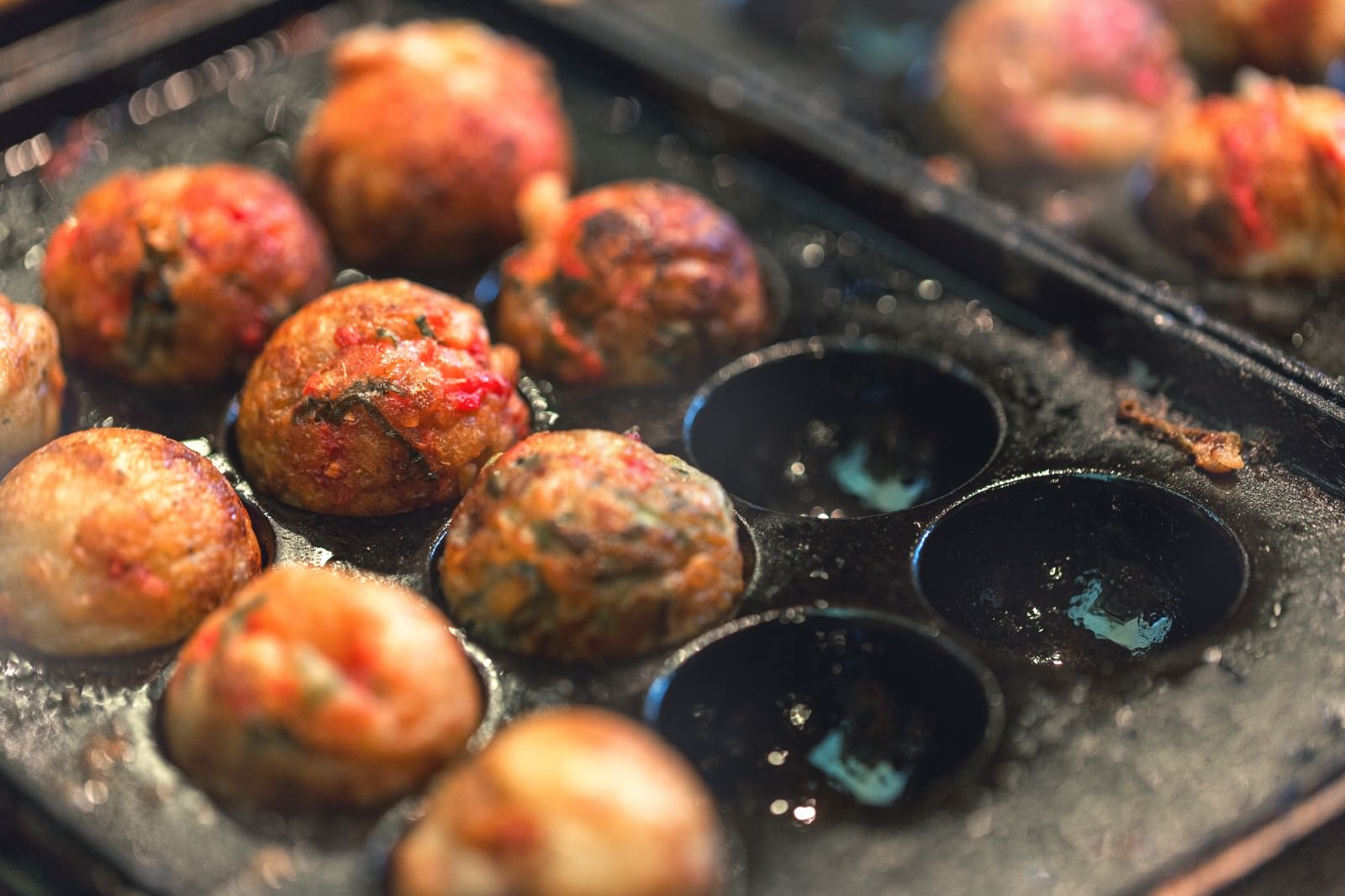
If you only want one recommendation: the Iwatani Cassette Gas Takoyaki Maker ENTAKO II ($84.99) is the pan we’d point most home cooks toward. It’s a genuine Made in Japan, all-in-one gas grill with nearly 900 verified ratings behind it, and it turns “trying to make takoyaki at home” into something you can actually pull off on the first attempt.
This comparison is based on manufacturer specifications, product listings, and patterns in verified owner reviews rather than hands-on testing.
- What Is Takoyaki, and Why Does the Pan Matter?
- Comparison Table
- What to Look for When Buying a Takoyaki Pan
- The Takoyaki Pans, Reviewed
- Which One Should You Buy?
- Sizing at a Glance
- Cast Iron vs. Coated Aluminum: What’s the Real Difference?
- Care and Maintenance
- How to Make Takoyaki at Home
- Common Mistakes to Avoid
- Frequently Asked Questions
- Is it safe to use a butane cassette stove indoors?
- Can I use metal picks on any of these pans?
- Do I need a special stove to use a cast-iron takoyaki plate?
- What can I make in a takoyaki pan besides takoyaki?
- Why is my takoyaki sticking to the pan?
- Is cast iron or coated aluminum better for a beginner?
- How many takoyaki does one batch make?
- Can I use frozen octopus?
- How long does a cast-iron takoyaki pan last?
- Why isn’t there an electric takoyaki plate in this guide?
- What You’ll Also Need
- Final Thoughts
What Is Takoyaki, and Why Does the Pan Matter?
Takoyaki (たこ焼き) is Osaka’s signature street food: golf-ball-sized rounds of savory, dashi-based batter cooked around a piece of diced octopus, then finished with takoyaki sauce, Kewpie mayo, bonito flakes, and green laver. The dish lives or dies on the pan. Each round is cooked in a half-sphere mold, rotated a quarter-turn at a time with a pick or skewer until the batter forms a crisp shell around a molten, custardy center — a technique that depends entirely on even, well-retained heat across every mold.
That’s the whole reason a dedicated takoyaki pan exists instead of a flat griddle. A generic nonstick skillet from a big-box store can’t hold the deep half-sphere shape or the heat retention that lets the outside crisp while the inside stays soft. The pans below range from traditional cast-iron plates you set on your own stovetop to a self-contained gas grill built specifically for this dish — all genuinely made in Japan, not just Japanese-branded.
In Japan, especially in Osaka where the dish originated, many households own a dedicated takoyaki pan and treat cooking it together as a casual, hands-on activity for family gatherings or parties — closer to how some Western households treat a fondue pot or a griddle for pancakes.
Comparison Table
| Product | Price | Material / Holes | Best For |
| Iwatani Cassette Gas Takoyaki Maker ENTAKO II | $84.99 | Steel body, fluorine-coated die-cast aluminum plate (20 holes) + built-in burner | Best Overall |
| Ikenaga Tekko Takoyaki (16 Holes) | $59.00 | Cast iron, 16 holes | Best Value |
| Iwachu 24025 Nambu Ironware Takoyaki (23 Holes) | $93.23 | Cast iron (Nambu ironware), 23 holes | Best for Groups |
| IPPINKA Nambu Tekki Cast Iron Takoyaki Pan (14 Holes) | $78.67 | Cast iron, 14 holes, wooden handle | Best Gift / Premium |
What to Look for When Buying a Takoyaki Pan
- Genuine Made in Japan sourcing. Several major brands sell takoyaki pans under Japanese names that are actually manufactured elsewhere — one widely sold Iwatani model, for instance, is manufactured in China despite the Japanese brand name. Check the listing’s own “About this item” or product description for an explicit country-of-origin claim rather than assuming from the brand name alone.
- Heat source compatibility. Most cast-iron takoyaki plates are designed to sit on a gas burner or a portable butane stove; not all are rated for induction. If your kitchen runs on induction, confirm that specifically before buying — one of our picks below runs noticeably hotter in the center than the edges on induction, per an owner review, even though it’s technically induction-compatible.
- Hole count and size. More holes (16–23) means bigger batches per round, which matters for a group; fewer holes (14) is easier to manage for a first attempt or a smaller household.
- Material and weight. Traditional cast iron (including Nambu ironware) holds and radiates heat evenly once preheated, but it’s heavy — some owners describe the larger cast-iron plates as noticeably heavier than a typical electric hot plate — and needs to be dried thoroughly after washing to avoid rust. Fluorine-coated cast aluminum, as used in the Iwatani grill below, is lighter and easier to clean but won’t hold heat quite as long once you turn off the burner.
- All-in-one vs. plate-only. A self-contained unit like the Iwatani ENTAKO II includes its own burner, which solves the “does this actually fit securely on my stovetop” problem that comes up repeatedly in reviews of plate-only pans meant for a portable butane stove. A standalone cast-iron plate is cheaper and more traditional but depends on your own burner having the right grate shape underneath it.
The Takoyaki Pans, Reviewed
Disclosure: As an Amazon Associate I earn from qualifying purchases.
Iwatani Cassette Gas Takoyaki Maker ENTAKO II (CB-ETK-2) — Best Overall
The ENTAKO II is a complete tabletop takoyaki grill, not just a plate: a powder-coated steel body houses a stainless steel U-shaped burner and a fluorine-treated, non-stick die-cast aluminum plate with 20 holes (40mm diameter each), and it runs on standard cassette butane canisters (sold separately). The listing states it’s Made in Japan — Iwatani is a long-established Japanese company best known for portable butane stoves and cassette-gas cooking equipment widely used in home kitchens across Japan. At 4.6 stars across 852 ratings, it has by far the deepest review history of anything in this roundup, and the pattern across reviews is consistent: even heat from the U-shaped burner, an easy-clean non-stick plate, and grooves molded into the plate that make it easier to shape round, uniform balls as a beginner.
It isn’t flawless — a few owners note the corners and outer edges of the plate cook slightly slower than the center, and you’ll want to rotate the outer balls in as you go rather than expecting perfectly uniform timing across all the wells. It’s also bulkier to store than a flat plate, since the burner is built in. But for anyone who doesn’t already have a butane stove or a gas range with a grate the right shape, this sidesteps that problem entirely.
Pros: Self-contained, no separate stove needed; strong, consistent review history; fluorine non-stick coating; molded grooves aid shaping; portable enough to bring to a friend’s house or take camping, per multiple reviews.
Cons: Outer wells run slightly cooler than the center; bulkier to store than a plate-only pan; requires butane canisters purchased separately.
Bottom line: If you want one pan that just works without fussing over stove compatibility, this is the one to buy.
Ikenaga Tekko Takoyaki, 16 Holes — Best Value
Made by Ikenaga Iron Works (池永鉄工), a cast-iron cookware manufacturer based in Osaka — takoyaki’s hometown — this 16-hole plate is the least expensive genuinely Made in Japan option in this guide at $59.00. It’s rated for both gas and induction cooktops, though one detailed owner review notes an important nuance: on an induction cooktop, the pan runs noticeably hotter in the middle than at the edges, while on a gas stove the heat spreads much more evenly. If you’re on induction, plan to start cooking from the center wells and work outward.
Reviews are limited in volume (currently 6 ratings, all 5-star) but consistent and detailed, including one from a reviewer explicitly identifying it as an authentic pan from Osaka. As with any cast iron, it needs standard seasoning care and thorough drying to avoid rust.
Pros: Lowest price of the verified Made in Japan options; genuine Osaka manufacturer; works on both gas and induction.
Cons: Thin review count so far; heat distribution is less even on induction than on gas, per owner feedback; no built-in burner, so you’ll need your own compatible stovetop.
Bottom line: The pick for someone who wants an authentic, traditional cast-iron pan without paying a premium.
Iwachu 24025 Nambu Ironware Takoyaki, 23 Holes — Best for Groups
Iwachu’s 23-hole plate is built from thick Nambu ironware (Nanbu Tekki), the traditional cast ironware craft from Iwate Prefecture, and it’s the largest-capacity pan in this guide — useful if you’re regularly cooking for a crowd. The listing explicitly states Made in Japan — Iwachu is one of the better-known Nambu ironware foundries in Iwate Prefecture, also recognized for its cast-iron kettles and teapots — and at 4.4 stars across 291 ratings it has the strongest review base of any plate-only pan here (most reviews are from Japanese buyers, but the pattern of feedback is consistent with the other cast-iron options). It’s rated for gas as well as both 100V and 200V induction.
Owner reviews (translated from Japanese) describe it as heavy — noticeably more so than an electric hot plate — and note the rim around the plate’s edge is fairly shallow, so batter and toppings can spill over the sides if you’re not careful pouring. Multiple reviewers say results improve significantly once the pan is fully preheated and well-oiled, and that it takes a bit more technique than a beginner-oriented pan.
Pros: Largest hole count (23) for bigger batches; thick Nambu ironware construction holds heat well once preheated; works on gas and both induction voltages.
Cons: Heaviest pan in this guide; shallow rim means more careful pouring is needed; takes more practice than the beginner-friendly options; stock has been limited at times.
Bottom line: Worth the extra weight and price if you regularly host takoyaki nights for a group.
IPPINKA Japanese Cast Iron Takoyaki Grill Pan, 14 Holes — Best Gift / Premium Pick
This is the most craft-forward option in the guide: cast in the Nambu Tekki tradition from Iwate Prefecture, with a heat-resistant wooden handle and grooved bottom notches designed to sit securely on a gas stove trivet. The listing explicitly confirms Made in Japan, and IPPINKA’s brand materials tie it to the same Nambu ironware heritage used for traditional tetsubin kettles and chagama tea-ceremony pots, sourcing pieces from artisan ironware workshops in the Tohoku region. At $78.67 it sits in the middle of the price range, with a smaller 14-hole count that makes it more manageable for a first attempt or a smaller household.
Its review count is thin so far (4 ratings, all 5-star), so treat the sample size with some caution even though the ratings themselves are strong. Unlike the Ikenaga and Iwachu plates above, this one is designed for gas stovetops rather than induction — worth checking before you buy if induction is your only option.
Pros: Genuine Nambu Tekki craftsmanship with real provenance; wooden handle designed to stay cool; smaller hole count is easier to manage for beginners; comes packaged well enough to give as a gift.
Cons: Very small review sample so far; gas stovetop only, not induction; pricier than the Ikenaga plate despite fewer holes.
Bottom line: The one to choose if you want a genuine piece of Japanese ironware craft, not just a cooking tool.
Which One Should You Buy?
- Want the simplest path to good results: Iwatani Cassette Gas Takoyaki Maker ENTAKO II — self-contained, well-reviewed, no stovetop-fit guesswork.
- On a budget but still want authentic Japanese iron: Ikenaga Tekko 16-Hole — the least expensive verified Made in Japan pick.
- Cooking for a group regularly: Iwachu 24025 Nambu Ironware 23-Hole — the largest batch size and thickest, most heat-retentive iron.
- Buying as a gift or want real craft heritage: IPPINKA Nambu Tekki 14-Hole — the most story-driven, giftable option.
Sizing at a Glance
| Pan | Hole Count | Heat Source | Approx. Weight | Roughly Good For |
| Iwatani ENTAKO II | 20 | Butane cassette (included burner) | ~4.9 lbs (2.2 kg) | 2-3 people |
| Ikenaga Tekko | 16 | Gas or induction | Not specified by listing | 2-3 people |
| Iwachu 24025 | 23 | Gas or induction (100V/200V) | ~6 lbs (2.7 kg) | Group or party |
| IPPINKA 14-Hole | 14 | Gas only | ~2.9 lbs | 1-2 people |
Hole count is a rough proxy for serving size — actual portions depend on how many rounds you cook.
Cast Iron vs. Coated Aluminum: What’s the Real Difference?
Three of the four pans in this guide are traditional cast iron, and one — the Iwatani ENTAKO II — uses a fluorine-treated (non-stick) die-cast aluminum plate. Cast iron is generally described as holding and radiating heat more evenly once it’s fully preheated, which is part of why traditional takoyaki plates are made from it; it’s also considerably heavier and needs to be dried thoroughly after every wash to prevent rust, since bare cast iron will corrode if left damp. Fluorine-coated aluminum heats up faster, is meaningfully lighter, and cleans up with just a wipe, but it won’t hold residual heat as long once the burner is off, and the coating — like any non-stick surface — is best treated gently with wood or silicone tools rather than metal picks. Neither is objectively “better” across the board; it’s a genuine tradeoff between traditional heat retention and everyday convenience.
Care and Maintenance
For the cast-iron plates (Ikenaga, Iwachu, IPPINKA): Hand wash only — no dishwasher, no soaking. Dry the plate thoroughly and completely after every use; any dampness left on bare or lightly seasoned cast iron can lead to rust, which several owner reviews specifically flag as something to watch for. A light wipe of cooking oil on the surface after drying helps maintain the seasoning between uses. Avoid metal scouring pads.
For the Iwatani ENTAKO II’s coated aluminum plate: Hand wash with a soft sponge; the fluorine coating is designed to release food easily, so aggressive scrubbing shouldn’t be necessary. Skip metal utensils and abrasive cleaners, which can wear down any non-stick coating over time.
How to Make Takoyaki at Home
The basic method is the same regardless of which pan you use. Yield depends on hole size, but this batter makes roughly 30–35 pieces at the standard ~4cm (1.6-inch) hole diameter used throughout this guide:
For the batter:
- 150g all-purpose or cake flour (about 1¼ US cups)
- 1 tsp baking powder (optional — not a traditional requirement, but adds a little lightness)
- ½ tsp salt
- 2 large eggs
- 400–450ml dashi stock (or water mixed with dashi powder)
- 1 tsp soy sauce
For the filling:
- 7 oz (200g) octopus, diced into roughly ½-inch pieces
- ¼ cup tenkasu (tempura scraps)
- 2–3 tbsp chopped green onion
- 2 tbsp chopped pickled red ginger (beni shoga)
- Cooking oil, for greasing the wells
Amounts vary by household and recipe — this is a common, reliable starting point rather than the only “correct” version. Takoyaki batter is meant to be fairly loose and thin; that looseness is what gives the finished balls a crisp exterior and a soft, creamy interior once fully cooked.
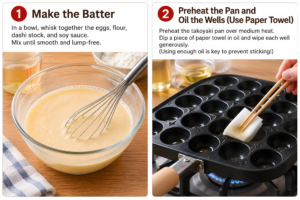
- Mix a thin, dashi-based batter (flour, eggs, and dashi stock, whisked until smooth with no lumps).
- Preheat the pan thoroughly and oil every well generously — this step matters more than people expect, and skipping it is the single most common reason batter sticks on the first attempt.
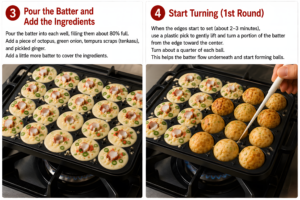
- Fill each mold with batter, then drop in a piece of diced octopus, along with tenkasu (tempura scraps), chopped green onion, and pickled red ginger.
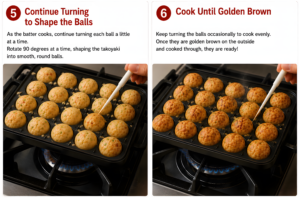
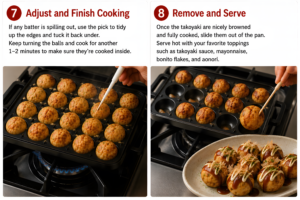
- Once the edges set, use a pick or thin skewer to rotate each ball a quarter turn, folding the still-liquid batter inward as you go.
- Keep rotating every minute or two until each ball is round and evenly browned. The outside should turn crisp and golden, and the inside soft and creamy — a glossy, flowing center is normal for takoyaki, but the batter itself should be fully cooked through, not raw.
- Serve hot, topped with takoyaki sauce, Kewpie mayonnaise, bonito flakes, and a dusting of aonori (green laver).
Common Mistakes to Avoid
- Not preheating long enough. Cold or underheated wells are the most common reason batter sticks, especially on the first batch of the day.
- Skimping on oil. Even non-stick plates benefit from a proper coat of oil before the first pour.
- Turning too early or too late. Rotate once the outer edge of the batter has visibly set, not before — and don’t wait so long that the shape flattens.
- Overfilling the wells. Batter that overflows the mold spreads into neighboring wells and makes clean rotations much harder, which several reviewers mention explicitly on the plates with shallower rims.
Frequently Asked Questions
Is it safe to use a butane cassette stove indoors?
Cassette butane stoves like the one built into the Iwatani ENTAKO II are widely used indoors in Japan and are designed for tabletop indoor use, but always follow the specific canister and stove manufacturer’s instructions, use it in a reasonably ventilated space, and never operate it near flammable materials or in a closed, unventilated room.
Can I use metal picks on any of these pans?
On bare or seasoned cast iron, metal picks are generally fine. On the Iwatani ENTAKO II’s fluorine-coated plate, it’s safer to stick with wood, bamboo, or silicone-tipped tools to avoid scratching the non-stick coating over time.
Do I need a special stove to use a cast-iron takoyaki plate?
Most cast-iron takoyaki plates are designed to sit on a gas burner grate or a portable butane stove. Check induction compatibility specifically if that’s your only cooktop — not every plate supports it, and even ones that do may heat less evenly on induction than on gas.
What can I make in a takoyaki pan besides takoyaki?
The half-sphere mold shape also works for Danish æbleskiver, Dutch poffertjes, and other round pancake-style treats, which several reviewers of similar pans mention using them for.
Why is my takoyaki sticking to the pan?
The two most common causes are an underheated pan and insufficient oil before pouring the batter — both are easy to fix by preheating longer and oiling more generously than feels necessary.
Is cast iron or coated aluminum better for a beginner?
Coated aluminum, like the Iwatani ENTAKO II’s plate, is generally more forgiving for a first attempt since it releases food more easily and doesn’t require seasoning maintenance. Cast iron rewards practice with excellent heat retention but has a slightly steeper learning curve.
How many takoyaki does one batch make?
That depends on the pan’s hole count — 14 to 23 in this guide — so a single batch ranges from about 14 to 23 pieces, with a second batch typically cooking faster since the pan is already hot.
Can I use frozen octopus?
Yes — thaw it fully and pat it dry first. Excess water from partially frozen octopus can make the batter spit and stick more than usual.
How long does a cast-iron takoyaki pan last?
With proper drying and occasional oiling to maintain the seasoning, cast-iron cookware like this is generally built to last for many years; owner reviews on the pans in this guide don’t report durability issues, though none has been in use long enough yet to speak to multi-year longevity.
Why isn’t there an electric takoyaki plate in this guide?
Household electric takoyaki plates are extremely common in Japan, but we couldn’t find one on Amazon that met this guide’s Made in Japan bar. Most electric takoyaki makers sold in the US are generic imports with no country-of-origin claim on the listing. A couple of Japanese heritage brands do sell 120V electric takoyaki attachments for the US market, but it’s worth knowing that at least one comparable US-market small appliance from a well-known Japanese kitchen brand is explicitly made in China rather than Japan, according to its own customer reviews — a reminder that a Japanese brand name doesn’t always mean Japanese manufacturing, electric appliances included. Japan’s own household electronics also run on 100V, which isn’t a straightforward match for US 120V outlets without a step-down transformer. Until a genuinely Made in Japan, US-voltage electric option turns up, every pick in this guide uses a gas or butane heat source instead.
What You’ll Also Need
A takoyaki pan alone isn’t quite enough to get started. A few things worth adding to your order:
- Shimomura Planning Octopus Picks, Set of 2 ($7.22) — A genuinely Made in Japan pair of scratch-resistant nylon picks designed specifically for rotating takoyaki without damaging non-stick coatings. At 4.6 stars across 271 ratings, they’re a far better tool for turning the balls than improvised chopsticks, though a few reviewers note they run a little short for comfort over a hot plate.
- Kayanoya Original Dashi Stock Powder ($22.60, 8g x 12 packets) — An Amazon Overall Pick at 4.8 stars across 864 ratings, this is a well-regarded dashi brand from Kubara Honke, a long-established Japanese food maker. It’s genuinely useful beyond takoyaki batter too — a household staple for miso soup, nabe hot pot, and tamagoyaki.
- Otafuku Takoyaki Flour (16 oz) and Otafuku Takoyaki Sauce ($12.59, 10.6 oz, 4.6 stars across 928 ratings) — A pre-mixed Japanese-brand flour saves you from sourcing dashi powder separately and getting the batter ratio right on your first attempt, and it’s worth pairing with a bottle of takoyaki sauce and Kewpie mayonnaise for topping.
Final Thoughts
All four pans in this guide come from listings that explicitly confirm Made in Japan manufacturing — a distinction that matters in a category where at least one major, genuinely Japanese brand still sells a China-manufactured version of a similar pan under the same name. For most home cooks, the Iwatani Cassette Gas Takoyaki Maker ENTAKO II is the easiest recommendation: it has the deepest review history of anything here, includes its own burner, and removes most of the stovetop-compatibility guesswork that trips up first-time buyers of plate-only pans. If you already have a good gas burner and want the more traditional route, the Ikenaga Tekko plate is the best value, the Iwachu 23-hole Nambu ironware plate is the one to reach for if you’re regularly cooking for a group, and the IPPINKA pan is the pick if craftsmanship and gift-worthiness matter as much as the takoyaki itself.
コメント