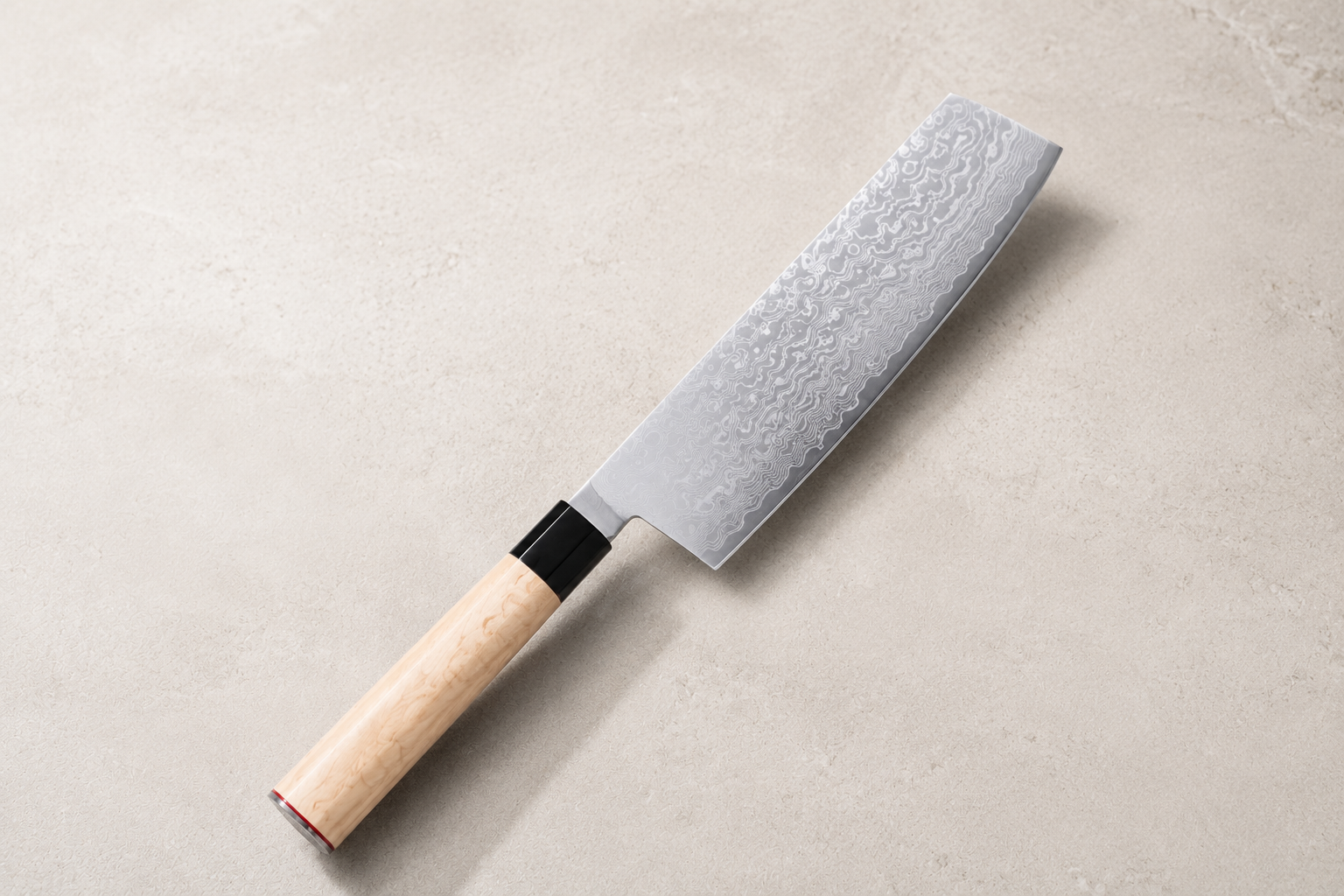
The Kai Seki Magoroku Damascus Nakiri ($89.63) is our top pick for most home cooks looking for a Japanese-made vegetable knife — at around $90, it sits in a useful middle ground between entry-level nakiris and premium options like the Miyabi Birchwood. If you’re not sure a nakiri belongs in your knife block yet, the Kai Seki Magoroku Moeki ($23.99) is the easier place to start.
What Is a Nakiri Knife?
A nakiri (菜切り包丁, “vegetable cutter”) is a Japanese kitchen knife designed primarily for vegetable prep. Unlike a Western chef’s knife or santoku, it has a rectangular, flat-edged blade with a squared-off tip instead of a curved belly — its relatively flat edge lets more of the blade contact the cutting board during push cuts, rather than rocking the blade the way you would with a curved edge. Nakiris are also typically thinner and lighter than a same-length chef’s knife, and double-beveled (sharpened on both sides), making them usable by both left- and right-handed cooks, unlike the professional single-bevel usuba.
Comparison Table
| Product | Price | Blade Material | Origin | Best For |
|---|---|---|---|---|
| Kai Seki Magoroku Moeki (AE2904) | $23.99 | Stainless steel, 6.5″ | Japan | Best Budget |
| Kai Seki Magoroku Damascus (AE5206) | $89.63 | Stainless steel composite (Damascus-clad), 6.5″ | Japan | Best Overall |
| Kyocera Revolution Series Ceramic Nakiri | $93.00 | Zirconia ceramic, 6″ | Japan | Best Low-Maintenance |
| Miyabi Birchwood SG2 Nakiri | $299.95 | SG2 powdered steel core, Damascus-clad, 6.5″ | Japan | Best Premium |
What to Look for When Buying
- Made in Japan, confirmed on the listing. Plenty of nakiri-shaped knives are made elsewhere and just styled to look Japanese — check that the country of manufacture is explicit, not just that the brand name sounds Japanese.
- Blade material. Stainless steel is generally the easiest to maintain. Damascus-clad knives use layered outer steel wrapped around a cutting core — the cladding is mostly about the pattern and outer layers, not the edge itself, so edge performance depends primarily on the core steel and heat treatment underneath it. Ceramic is rust-proof and holds an edge a long time, but it’s more brittle than steel and can chip on bone or frozen food.
- Handle and blade length. Traditional wood handles run lighter and more compact than Western-style resin handles — worth checking if you have larger hands. Most nakiris run 6–7 inches; shorter blades are easier to maneuver, longer ones cover more board per pass.
- Dishwasher-safe vs. hand-wash only. A few nakiris (like the Kai Moeki below) are dishwasher-safe. Most higher-end Japanese knives — anything with a wood handle or Damascus cladding — are hand-wash only.
The Nakiri Knives We Recommend
Disclosure: As an Amazon Associate I earn from qualifying purchases.
Kai Seki Magoroku Moeki (AE2904) — Best Budget Pick
Kai is one of the most established names in Seki, Japan’s cutlery-making region, and this is their entry-level nakiri: a triple-layer stainless steel blade with a heat-resistant resin handle, marketed as dishwasher safe — a rarity in this guide. Pros: very low price for a Made-in-Japan knife from a known maker; dishwasher safe. Cons: 4.2-star average is the lowest here; some owner reviews mention sharpening the factory edge to improve initial performance. Bottom line: a low-risk way to add a nakiri to your knife roll.
Kai Seki Magoroku Damascus (AE5206) — Best Overall
The step up from the Moeki, with a Damascus-clad stainless composite blade and a wood handle shaped into a comfortable inverted-triangle profile. At 4.6 stars across 189 ratings, it’s the strongest price-to-satisfaction combination in this guide. Pros: Japanese production and a more traditional wood-handle presentation without moving into collector-level pricing; good review base. Cons: hand-wash only; no sheath included. Bottom line: for most home cooks, this is the most balanced option in our comparison — Japanese-made, traditionally styled, well-reviewed, and substantially less expensive than the Miyabi.
Kyocera Revolution Series Ceramic Nakiri — Best for Low Maintenance
Kyocera swaps steel for a zirconia ceramic blade produced in Japan. It won’t rust or react with acidic foods, and Kyocera states its ceramic blade can maintain its edge up to 10 times longer than steel — though it requires ceramic-compatible sharpening equipment or professional sharpening rather than a standard whetstone. The listing itself warns against hard or frozen foods, since ceramic is more brittle than steel. Pros: rust-proof, long edge retention per the manufacturer, lightweight. Cons: brittle; needs specialized sharpening; plastic handle feels less premium than the wood-handled picks. Bottom line: smart pick if rust and resharpening frequency matter more to you than brittleness.
Miyabi Birchwood SG2 Nakiri — Best Premium / Gift Pick
Handcrafted in Seki, Japan, with a core of SG2 micro-carbide powdered steel wrapped in a 101-layer Damascus pattern and a signature Karelian birch handle, per the manufacturer’s own description. Reviewers consistently describe the factory edge as extremely sharp out of the box. At $299.95 (10% off a $334.95 typical price) with a 4.8-star average across 130 ratings, it’s the clear splurge pick. Pros: powdered steel core, distinctive handle, high owner rating. Cons: nearly 3x the price of our Best Overall pick; hand-wash only; a few reviewers note the handle runs small. Bottom line: the splurge pick — best suited to someone who values premium materials, Japanese craftsmanship, and presentation enough to justify the price.
Which One Should You Buy?
- Best Budget: Kai Seki Magoroku Moeki ($23.99)
- Best Overall: Kai Seki Magoroku Damascus ($89.63)
- Best Low-Maintenance: Kyocera Revolution Series Ceramic ($93.00)
- Best Premium / Gift: Miyabi Birchwood SG2 ($299.95)
Using and Caring for Your Nakiri
The nakiri is built for a push cut: lift the blade and bring it straight down through the food rather than rocking it the way you would a curved Western knife.
For steel and Damascus-clad blades (Kai Moeki, Kai Damascus, Miyabi Birchwood), hand-washing is the safer default even for the dishwasher-rated Moeki — dishwasher heat and detergent dull an edge faster over time. Dry immediately, and store in a block or on a magnetic strip rather than loose in a drawer. For the ceramic Kyocera, hand wash only, avoid frozen food or bone entirely, and use ceramic-compatible sharpening equipment rather than a standard whetstone. Across every material, rinsing and drying right after use is the single biggest thing that extends a knife’s life.
Frequently Asked Questions
Is a nakiri knife safe for beginners?
Yes — nakiris are double-beveled and usable by both left- and right-handed cooks, unlike single-bevel professional knives like the usuba. The flat edge is fairly forgiving to learn push-cutting on.
Can a nakiri replace my chef’s knife?
Not entirely. Its flat edge and lack of a point make it awkward for rock-chopping meat or piercing/boning tasks. Most cooks use it alongside a chef’s knife or santoku rather than instead of one.
What’s the difference between a nakiri and a santoku?
The nakiri has a flat edge with a squared tip, built specifically for vegetables. The santoku has a slightly curved, rounded-tip edge and handles vegetables, fish, and meat. Want one all-purpose knife? Get a santoku. Vegetable prep is the priority? The nakiri does that one job better.
Is ceramic or steel better for a nakiri?
Neither is strictly better. Ceramic resists rust and holds an edge longer between sharpenings but is brittle. Steel is more forgiving of everyday use and easier to resharpen on a standard whetstone, but needs consistent drying to avoid rust.
How do I keep a nakiri sharp?
Steel nakiris can be maintained with a honing rod and resharpened periodically on a whetstone — see our whetstone guide. Ceramic blades need ceramic-compatible sharpening equipment; a standard whetstone won’t touch zirconia.
What You’ll Also Need
A sharp nakiri deserves a board that won’t fight back — see our hinoki and ginkgo cutting board guide. And since even a Made-in-Japan blade needs occasional sharpening, our whetstone comparison covers grit selection for the steel blades above.
Final Thoughts
A nakiri isn’t a knife everyone needs, but if you cook a lot of vegetables, the difference between fighting a curved blade and push-cutting with a flat one is noticeable within the first few uses. All four picks here are confirmed Japan-made, so the choice comes down to budget and maintenance preference rather than authenticity. The Kai Seki Magoroku Damascus is our starting recommendation for most people. Budget-conscious cooks have a solid option in the Kai Moeki, the Kyocera ceramic is worth a look if rust and resharpening frequency worry you more than brittleness, and the Miyabi Birchwood is there for anyone who wants — or is buying as a gift — the nicest nakiri in this lineup.
コメント