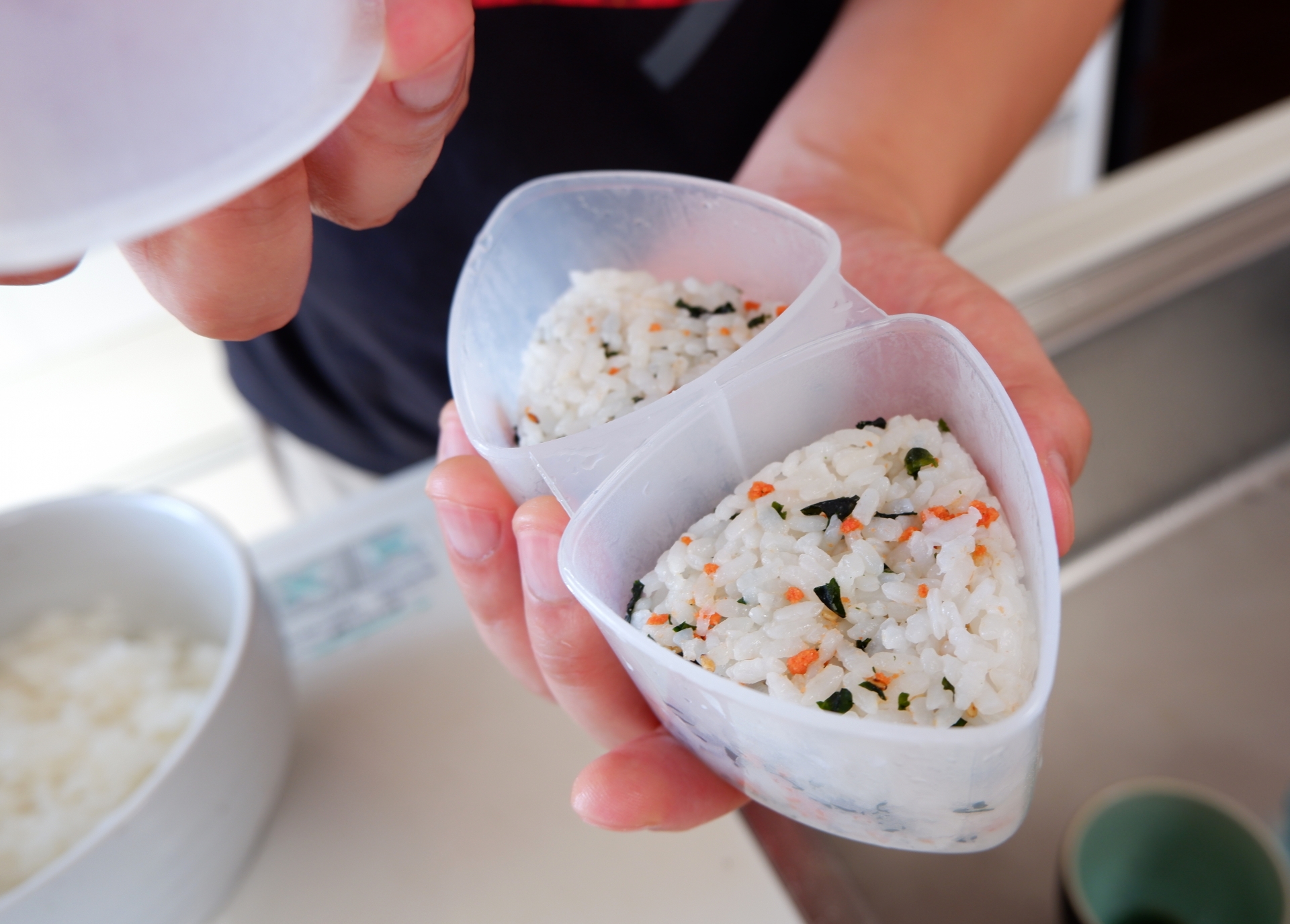
If you only have room for one onigiri mold, the JapanBargain 1761 Triangle Mold ($6.99) is the safest pick — it’s made in Japan, dishwasher-safe, and backed by more than 1,200 reviews averaging 4.6 stars. If you want to try the flat “rice sandwich” style instead of the classic triangle, the Akebono Sangyo WE-960 ($11.99) is worth a look, and if you’d rather give a mold as a gift, the TIKUSAN hinoki cypress mold ($42.99) is the only wood option in this roundup.
- What Is an Onigiri Mold, and Why Use One?
- Quick Comparison
- What to Look for When Buying an Onigiri Mold
- Product Reviews
- Which One Should You Buy?
- Sizing Guide
- A Quick Note on Materials
- Care and Maintenance
- How to Use an Onigiri Mold
- Common Mistakes to Avoid
- Frequently Asked Questions
- Are onigiri molds dishwasher-safe?
- Is it safe to eat rice pressed in a plastic mold?
- What’s the difference between onigiri and onigirazu?
- Can I make onigiri without a mold?
- Do I need special rice for a mold to work?
- Why does my rice stick to the mold even though it’s “non-stick”?
- How many onigiri does one mold make?
- What You’ll Also Need
- Final Thoughts
What Is an Onigiri Mold, and Why Use One?
Onigiri (お握り), often called Japanese rice balls, are one of the most common foods in Japan — sold at every convenience store, packed into bento boxes, and shaped by hand in home kitchens for generations. Traditionally, onigiri are formed by wetting your hands with salted water and pressing rice into a triangle or round shape, which takes practice to do neatly and can get messy, especially with hot, sticky rice.
An onigiri mold solves that problem by giving the rice a shape to press into, so every rice ball comes out a consistent size without repeatedly wetting and reshaping your hands. That makes molds especially useful for packing a batch of bento-box lunches quickly, for getting kids involved in making their own rice balls, or for anyone who just wants tidier results than free-handing it.
For a lot of people, onigiri are tied to childhood as much as to any particular recipe. One of our writers grew up with a mother who packed onigiri into her school lunches for field trips and made her bento every single day throughout all three years of high school — usually wrapped in nori, with a different filling each time, and occasionally shaped into hearts or stars with novelty molds just to make lunch more fun to open. Some home cooks shape every onigiri by hand, but her mom always reached for a mold instead. When you’re packing a lunch every single day for years, that’s exactly the kind of repetition where a mold earns its keep.
Quick Comparison
| Product | Price | Material / Style | Best For |
|---|---|---|---|
| JapanBargain 1761 | $6.99 | Polypropylene, classic double-triangle press | Best Overall |
| JapanBargain 3255 | $7.50 | Plastic, 5-compartment rectangular nigiri press | Best for Nigiri-Style |
| Akebono Sangyo WE-960 | $11.99 | Polypropylene resin, flat “rice sandwich” shape | Best for Onigirazu / Rice Sandwiches |
| TIKUSAN Hinoki Wood Mold | $42.99 (5-mold size) | Japanese hinoki cypress wood, triangle molds | Best Artisan / Gift Pick |
What to Look for When Buying an Onigiri Mold
- Material. Food-grade polypropylene plastic is the most common, dishwasher-friendly, and cheapest option. Wood molds (usually hinoki cypress) are hand-wash only and priced more like a kitchen accessory than a disposable gadget.
- Shape and style. Most molds make the classic triangle onigiri, but some make rectangular nigiri-style rice presses, and others make a flatter “rice sandwich” (onigirazu) shape — worth matching to how you actually plan to eat them.
- Number of cavities. Single-mold designs make one rice ball at a time; multi-cavity trays let you press out a whole batch for bento boxes or a crowd in one go.
- Non-stick surface. Look for a textured, embossed, or bumpy interior — several listings and owner reviews mention this is what actually keeps sticky Japanese rice from clinging to the mold, more than the base material alone.
- Dishwasher-safe vs. hand-wash only. Plastic molds are often listed as dishwasher-safe, though check the specific listing — some owner reviews describe hand-washing their mold regardless. Wood molds should be hand-washed and dried promptly to avoid warping.
- Made in Japan. If authenticity matters to you, check that the listing explicitly states “Made in Japan” rather than just featuring Japanese-style branding or packaging.
Product Reviews
Disclosure: As an Amazon Associate I earn from qualifying purchases.
JapanBargain 1761 Triangle Onigiri Mold — Best Overall
The JapanBargain 1761 is a simple two-piece polypropylene mold that presses out the classic double-triangle onigiri shape. The listing describes it as made in Japan from food-grade, BPA-free polypropylene, and it’s the best-reviewed mold in this roundup by a wide margin, with over 1,200 ratings averaging 4.6 stars. A small removable button in the center of each triangle creates a pocket for fillings like umeboshi or salmon, and can be popped out if you’d rather fill the rice yourself.
The listing states the mold is dishwasher-safe, though it’s worth noting that several long-time owner reviews describe hand-washing it instead, so if you want to be cautious with a plastic mold, hand-washing is a safe default regardless of what the listing says.
Pros:
- Made in Japan from food-grade polypropylene
- Removable filling button for umeboshi, salmon, or other classic fillings
- By far the most-reviewed mold in this comparison, with a high average rating
- Low price point makes it an easy first mold to try
Cons:
- Makes only two onigiri per press, so a big batch takes several rounds
- Some reviewers say there’s a small learning curve to get the fill level right
Bottom line: A well-reviewed, inexpensive starting point that’s hard to go wrong with, especially if you’re new to using an onigiri mold at all.
JapanBargain 3255 Rectangular Onigiri Mold — Best for Nigiri-Style
Where the 1761 makes the classic triangle, the JapanBargain 3255 presses out rectangular, nigiri-style rice blocks — five compartments per press. The listing shows the brand as TKG Endo Shoji, a Japanese kitchenware wholesaler, and states the mold is made in Japan from plastic. At 4.4 stars across 375 ratings, it’s solidly reviewed, with several buyers using it specifically for spam musubi or crispy rice preparations rather than traditional triangle onigiri.
One recurring note in the reviews: a few owners mention the individual compartments are on the smaller side, so this is more of a snack-sized or musubi-style mold than a mold for a full meal-sized rice ball.
Pros:
- Made in Japan, sold by an established Japanese kitchenware brand
- Five compartments per press for faster batches
- Rectangular shape works well for musubi-style dishes like spam musubi
Cons:
- Compartments run small according to multiple owner reviews
- Only 17 units were in stock at the time of writing — availability may be limited
Bottom line: The one to reach for if you’re making musubi or nigiri-style rice blocks rather than the classic triangle.
Akebono Sangyo WE-960 — Best for Onigirazu / Rice Sandwiches
The Akebono Sangyo WE-960 makes a different style of onigiri entirely: a flat, wide “rice sandwich” (sometimes called onigirazu or gohan sando) rather than a hand-sized triangle. The listing describes a mold body made of polypropylene, states the product is made in Japan, and lists heat resistance up to 248°F (120°C) and cold resistance to -4°F (-20°C). The mold has a double-embossed interior designed to keep rice from sticking, and its shallow design leaves room to layer in more filling than a standard triangle mold typically allows.
Reviewers consistently mention that the rice releases cleanly and that the mold works well for building a nori-wrapped rice sandwich with the filling visible in cross-section — a different eating experience than a classic onigiri. One thing to flag: the listing’s own weight figures are inconsistent (it lists both 3.04 ounces and 1.8 lbs for the same product), which looks like a listing error rather than a real spec discrepancy, so don’t take either number as exact.
Pros:
- Made in Japan, from an established Japanese kitchenware brand (Akebono Sangyo)
- Distinct flat “rice sandwich” shape, good for generous or unusual fillings
- Reviewers consistently report clean, non-stick release
Cons:
- Not a classic triangle onigiri shape, so it’s a different product than what some buyers may expect
- Listing has an internal weight inconsistency worth ignoring rather than relying on
- Limited stock at the time of writing
Bottom line: Worth choosing specifically if you want the onigirazu-style rice sandwich rather than a traditional triangle — not a direct substitute for the other molds here.
TIKUSAN Hinoki Cypress Wood Onigiri Mold — Best Artisan / Gift Pick
The TIKUSAN mold is the only wood option in this comparison, made from Japanese hinoki cypress and sold in several sizes — from a compact 2-mold version around $28.99 up to the 5-mold Type1 version at $42.99 reviewed here. The listing describes hinoki as moisture-resistant with “excellent preservation properties,” and notes it’s traditionally used as a building material for temples and shrines in Japan — that’s the seller’s own description rather than an independently verified material claim, but it’s consistent with hinoki’s general reputation as a durable, aromatic Japanese building and craft wood.
Reviews are mixed at 3.9 stars across a small sample of 6 ratings. Positive reviews mention the pleasant woodsy scent and that it saves time over shaping onigiri by hand. But one detailed review flags a real usability issue: the manufacturer’s instructions say to wet the mold before use, and doing so makes the wood swell slightly, which can make the lid piece fit more tightly and awkwardly than expected. If you buy this mold, it’s worth being aware of that tradeoff going in.
Pros:
- Made in Japan from hinoki cypress, a genuinely distinctive material versus every other plastic option here
- Pleasant natural scent noted by multiple reviewers
- Sold in multiple sizes, from small gift-sized molds to a 5-cavity family size
- Gift-worthy presentation compared to a plastic mold
Cons:
- Small review sample (6 ratings) and a mixed 3.9-star average
- At least one owner reports the wood swelling and fitting tightly after the recommended pre-soak
- By far the most expensive mold in this roundup
- Requires hand-washing and prompt drying, unlike the dishwasher-safe plastic options
Bottom line: A genuinely different, gift-worthy option for someone who wants a wood kitchen tool rather than plastic — just go in with realistic expectations about fit and hand-care, not a flawless artisan product.
Which One Should You Buy?
- Want the safest, most-reviewed option? Go with the JapanBargain 1761.
- Making musubi or nigiri-style rice blocks? Go with the JapanBargain 3255.
- Want a rice sandwich instead of a triangle? Go with the Akebono Sangyo WE-960.
- Buying a gift, or want a wood tool instead of plastic? Go with the TIKUSAN hinoki mold.
Sizing Guide
Mold dimensions vary more than you’d expect, and they directly affect how large your finished onigiri will be:
| Product | Mold Dimensions | Cavities |
|---|---|---|
| JapanBargain 1761 | 5 x 3 x 2 in | 2 triangles per press |
| JapanBargain 3255 | 6 x 2.5 x 1 in | 5 rectangular compartments |
| Akebono Sangyo WE-960 | 7.9 x 4.3 x 0.9 in | 1 rice sandwich per press |
| TIKUSAN Hinoki (Type1, 5-mold) | 17.7 x 3.9 x 1.2 in tray; 2.9 x 2.7 x 1.2 in per onigiri | 5 triangles per press |
The TIKUSAN mold is also sold in a smaller size (roughly 7 x 3.3 x 1.2 inches, 2 molds, around $28.99) with a slightly smaller per-onigiri output, if the 5-mold family size is more tray than you need.
A Quick Note on Materials
Most onigiri molds, including three of the four in this roundup, are made from polypropylene (PP) — a food-grade plastic widely used in kitchenware because it holds up to repeated washing, doesn’t absorb odors easily, and is generally considered safe for food contact. It’s the same material used in a lot of reusable food storage containers.
Hinoki cypress, used in the TIKUSAN mold, is a different category of material altogether — a light-colored Japanese softwood prized in traditional building and woodworking for its aroma, straight grain, and natural resistance to moisture and decay. That reputation is well established in Japanese carpentry generally, though it’s worth remembering that a small kitchen mold isn’t put through the same stresses as structural lumber, and how well any individual piece holds up in a wet kitchen environment over years of use isn’t something this comparison can verify firsthand.
Care and Maintenance
Plastic molds (JapanBargain 1761, JapanBargain 3255, Akebono Sangyo WE-960): Rinse promptly after use so rice doesn’t dry and harden inside the mold’s texture — dried rice is much harder to clean off than fresh rice. Listings describe these as dishwasher-safe, but if you want to extend the life of the embossed non-stick texture, hand-washing with a soft brush is the gentler option.
Wood mold (TIKUSAN hinoki): Hand-wash only — a wood tool shouldn’t go in the dishwasher. Dry it promptly and thoroughly after each use rather than leaving it wet, since wood that stays damp is more prone to warping or, per at least one owner review, swelling enough to affect the fit. The manufacturer’s instructions call for lightly wetting the mold before filling it with rice to help release the onigiri; just be aware that’s also the step one reviewer linked to a tighter, more cumbersome fit.
How to Use an Onigiri Mold
- Cook short-grain Japanese rice and let it cool just enough to handle — it should still be warm and sticky, not hot.
- Lightly wet the inside of the mold with water (this helps prevent sticking on both plastic and wood molds).
- Fill the mold about halfway with rice, add your filling of choice (umeboshi, salmon, tuna mayo, or simply salt), then top with more rice.
- Press the lid or top piece down firmly and evenly so the rice holds together once released.
- Remove the onigiri from the mold — most molds release with a gentle push or by lifting the mold away rather than pulling on the rice itself.
- Wrap the bottom with a strip of nori seaweed if desired, and serve.
Beyond the usual umeboshi, salmon, or tuna mayo, one filling worth trying is thinly sliced beef simmered in a sweet-savory sauce — the kind used for yakiniku or gyudon. It’s a heartier, more substantial filling than the classics, and it’s exactly the kind of saucy filling that’s much easier to tuck in neatly with a mold than to pack by hand, since you’re not pressing sauce-coated rice between your palms.
Common Mistakes to Avoid
- Using the wrong rice. Standard Japanese short-grain rice is sticky enough to hold its shape; long-grain rice like basmati or jasmine won’t bind the same way in a mold.
- Overfilling the mold. Packing in too much rice makes it harder to release cleanly and can distort the shape — most molds work best filled level, not mounded.
- Skipping the water step. Even on a “non-stick” mold, a light wetting of the interior surface before adding rice makes release noticeably easier.
- Letting rice dry in the mold. Rinse or wash promptly after use; dried rice is much harder to scrub out of the mold’s texture than fresh rice.
Frequently Asked Questions
Are onigiri molds dishwasher-safe?
The plastic molds in this comparison are generally listed as dishwasher-safe, though some long-time owners say they hand-wash theirs anyway to protect the textured non-stick surface. Wood molds, like the TIKUSAN hinoki mold, should always be hand-washed — never put a wood kitchen tool in the dishwasher.
Is it safe to eat rice pressed in a plastic mold?
The plastic molds in this roundup are described in their listings as food-grade and BPA-free, which is standard for kitchenware designed for direct food contact. As with any food-contact plastic, it’s worth replacing a mold if it becomes visibly cracked, warped, or discolored over time.
What’s the difference between onigiri and onigirazu?
Onigiri is the classic hand-sized rice ball, usually triangular or round, with filling tucked inside the rice. Onigirazu (sometimes called a “rice sandwich”) is a flatter, wider preparation where rice and fillings are layered and wrapped in nori like a sandwich, then typically sliced in half to show the layers. The Akebono Sangyo WE-960 in this roundup is built for the onigirazu style rather than the classic triangle.
Can I make onigiri without a mold?
Yes — hand-shaping with salted water is the traditional method, and plenty of people prefer it. A mold mainly helps with consistency and speed, especially for a big batch or for kids learning to make their own.
Do I need special rice for a mold to work?
Short-grain Japanese rice (sometimes labeled “sushi rice”) is what gives onigiri its characteristic sticky texture that holds together. Long-grain varieties generally won’t hold their shape the same way once pressed.
Why does my rice stick to the mold even though it’s “non-stick”?
This is almost always a moisture issue rather than a defective mold — lightly wetting the mold’s interior with water before adding rice is what actually keeps sticky rice from clinging, on both plastic and wood molds. A completely dry mold, even a textured or embossed one, is more likely to stick.
How many onigiri does one mold make?
It depends on the mold. Single or double-cavity molds like the JapanBargain 1761 make one to two onigiri per press, while multi-cavity trays like the JapanBargain 3255 (5 compartments) or the TIKUSAN 5-mold tray let you press out a full batch at once.
What You’ll Also Need
A mold gets you a consistent shape, but a couple of other tools make the process noticeably smoother:
Marna Standing Rice Spoon (K555CL)
This TPX resin rice paddle is made in Japan and won a Good Design Award. Its embossed, non-stick surface keeps scooped rice from sticking to the paddle itself, and the freestanding design means it doesn’t need to rest in a separate holder. At 4.5 stars across more than 4,400 ratings, it’s one of the most consistently well-reviewed rice tools on Amazon. Price: $11.00.
iimon mart Japanese Rice Measuring Cup (180ml / 1 Gō)
Japanese rice measurements are based on the traditional “gō” unit (180ml), which is smaller than a standard US measuring cup (240ml) — using the wrong size measurement is a common reason home-cooked rice comes out too dry or too wet. This stainless steel cup is made in Japan and engraved with the accurate 1-gō measurement so it won’t fade over time. Price: $7.99.
Final Thoughts
None of the molds in this comparison require a big investment, which makes it easy to just pick based on the shape you actually want to eat. The JapanBargain 1761 is the lowest-risk choice thanks to its huge review base and low price, and it’s the one we’d point a first-time buyer toward. If you want something other than a classic triangle, the JapanBargain 3255 and Akebono Sangyo WE-960 cover musubi-style and onigirazu-style rice respectively. The TIKUSAN hinoki mold is the outlier here — a genuinely different, gift-worthy wood tool, but one with a smaller review base and at least one credible report of the wood swelling after the recommended pre-soak, so it’s worth buying with realistic expectations rather than assuming flawless artisan quality at this price point.
コメント