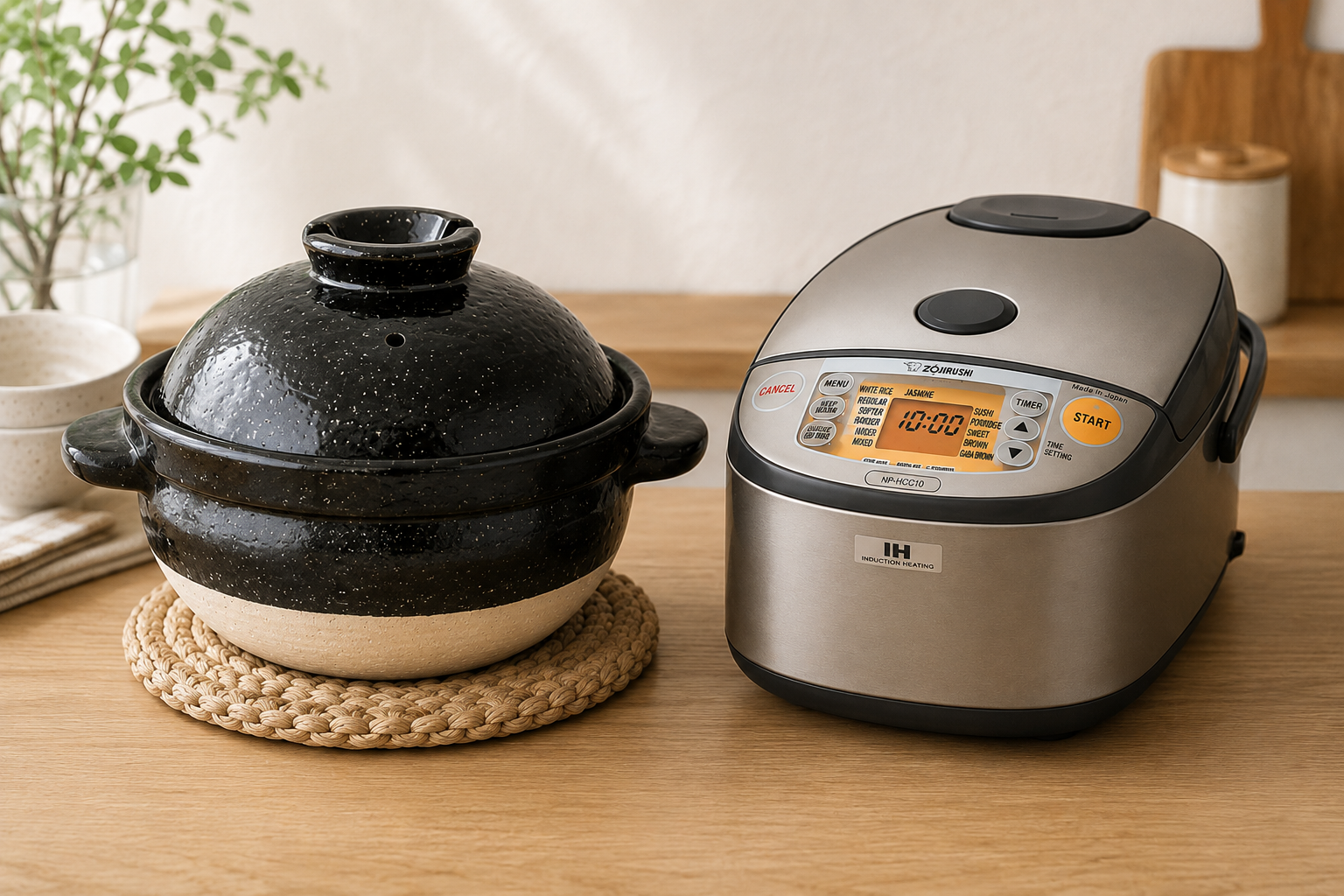
If you eat rice almost every day and want consistent, hands-off results, an electric rice cooker like the Zojirushi NP-HCC10XH Induction Rice Cooker ($380.59) is the better everyday tool. If you’re willing to trade convenience for a more hands-on cooking method — and the possibility of okoge and a different rice texture — a Nagatani Seitou Kamado-san (ACT-03) donabe ($218.94) is the more interesting choice. If you already own a rice cooker, a donabe can make sense as a second pot for meals where you want to focus more on the rice itself. Prices and ratings were checked in August 2026 and may change.
Note: these two picks aren’t capacity-matched. The Kamado-san reviewed here is a small rice pot sized for about 2 cups of dry rice, while the Zojirushi is a 5.5-cup model. The price comparison reflects these specific products, not a general price gap between donabe and electric rice cookers as categories.
- What’s Actually Different Between Them?
- Quick Comparison
- Taste and Texture
- Time and Effort
- Cost Over Time
- Learning Curve
- Which One Should You Buy?
- Nagatani Seitou Kamado-san (ACT-03)
- Zojirushi NP-HCC10XH Induction Rice Cooker
- FAQ
- Can a donabe fully replace an electric rice cooker?
- Is donabe rice actually better, or is it just hype?
- Is a donabe hard to use for a beginner?
- Does cooking rice in a donabe use less electricity than a rice cooker?
- Can you cook other grains or dishes in a donabe made for rice?
- How long does a donabe actually last?
- Final Thoughts
What’s Actually Different Between Them?
A donabe is an unglazed or partially glazed clay pot used on a stovetop; most are made for gas heat, though some specially designed models are induction-compatible, so it’s worth checking the manufacturer’s heat-source specifications before you buy. An electric rice cooker, by contrast, is a sealed countertop appliance with a heating element and a timer. Both can produce excellent rice, but they’re built around different tradeoffs: one prioritizes flavor and texture at the cost of attention, the other prioritizes convenience at the cost of some nuance. We cover product picks and buying criteria in more depth in our full guide to the best Japanese donabe rice cookers — this article is focused specifically on helping you decide which category is the right fit for how you actually cook.
Quick Comparison
| Factor | Donabe | Electric Rice Cooker |
|---|---|---|
| Hands-on attention | Requires watching heat and listening/watching for the steam change | Measure, add water, press start, walk away |
| Total time (rinse to rest) | Roughly 45–50 minutes including a 20-minute soak and 15–20 minute rest | Roughly 45–70 minutes depending on the mode, entirely unattended |
| Upfront cost (as reviewed) | $218.94 | $380.59 |
| Ongoing cost | Stovetop fuel (gas, in the case of the model reviewed here), plus replacement if damaged | Electricity; replacement parts such as the inner pot may eventually be needed |
| Heat source | Usually gas; induction compatibility depends on the specific model (the Kamado-san reviewed here is gas-only per the listing) | Built-in electric heating element |
| Crispy bottom layer (okoge) | Achievable with direct heat | Not typically produced in standard rice-cooker modes |
| Other uses | Some general-purpose donabe double as pots for soups and stews, though rice-focused designs like the Kamado-san are built specifically around rice | Usually single-purpose, though some models add steam/porridge settings |
| Best for | Rice as the centerpiece of a meal, special occasions, cooks who enjoy the process | Daily meals, hands-off convenience, consistent results |
Taste and Texture
We cook rice with both of these regularly in our own kitchen, so this comparison isn’t just researched — it reflects what we’ve actually noticed using each one side by side. In our experience, donabe rice comes out a little sweeter and glossier than rice cooker rice, especially eaten on its own rather than mixed into another dish. Clay heats more slowly and less evenly than a metal inner pot, and that gentler heat appears to encourage more thorough moisture absorption in each grain — which lines up with the difference we taste. Okoge, the crisp, lightly toasted layer that forms on the bottom of the pot when you let a donabe run a little past the steam signal, is one of the best parts of cooking with one, and it’s something a sealed electric cooker simply can’t produce. There’s also a mood factor: bringing a donabe straight to the table just makes a meal feel more special, and the actual hands-on stovetop time is shorter than most people expect — the active cooking window is only about 10–12 minutes (see the timing breakdown below). Donabe rice also holds up well after it cools, which makes it a good choice for bento or onigiri; rice cooker rice, by comparison, is best eaten warm.
Time and Effort
Neither one is fast, but they demand different kinds of attention. A donabe typically needs the rice rinsed and soaked for about 20 minutes, then roughly 10–12 minutes over medium-high heat until steam changes from the vent, then a short rest of 2–3 minutes on the heat (longer if you want okoge), then 15–20 minutes off the heat, covered, before you fluff it. You’re not stirring or babysitting it the whole time, but you do need to be in the kitchen to catch the steam change. An electric rice cooker’s total cycle is often comparable or even a bit longer — many models run 45 minutes to over an hour on standard settings — but every minute of it is unsupervised. If your kitchen routine means you’re doing other things while dinner cooks, that difference in required attention matters more than the raw minutes.
Cost Over Time
As reviewed here, the Kamado-san donabe costs less upfront than the Zojirushi induction rice cooker. It runs on stovetop gas rather than drawing household electricity, and it has no motor or heating element to eventually fail — the main long-term risk is cracking from thermal shock or a dry-fire accident, which is avoidable with normal care (see our donabe buying guide for seasoning and care tips). An electric rice cooker draws power every time you use it, and replacement parts such as the inner pot may eventually be needed if the coating becomes damaged or worn. Neither option has a clearly documented lifespan advantage here; the bigger cost variable is really how many rice cookers or donabe pots you go through due to accidents or replacement, which comes down to how carefully each is used.
Learning Curve
A rice cooker requires relatively little active attention to get right — the main way to get it wrong is an incorrect water ratio. A donabe has a slightly steeper learning curve, and the mistakes are more consequential: setting the heat too high can boil rice over or scorch it before the timer would suggest, and putting a donabe over direct heat while its base is still wet from washing is one of the more common ways owners crack one, since the porous, still-damp clay can expand suddenly when heated. New donabe cooks also sometimes lift the lid to check progress, which lets out the steam you need to finish the rice properly. None of this is hard to avoid once you know about it, but it does mean your first few batches are more of a learning process than they would be with a rice cooker.
Which One Should You Buy?
- You cook rice daily and want zero mental overhead: an electric rice cooker, hands down — the Zojirushi NP-HCC10XH below is a strong pick.
- You want the best possible bowl of plain rice for a special meal: a donabe, like the Kamado-san below, is worth the extra attention.
- You have a small kitchen and want one pot with more than one use: some general-purpose donabe double as stovetop pots for soups and hot pot, though the rice-focused Kamado-san reviewed here doesn’t advertise that use — check the specific listing if versatility matters to you.
- You’re buying a gift for someone who already owns a rice cooker: a donabe is the more distinctive, occasion-worthy gift.
- You’re not sure and cook rice often: an electric rice cooker for weeknights and a donabe for weekends or guests is a common way to split the two, without needing to pick just one.
Nagatani Seitou Kamado-san (ACT-03)
Disclosure: As an Amazon Associate I earn from qualifying purchases.
This is the same donabe we recommend as our top pick in the full donabe buying guide. We picked it for this comparison because its double-lid design is built specifically around rice cooking, which makes it a more relevant match-up against a dedicated electric rice cooker than a general-purpose donabe would be. The listing confirms it’s made in Japan and states it’s made specifically for gas stovetops — not induction-compatible, per the manufacturer, so don’t plan on using it on an induction cooktop. It’s sized for about 2 cups of dry rice (noticeably smaller than the Zojirushi below), and comes with a rice paddle and recipe booklet. It’s rated 4.4 stars from 106 ratings on Amazon.
Zojirushi NP-HCC10XH Induction Rice Cooker
We picked this one because it’s a well-established induction (IH) model with a long Amazon review history, which made it a reasonable, verifiable “convenience” counterpart to the Kamado-san. Unlike simpler rice cookers that heat mainly from a bottom heating plate, IH models use electromagnetic induction to heat the inner cooking pan directly. The listing confirms specific features: multiple cooking-menu settings, dedicated modes for brown rice, GABA brown rice, and germinated brown rice, automatic and extended keep-warm, and a two-setting delay timer. The product description states it’s made in Japan. It’s a 5.5-cup capacity model — notably larger than the Kamado-san — rated 4.7 stars from 4,463 ratings on Amazon.
FAQ
Can a donabe fully replace an electric rice cooker?
It can, if you don’t mind being in the kitchen for the cooking window and don’t need a keep-warm function — donabe doesn’t have one, so rice is best eaten within a couple hours of cooking or reheated afterward. Many people who own both reach for the rice cooker for convenience and the donabe when they want the different texture and cooking experience.
Is donabe rice actually better, or is it just hype?
In our own kitchen, yes — we notice donabe rice tastes a little sweeter and glossier than rice cooker rice, and we genuinely prefer it for meals where the rice itself is the focus. That said, the difference is subtle enough that whether it’s worth the extra attention comes down to personal priorities rather than an objective “better.”
Is a donabe hard to use for a beginner?
Not hard, but it rewards attention the first several times you use it — see the Learning Curve section above. Most of the common mistakes (boiling over, cracking from a wet base, lifting the lid too early) are avoidable once you know what to watch for.
Does cooking rice in a donabe use less electricity than a rice cooker?
A donabe used on a gas stove, like the Kamado-san reviewed here, uses no household electricity for the cooking itself. Some donabe are designed to work on induction stovetops instead, in which case they’d draw power only for the cooking window, similar to any other induction cooking. An electric rice cooker draws power for the full cook cycle and then continues drawing a smaller amount if you leave it on keep-warm, which a donabe has no equivalent of.
Can you cook other grains or dishes in a donabe made for rice?
Some general-purpose donabe can also work as a stovetop vessel for soups, stews, and hot pot once you remove any inner steam lid, and many rice-sized donabe can handle other grains with adjusted water ratios. But rice-focused designs like the Kamado-san reviewed here are built specifically around rice cooking, and the manufacturer doesn’t advertise other uses for it — check the specific listing for your donabe before repurposing it outside plain rice.
How long does a donabe actually last?
With normal care — drying the base before heating, avoiding sudden temperature changes, and not using metal utensils that could chip the glaze — a donabe can last many years. The main failure mode is cracking, usually from thermal shock rather than everyday wear, which is why care instructions emphasize heating and cooling it gradually.
Final Thoughts
There’s no universally “better” choice here — a donabe and an electric rice cooker are built for different priorities, and the right one depends on how much attention you want to give your rice on a given day. If you’re deciding between the two specific products reviewed here, the Zojirushi NP-HCC10XH is the safer everyday choice for most households, and the Nagatani Seitou Kamado-san is worth adding if you want a different texture and cooking experience for the meals where it matters — just remember it’s gas-only and sized for smaller portions than the Zojirushi. For more donabe options across sizes and price points, see our full donabe rice cooker buying guide.
コメント