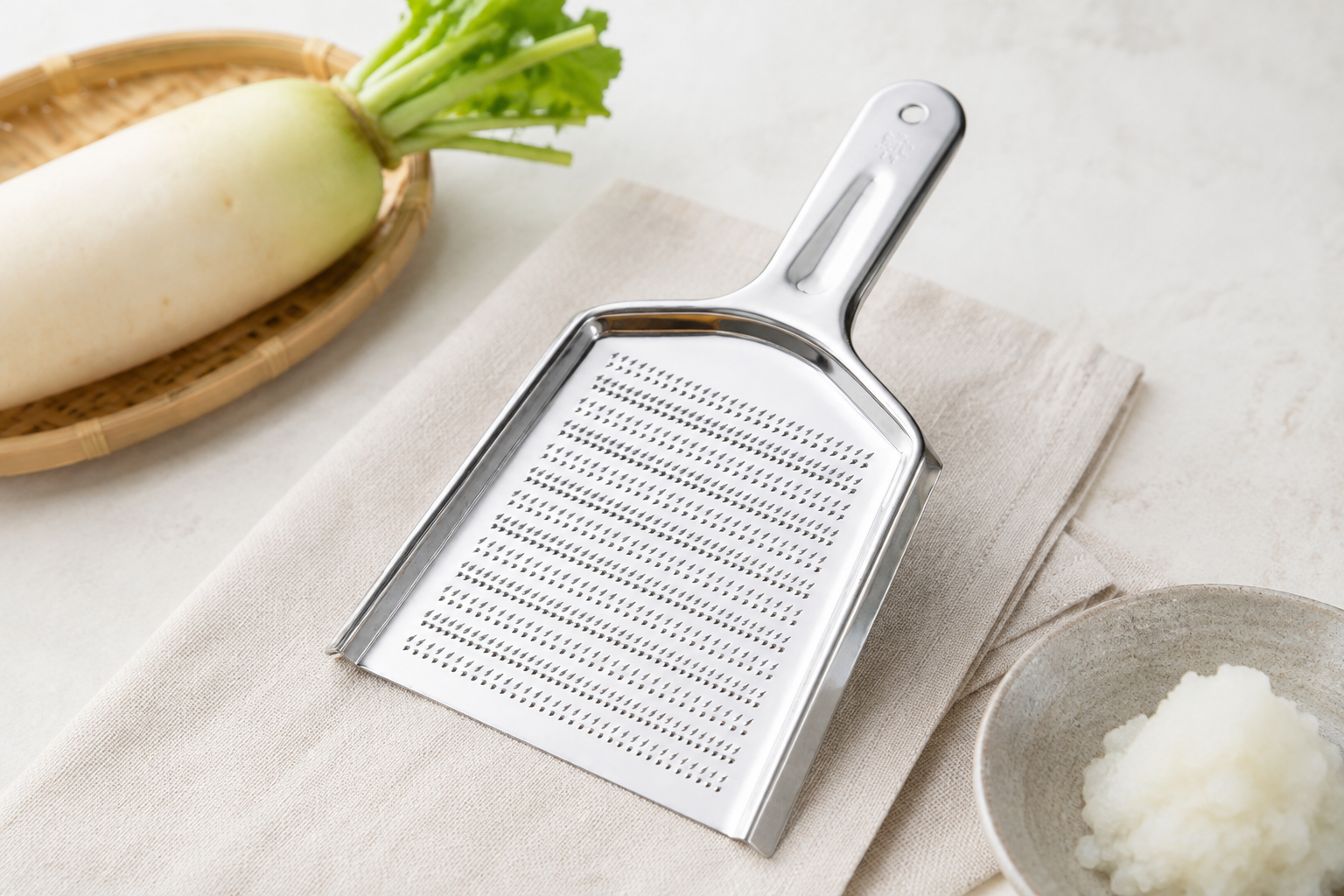
Quick answer: For most people, the TIKUSAN Stainless Steel Oroshigane is the best all-around choice — a large, traditional trough-style grater that’s genuinely made in Japan and priced around $45. Read on for the full comparison, a breakdown of stainless vs. ceramic vs. copper, and how to actually use one.
- What Is an Oroshigane, and Why Does It Matter?
- Comparison at a Glance
- How I Chose These Oroshigane
- What to Look for When Buying an Oroshigane
- Product Reviews in Detail
- Which One Should You Buy?
- Material Matters: Stainless Steel vs. Ceramic vs. Copper
- How to Actually Use One
- Recipe Ideas: What to Grate and How to Use It
- Care and Maintenance
- Common Mistakes (and What’s Actually Going Wrong)
- What You’ll Also Need
- FAQ
- Final Thoughts
What Is an Oroshigane, and Why Does It Matter?
Oroshigane (literally “grating metal”) is the everyday Japanese grater — the tool behind the mound of grated daikon next to your tempura, the fresh ginger stirred into a dipping sauce, or the wasabi paste served with sashimi. It looks simple: a flat or curved plate covered in small raised teeth, usually with a channel or well underneath to catch the juice. But the teeth are doing something a Western box grater or Microplane isn’t built for.
Most Microplane-style graters use sharp, etched cutting edges that shear food into fine shreds. An oroshigane uses closely spaced, raised teeth that work through a rubbing-and-pushing motion instead, breaking ingredients down into a much finer, almost paste-like texture. That difference matters more than it sounds — for daikon oroshi, fresh ginger, or wasabi, a paste-like grate can release more juice and produce a milder, less fibrous result than shredded strands, which is part of why the tool has stuck around in Japanese kitchens for so long.
Comparison at a Glance
| Product | Price* | Material | Origin | Best For |
|---|---|---|---|---|
| TIKUSAN Stainless Steel Oroshigane (5.1″x9.4″) | Around $45 | Stainless steel | Japan (confirmed) | Overall pick, most versatile |
| Kyocera Ceramic Grater (6.5″ Medium) | Around $24 | Ceramic | Japan (confirmed) | Ginger and garlic, wear-resistant |
| Japanese Stainless Steel Grater with Handle (Niigata) | Around $21 | Stainless steel + polypropylene | Niigata, Japan (confirmed) | Easy cleanup, dishwasher-safe |
| TSUBOE Copper Grater DO-070 | Around $15 | Copper | Tsubame, Japan (confirmed via manufacturer and other retailers) | Budget pick, fine texture on small batches |
*Prices checked in August 2026 and may change.
How I Chose These Oroshigane
I compared Japanese graters based on five factors: confirmed country of manufacture, grating surface and tooth design, size, ease of cleaning, and suitability for common Japanese ingredients like daikon and ginger. I checked manufacturer information and product listings for materials and care instructions, then looked at patterns in owner reviews to spot recurring usability issues. I haven’t tested these graters myself, so I’ve tried to avoid performance claims that aren’t backed by specifications or consistent owner feedback — where a listing didn’t confirm something (like country of origin on one product below), I’ve said so directly rather than assuming.
What to Look for When Buying an Oroshigane
- Material. Stainless steel is the durable, low-maintenance default. Ceramic is highly wear-resistant and won’t react with acidic or pungent ingredients, though it can chip or crack if dropped. Copper is the traditional material for oroshigane, and hand-tooled copper graters are often associated with an especially fine grating surface — though it needs more careful drying to avoid tarnishing, and tooth pattern and craftsmanship matter at least as much as the base material itself.
- Tooth pattern. Finer, more closely spaced teeth generally produce a smoother, more paste-like grate — useful for ginger and wasabi. Coarser teeth are fine for daikon if you want more texture.
- A juice well or trough. Grating releases liquid that’s genuinely useful in sauces and dressings — a built-in channel or well saves you from grating over a bowl by hand.
- Size. A larger surface is faster for a big batch of daikon oroshi; a small one is easier to store and fine for grating a knob of ginger.
- Handle or non-slip base. Some graters are flat plates you hold directly; others have an ergonomic handle or a groove that clips onto a bowl’s edge, which is easier to use one-handed.
- Dishwasher safety. Not all of these are dishwasher-safe — check the specific listing rather than assuming.
Product Reviews in Detail
Disclosure: As an Amazon Associate I earn from qualifying purchases.
TIKUSAN Stainless Steel Oroshigane (5.1″x9.4″) — Best Overall
Check the latest price on Amazon →
This is a traditional flat oroshigane with a fine grating surface and a built-in trough along one edge to catch juice as you work. The listing’s product details confirm a country of origin of Japan, and the fine, densely packed teeth are designed for daikon, ginger, garlic, and other root vegetables and fruit rather than one narrow use case.
Pros:
- Large grating surface is better suited to bigger portions of daikon oroshi than the smaller graters in this comparison
- Built-in trough catches the juice instead of losing it to the cutting board
- Stainless steel resists rust and is easy to rinse clean
- Versatile enough for ginger, garlic, and fruit, not just daikon
Cons:
- No handle — you hold the plate itself, which some people find less comfortable than a handled grater
- At around $45, it’s the most expensive option in this comparison
Bottom line: the size and trough design make this the strongest option here for people who regularly prepare daikon oroshi, though it’s not automatically worth the higher price if you’re mostly grating small amounts of ginger or garlic.
Kyocera Ceramic Grater (6.5″ Medium) — Best for Ginger and Garlic
Check the latest price on Amazon →
Kyocera’s ceramic grater is confirmed made in Japan on the listing, and it’s by far the most reviewed product in this comparison, with well over a thousand ratings. The grating surface is ceramic rather than metal, with a conical blade arrangement and a non-slip silicone base on the underside so it stays put while you work with one hand.
This is actually the one I use myself at home, and it’s held up well over several years of regular use. The ceramic teeth turn daikon into a genuinely fluffy, airy oroshi, there’s no metallic smell or taste picked up from the daikon or ginger, and it hasn’t rusted. It is a bit heavier and takes up more space than the other graters in this comparison, but I still reach for it over the metal options — as long as you don’t drop it hard enough to crack the ceramic, it just keeps working.
Pros:
- Ceramic teeth are highly wear-resistant and require little maintenance, unlike metal graters that can gradually dull with years of use
- Non-reactive surface, so there’s no metallic taste transferred to acidic or pungent ingredients
- Non-slip silicone base makes one-handed grating easier
- Comes with a small cleaning brush
Cons:
- Ceramic is more fragile than stainless steel or copper — a drop onto a hard floor can chip or crack it
- No trough — grate over a bowl or plate to catch the juice
- Heavier and takes up more drawer space than the other graters in this comparison
Bottom line: the closely spaced ceramic teeth make this a genuinely good pick specifically for ginger and garlic, where a fine, even grate matters more than raw grating speed.
Japanese Stainless Steel Grater with Handle (Niigata) — Best for Easy Cleanup
Check the latest price on Amazon →
Made in Niigata, Japan, per the listing, this one takes a different approach: a stainless steel grating blade set into a polypropylene body with an ergonomic handle, plus a groove that lets you fix it to the edge of a bowl. It’s explicitly listed as dishwasher-safe, which the other three products in this comparison are not.
Pros:
- Dishwasher-safe — no hand-washing ritual required
- Groove clips onto a bowl’s edge, freeing up your other hand
- Compact and easy to store
Cons:
- Fewer owner reviews than the other picks here, so there’s less of a track record to go on
- Plastic body means it won’t feel as substantial as an all-metal grater
Bottom line: if seasoning routines and hand-wash-only rules on the other picks sound like a hassle, this is the low-maintenance option.
TSUBOE Copper Grater DO-070 — Best Budget Pick
Check the latest price on Amazon →
This small copper grater is sold under the TSUBOE brand — a Japanese grater manufacturer based in the Tsubame-Sanjo area of Niigata Prefecture, a region with a long metalworking history. The Amazon listing itself doesn’t include a formal country-of-origin field, but this exact model (100x60mm, DO-070) is independently listed as hand-crafted in Tsubame, Japan by other retailers specializing in authentic Japanese imports, and at least one Amazon reviewer notes it as made in Japan as well. Copper is confirmed as the material in the product details.
Pros:
- Lowest price of the four by a wide margin
- Copper is the traditional oroshigane material, and small copper graters like this one are a common choice among sushi and Japanese cuisine cooks for fresh wasabi and daikon in small quantities
- Compact size is easy to store in a drawer
Cons:
- Small surface area makes it slow for grating a large amount of daikon
- Copper needs to be dried thoroughly after washing to avoid water spots and tarnish
- No handle or non-slip base
Bottom line: a low-cost way to try a traditional copper oroshigane without committing to a full-size, more expensive version.
Which One Should You Buy?
- If you want one grater that handles daikon, ginger, and garlic without a second thought, get the TIKUSAN Stainless Steel Oroshigane.
- If ginger and garlic are your main use case and you want a surface that resists dulling and needs little upkeep, get the Kyocera Ceramic Grater.
- If you want to toss it in the dishwasher and not think about it, get the Japanese Stainless Steel Grater with Handle.
- If you’re curious about traditional copper oroshigane and want to try one cheaply, get the TSUBOE Copper Grater.
Material Matters: Stainless Steel vs. Ceramic vs. Copper
Material affects durability, maintenance, and weight, but it isn’t the only thing that determines the texture you get — tooth shape, spacing, and grating technique matter just as much. With that caveat, some general patterns hold. Stainless steel is the most common choice for a reason: it’s durable, easy to clean, and holds a reasonably fine edge on the teeth for years. Ceramic is highly wear-resistant, since it doesn’t dull with use the way metal teeth gradually can, and because it’s non-reactive, it won’t pick up or transfer any metallic taste — which matters more than you’d think with something as pungent as fresh ginger or wasabi. The tradeoff is that ceramic is more brittle and can chip or crack if dropped.
Copper is the traditional material for oroshigane, and hand-tooled copper graters are often associated with an especially fine grating surface, which is part of why small copper graters are a common choice among sushi and Japanese cuisine cooks for fresh wasabi. That doesn’t mean copper automatically outperforms stainless steel on its own, though — the tooth pattern and craftsmanship on a given grater matter at least as much as the base material. Copper is also more high-maintenance: it needs to be dried properly after every use to avoid spotting.
None of these is objectively the “best” material across the board. It genuinely depends on whether you’re grating a large daikon regularly (stainless steel’s durability and surface area win), fine ginger and garlic in small amounts (ceramic’s wear-resistance wins), or you want the traditional texture in occasional small batches (copper).
How to Actually Use One
Grating daikon isn’t quite as simple as pressing down and going. A few details make a real difference in the result:
- Tip vs. shoulder end. On a whole daikon radish, the tip end grates spicier, and the shoulder (top) end grates milder. If you want a milder daikon oroshi, use the top half of the radish.
- Grate in circular motions rather than long back-and-forth strokes. Many Japanese cooking guides recommend this for a fluffier, more even texture, and it’s gentler on the ingredient than pressing hard in straight strokes.
- Don’t skip the juice. The liquid that collects in a trough or well is genuinely useful in dipping sauces, dressings, and marinades — it’s not just runoff to pour down the drain.
- Use it soon after grating. Daikon oroshi and grated ginger both lose pungency and get watery if they sit around, so grate close to when you’re going to eat.
Recipe Ideas: What to Grate and How to Use It
An oroshigane isn’t just for daikon and wasabi — it’s genuinely useful for garlic, ginger, and even fruit. Here are a few ways to put it to work beyond the classic tempura side.
Grated Garlic
Grating a clove of garlic on an oroshigane gives you a smooth, almost paste-like garlic that blends seamlessly into stir-fries, dressings, marinades, and sauces — no mincing board needed, and no risk of biting into a stray chunk.
Grated Ginger
This is one of the most common everyday uses for an oroshigane in a Japanese kitchen. Grated ginger is the base for shogayaki (ginger pork), teriyaki-style sauces, soups, and dressings. It’s also worth trying in a homemade ginger ale — grated fresh ginger steeped with sugar and soda water makes a noticeably brighter, spicier drink than the bottled kind.
Grated Apple
Grated apple adds a natural sweetness to curry, dressings, and sauces without needing extra sugar — it’s a common addition to Japanese curry roux for exactly that reason. I also reach for grated apple when I have a cold; it’s gentle on the stomach and easy to eat when you don’t have much appetite.
Grated Daikon with Ponzu & Tofu
One of the simplest ways to use an oroshigane: top a block of cold silken tofu (hiyayakko) with a mound of grated daikon and a drizzle of ponzu. It’s a genuinely Japanese dish, and with only three ingredients, it’s easy to recreate even if you don’t have a well-stocked Japanese pantry.
Care and Maintenance
Stainless steel (TIKUSAN, Niigata handle grater): Rinse promptly after use so grated fiber doesn’t dry onto the teeth — dried residue is much harder to remove than fresh. A small brush cleans the teeth more effectively than a sponge. The Niigata handle grater is listed as dishwasher-safe; check your specific listing before assuming the same for other stainless models.
Ceramic (Kyocera): Wash with the included brush or a soft sponge. Handle it gently — ceramic teeth can chip or crack if the grater is dropped onto a hard surface, which isn’t a risk with metal graters.
Copper (TSUBOE): Hand wash and dry thoroughly and immediately — copper left damp can develop water spots or tarnish. Avoid abrasive scrubbers that could scratch the surface.
Common Mistakes (and What’s Actually Going Wrong)
Grated daikon turns watery and mushy: Try using lighter pressure. Pressing hard can crush the daikon rather than producing an even, fine grate, and let the teeth do more of the work with light strokes.
The grater seems dull after a while: On a metal oroshigane, this can genuinely happen over years of use as the teeth wear down. A ceramic grater largely sidesteps this, since ceramic is much more wear-resistant than metal under normal use.
Grated ginger or daikon tastes flat: It’s likely sat too long before serving. Both lose aroma and pungency within an hour or two, so grate close to serving time rather than prepping far in advance.
Residue stuck in the teeth after washing: Dried fiber is much harder to remove than fresh — rinse the grater right after use rather than leaving it in the sink.
What You’ll Also Need
A small bamboo brush can make it easier to remove fibers caught between the teeth on any of these graters — it gets into the teeth in a way a sponge can’t, without scratching the surface. The Kotobuki Japanese Bamboo Brush for Grater (Made in Japan, around $7) is a simple, inexpensive addition if your grater didn’t come with one.
FAQ
What’s the difference between an oroshigane and a Western Microplane or box grater?
Most Microplane-style graters use sharp, etched cutting edges that shear food into fine shreds through a slicing action. An oroshigane uses raised, closely spaced teeth that work through a rubbing-and-pushing motion instead, producing a finer, more paste-like texture — better suited to daikon, ginger, and wasabi than to hard cheese or citrus zest.
Can I use one of these for cheese or citrus zest?
You can, but it’s not really what they’re built for. A Microplane will generally give you better results on hard cheese and zest, since its shearing action handles those textures differently than an oroshigane’s rubbing action.
Are these the same as a sharkskin wasabi grater?
No. Traditional sharkskin (samegawa) graters are a separate, specialized tool used specifically for fresh wasabi rhizome in professional and enthusiast settings. These all-purpose oroshigane can grate wasabi in a pinch and will produce a reasonable result, but a dedicated sharkskin grater is generally considered the better tool if fresh wasabi is a regular thing for you.
Which end of the daikon should I grate for a milder result?
The shoulder (top) end grates milder; the tip end grates spicier. If a recipe calls for mild daikon oroshi, reach for the top half of the radish.
Are any of these dishwasher-safe?
The Japanese Stainless Steel Grater with Handle (Niigata) is explicitly listed as dishwasher-safe. The TIKUSAN, Kyocera, and TSUBOE listings don’t make that claim, so hand-washing is the safer default for those three unless the manufacturer says otherwise.
Why does fresh-grated ginger taste different from the jarred, pre-minced kind?
Grating ruptures the ginger’s cells and releases aromatic oils and gingerol compounds in a way that’s different from how factory processing or chopping affects them. For dishes where a bright, fresh ginger flavor matters, freshly grated is a noticeably different experience from pre-minced.
Can left-handed cooks use these easily?
Yes — none of these four graters have a handedness built into the design. The Niigata grater’s ergonomic handle and the flat plate designs all work equally well regardless of which hand you grate with.
How do I know if my grater’s teeth are getting dull?
If you’re pressing noticeably harder than you used to for the same result, or getting a coarser, less even texture, the teeth may be wearing down. This mainly applies to metal oroshigane; ceramic teeth are much more wear-resistant and shouldn’t dull under normal home use.
Final Thoughts
An oroshigane is a small, inexpensive tool, but it’s one of those pieces of Japanese kitchen craft that makes a genuine difference — fresh daikon oroshi and freshly grated ginger just aren’t the same coming from a jar. For home cooks who regularly make daikon oroshi, the TIKUSAN is the strongest all-around option here: it has the largest working surface, a built-in trough for catching liquid, stainless steel construction, and a confirmed Japanese origin.
But it isn’t automatically worth the higher price if you’re mostly grating a little ginger or garlic at a time — for that, the Kyocera ceramic grater is smaller, less expensive, and easier to stabilize on the counter with one hand. The TSUBOE is worth a look if you’re specifically curious about a compact copper-style oroshigane and want to try one cheaply, while the Niigata handle grater makes the most sense if dishwasher-safe cleanup matters more to you than an all-metal build.
コメント