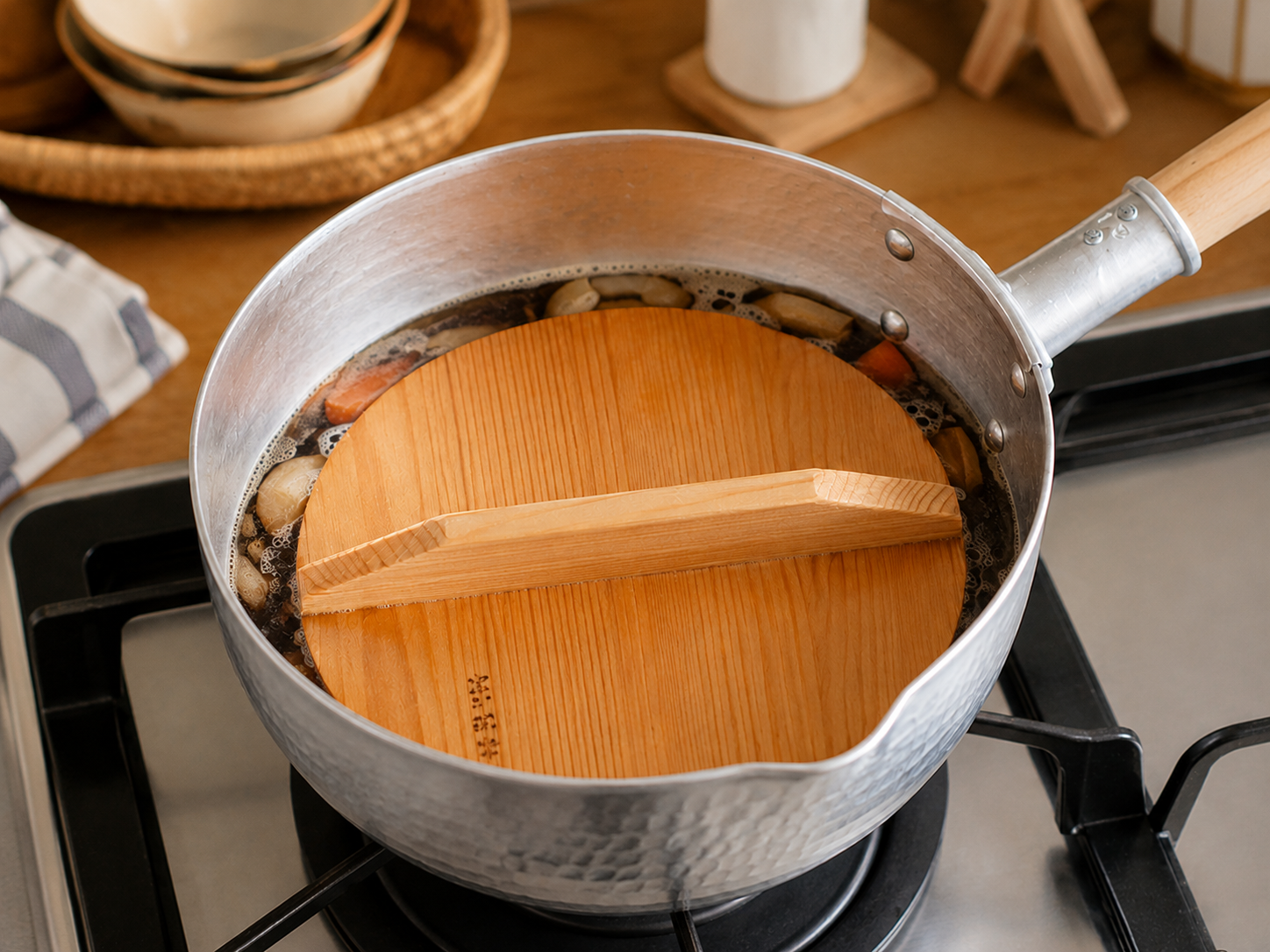
If you already own a yukihira nabe or any small Japanese saucepan and want to start simmering instead of just boiling and blanching, our top pick for readers pairing a lid with a traditional medium-size yukihira pot is the TIKUSAN Wooden Otoshibuta, 18cm ($21.99). If you’d rather have one lid that adjusts to fit several different pots, the SOONEAR stainless pick below is the more practical all-around choice.
- What Is an Otoshibuta, and Why Does It Matter?
- Do You Actually Need to Buy One?
- Quick Comparison
- What to Look for When Buying an Otoshibuta
- Product Reviews
- Which One Should You Buy?
- Sizing Guide
- A Quick Note on Materials
- Care and Maintenance
- How to Use an Otoshibuta
- Common Mistakes to Avoid
- Frequently Asked Questions
- Is an otoshibuta the same as a regular pot lid?
- Do I need an otoshibuta if I already have a regular lid for my pot?
- What can I use instead of an otoshibuta if I don’t have one?
- Is it safe to use a wooden otoshibuta on the stovetop?
- What size otoshibuta do I need?
- Can I put an otoshibuta in the dishwasher?
- What You’ll Also Need
- Final Thoughts
What Is an Otoshibuta, and Why Does It Matter?
An otoshibuta (落とし蓋), or “drop lid,” is a round lid sized to sit directly on the surface of the food and liquid inside a pot — not up on the rim like a regular lid. It’s the traditional tool for simmered Japanese dishes: nimono (simmered vegetables), nikujaga, chikuzenni, sakana no nitsuke (simmered fish), daikon in dashi, and braises like chashu. Because the lid rests right on the ingredients, it holds pieces in place so they don’t tumble around and break apart, helps keep them in contact with the simmering liquid so they don’t dry out on top, and helps distribute that liquid around the ingredients. Steam still escapes around the lid’s edges, so it isn’t sealing the pot the way a regular lid does — it’s a more targeted tool than a general-purpose pot cover.
We covered this exact gap in our yukihira pot guide: several of the yukihira pots we recommended there are sold without any lid at all, and a regular flat lid resting on the rim doesn’t do the same job as a drop lid once you move from boiling water to actually simmering something. An otoshibuta is the purpose-built answer, and it’s inexpensive enough that it’s worth owning alongside whatever small saucepan you’re already simmering in.
Do You Actually Need to Buy One?
No, not strictly. For occasional use, a loosely crumpled sheet of aluminum foil or a circle of parchment paper shaped into a dome works as a disposable substitute, and Japanese home cooks improvise one this way often. A dedicated otoshibuta makes more sense once you’re making simmered dishes regularly enough that reaching for foil every time gets old, or if you want the more predictable fit and durability of a purpose-built lid.
Quick Comparison
| Product | Price | Material / Size | Best For |
|---|---|---|---|
| TIKUSAN Wooden Otoshibuta, 18cm | $21.99 | Wood / 18cm (7.1″) | Standard Yukihira & Small Pots |
| SOONEAR Stainless Expandable Otoshibuta | $13.88 | Stainless steel / 5–9″ adjustable | Multiple Pot Sizes |
| TIKUSAN Wooden Otoshibuta, 22cm | $23.99 | Wood / 22cm (8.7″) | Larger Pots |
| Pearl Metal Cedar Otoshibuta, 20cm | $13.99 | Cedar wood / 20cm (7.9″) | Budget Pick |
What to Look for When Buying an Otoshibuta
- Match the size to your pot’s actual interior diameter, not the other way around. A drop lid should be roughly 1–2cm (about 0.5″) smaller than your pot’s interior diameter so it can float down onto the food while steam still escapes around the edges. Too large and it just rests on the rim like a normal lid, defeating the purpose; too small and it won’t cover enough of the food’s surface to do its job. Note that a pot’s nominal size (the “18cm” or “24cm” in its name) doesn’t always equal its exact interior diameter — measure before ordering.
- Wood vs. stainless steel is a real trade-off, not just aesthetics. Wood is the traditional choice and needs to be hand-washed and fully air-dried after each use to avoid warping or mold. Stainless steel is more durable, dishwasher-safe in most cases, and doesn’t require the same drying ritual, but some cooks prefer the way wood interacts with a simmering liquid.
- Verify “Made in Japan” on the actual listing, not just the product name. As with the yukihira pots in our companion guide, a Japanese-sounding brand name isn’t proof of where something was manufactured — check that the bullets or product details explicitly state the country of origin before assuming it.
- Fixed-size vs. adjustable/expandable. An adjustable stainless otoshibuta can flex to fit several different pots, which is convenient if you cook in more than one size regularly. A fixed wooden lid sized correctly for one pot will typically float more predictably than an adjustable one at its extreme settings.
- Check whether it has a lift handle or tab. Lifting a flat wooden disc out of hot simmering liquid with just your fingers isn’t fun — a small handle, hole, or tab makes it much easier to check on food mid-cook.
- Solid vs. perforated design. Most traditional otoshibuta are solid wood or solid metal. A few stainless versions are perforated or slatted, which changes how liquid moves through the lid rather than just around its edges — useful to know before you buy if you have a strong preference either way.
Product Reviews
Disclosure: As an Amazon Associate I earn from qualifying purchases.
TIKUSAN Wooden Otoshibuta, 18cm — Best Match for Standard Yukihira Pots
View on Amazon — $21.99 | 4.4 out of 5 stars (46 ratings)
This is the same TIKUSAN otoshibuta we pointed to in our yukihira pot guide. It’s a natural pairing for a nominal 18cm yukihira pot or similarly sized small saucepan, including the TIKUSAN and MARUYAMA GIKEN pots from that guide — but nominal pot sizes don’t always match the exact interior diameter, so measure your pot before ordering rather than assuming an exact fit. The listing stated it was made in Japan when we checked, and gives a single spec, the 18cm lid diameter, without naming a specific wood species, so we’re not going to guess at one here. It’s a plain, solid wooden disc without a lift handle, which is standard for this style of lid.
Pros
- A natural pairing for the most common yukihira/small-saucepan diameter in our guide
- Made in Japan stated on the listing
- Simple, traditional design with no adjustable parts to fail
- Inexpensive enough to buy alongside a new pot without a second thought
Cons
- No lift handle — you’ll need tongs or a fork to remove it from hot liquid
- Wood species isn’t specified on the listing
- Only fits pots close to 18–20cm; you’ll need a different size for anything smaller or larger
Bottom line: if you already own or are buying a yukihira pot around 18cm, this is a natural pairing — just confirm the pot’s actual interior diameter first.
SOONEAR Stainless Expandable Otoshibuta — Best Adjustable / Multiple Pot Sizes
View on Amazon — $13.88 | 4.5 out of 5 stars (131 ratings)
This is a take-apart stainless steel design that expands and contracts from about 5″ to 9″ (roughly 13–23cm), so it can flex to sit on the ingredients in a range of different pots rather than being locked to one size. The listing stated it was made in Japan in the bullet text itself when we checked, not just the title, which is the kind of detail worth checking for on any “made in Japan” claim. Because it’s built from overlapping stainless leaves rather than a solid disc, it separates apart for washing — the manufacturer markets this as an advantage over wood, which can’t be taken apart to clean between uses.
Pros
- Adjusts to fit multiple pot sizes instead of buying separate lids
- Made in Japan is stated in the actual product bullets, not just the title
- Stainless steel construction — easier to clean than wood and doesn’t need the same drying ritual
- Highest review count and rating of the four picks here
Cons
- Take-apart, overlapping-leaf design has more parts than a solid wooden disc, which means more parts that can trap food if not rinsed promptly
- An adjustable lid at its minimum or maximum extension may not float quite as predictably as a lid sized specifically for your pot
- The listing doesn’t state whether this specific product is dishwasher safe — check before assuming, even though the material generally is
Bottom line: the practical choice if you regularly cook in more than one pot size and don’t want to buy multiple fixed lids.
TIKUSAN Wooden Otoshibuta, 22cm — Best for Larger Pots
View on Amazon — $23.99 | 4.4 out of 5 stars (46 ratings)
The same TIKUSAN wooden otoshibuta as our top pick, scaled up to 22cm. That makes it a reasonable match for a pot around 24cm in diameter — including the Taniguchi Metal yukihira pot from our companion guide — since a drop lid is generally sized a couple of centimeters smaller than the pot itself. As with the 18cm version, the listing stated “Made in Japan” when we checked, but doesn’t name a specific wood species.
Pros
- Sized appropriately for larger pots (roughly 24cm), where a smaller lid wouldn’t cover enough surface area
- Same made-in-Japan listing claim as the 18cm version
- Simple solid-wood construction, no moving parts
Cons
- Overkill if your pots are all in the 16–18cm range
- No lift handle, same as the 18cm version
- Priced a few dollars above the smaller size for what is otherwise the same product
Bottom line: the size to reach for once you’re cooking in anything closer to 22–24cm rather than a compact single-serving pot.
Pearl Metal Cedar Otoshibuta, 20cm — Best Budget
View on Amazon — $13.99 | 3.8 out of 5 stars (92 ratings)
This is the least expensive wooden option in our comparison, made from cedar, and the listing stated it was made in Japan when we checked. Its 3.8-star rating was the lowest of the four products we compared at the time of review, though we didn’t find enough evidence in the listing data to attribute that lower score to one consistent, widely-repeated issue — worth reading a sample of current reviews yourself before buying.
Pros
- Least expensive option in this guide
- Made in Japan, stated on the listing
- Lightweight at roughly 3.5oz (100g)
- 20cm size sits between the two TIKUSAN options
Cons
- Lowest rating of the four picks (3.8 vs. 4.4+ for the others)
- Cedar is a softer wood than some alternatives, so it may be more prone to staining or wear over time than a harder wood or stainless steel
- Not dishwasher safe
Bottom line: a reasonable budget pick if you’re just trying an otoshibuta for the first time, but the TIKUSAN or SOONEAR picks above have higher customer ratings at the time of our review, if you’re willing to spend a little more.
Which One Should You Buy?
- Own a yukihira pot or similar small saucepan around 18cm? The TIKUSAN 18cm is the traditional pairing — just check your pot’s actual interior diameter first.
- Cook in more than one pot size? The SOONEAR adjustable stainless lid saves you from buying multiple fixed sizes.
- Have a larger pot, around 22–24cm? Size up to the TIKUSAN 22cm.
- Just want to try an otoshibuta before committing? The Pearl Metal cedar lid is the cheapest way in, with the caveat that its rating trails the others.
Sizing Guide
| Pot Interior Diameter | Recommended Otoshibuta Size | Notes |
|---|---|---|
| 14–16cm | ~13–14cm | Matches a compact yukihira pot like the 1.7-quart size in our yukihira guide |
| 18–20cm | 16–18cm | The most common size — matches the TIKUSAN 18cm above and two of the four yukihira pots in our guide |
| 22–24cm | 20–22cm | Matches the TIKUSAN 22cm above and a larger pot like the Taniguchi 24cm from our yukihira guide |
| Multiple sizes / unsure | 5–9″ adjustable | The SOONEAR expandable lid covers roughly this whole range in one product |
As a rule of thumb, aim for an otoshibuta about 1–2cm smaller than your pot’s interior diameter, measured across the inside rim rather than the outside of the pot.
A Quick Note on Materials
Wood is the traditional material for an otoshibuta. Regardless of the specific wood, it needs to be fully dried after each use — trapped moisture left in damp wood is what leads to warping or mold over time, not the simmering itself.
Stainless steel, like the SOONEAR pick above, doesn’t have that drying requirement and generally won’t absorb odors or stains the way wood can over years of use. It’s the lower-maintenance option, at the cost of the traditional look and feel that draws a lot of people to an otoshibuta in the first place.
Care and Maintenance
Wooden otoshibuta (both TIKUSAN sizes and the Pearl Metal cedar lid): wash it soon after use rather than leaving it in the sink — wood left damp for a while is what leads to mold and lingering odors, not just warping. Hand wash with mild soap and warm water, and stand it on its edge or lay it flat somewhere with good airflow until it’s completely dry before storing it. Don’t leave it soaking, and don’t run it through the dishwasher unless the specific listing says it’s rated for that — none of the wooden picks in this guide are.
Stainless steel otoshibuta (the SOONEAR pick): rinse promptly after use, especially around the overlapping leaves where small food particles can collect. Stainless steel is generally easier to care for than unfinished wood, but check the manufacturer’s instructions for this specific product before putting it in the dishwasher.
How to Use an Otoshibuta
- Cut your ingredients (daikon, potatoes, kabocha, chicken, pork belly, etc.) and add them to your pot along with dashi, water, or another simmering liquid and your seasonings.
- Bring the liquid to a simmer over medium heat — not a hard boil.
- Lower the otoshibuta directly onto the surface of the liquid so it rests on the ingredients, not up on the pot’s rim.
- Reduce the heat to maintain a gentle simmer. You should see the lid move slightly as the liquid circulates beneath it.
- Simmer until the ingredients are tender, checking occasionally by lifting the lid with tongs or a fork rather than your fingers.
- Remove the otoshibuta before serving — it’s a cooking tool, not a serving lid.
Basic Nikujaga Recipe (Serves 2–3)
Ingredients: 200g thinly sliced beef, 3 medium potatoes (cut into large chunks), 1 carrot (roll-cut), 1 onion (cut into wedges), 1 tbsp vegetable oil, 300–400ml dashi, 3 tbsp soy sauce, 3 tbsp mirin, 1–2 tbsp sugar, 1 tbsp sake.
- Heat the oil in your pot and sauté the beef until it’s no longer pink, then add the onion and cook until translucent.
- Add the potato and carrot and stir briefly to coat with oil.
- Pour in the dashi, bring to a boil, and skim off any foam (aku) that rises to the surface.
- Add the soy sauce, mirin, sugar, and sake.
- Lower the otoshibuta directly onto the ingredients and simmer on low for 15–20 minutes, until the potatoes are tender.
- Remove the otoshibuta and let the pot sit off heat for a few minutes so the flavor soaks in before serving.
Using an Otoshibuta for Simmered Fish (Sakana no Nitsuke)
Beyond nikujaga, a wooden otoshibuta is also a natural fit for sakana no nitsuke — fish simmered in a soy sauce, mirin, and sugar broth. Because it lets steam escape around its edges rather than sealing it in, it also helps carry off some of the fish’s stronger smell as it cooks, which is a real, practical advantage for this dish specifically. It also helps keep delicate fish fillets from breaking apart as they simmer, so the finished piece holds its shape and looks better on the plate. Foil or a paper towel can stand in occasionally, but if you make nitsuke or nikujaga often, a dedicated wooden otoshibuta is worth having — just be sure to wash and dry it soon after each use, since wood left damp is what leads to mold and lingering odors.
Common Mistakes to Avoid
- Using the wrong size. Too large and it just sits on the rim like a regular lid, trapping steam instead of letting it vent around the edges; too small and it won’t cover enough of the food’s surface to keep everything evenly in contact with the liquid.
- Treating it like an airtight lid. An otoshibuta is meant to let steam escape around its edges. If you want to fully seal a pot, use its actual matching lid instead.
- Leaving a wooden otoshibuta wet after washing. This is the most common cause of warping and mold in wooden kitchen tools generally, not just drop lids.
- Grabbing a hot otoshibuta with bare fingers. None of the wooden picks in this guide have a lift handle — use tongs, chopsticks, or a fork.
Frequently Asked Questions
Is an otoshibuta the same as a regular pot lid?
No. A regular lid sits up on the pot’s rim and seals in steam. An otoshibuta sits directly on the food and liquid surface, inside the pot, and is specifically meant to let some steam escape around its edges while holding ingredients in place.
Do I need an otoshibuta if I already have a regular lid for my pot?
Not strictly. Its main advantage is helping keep ingredients in place and in contact with the simmering liquid rather than tumbling around loose. As noted above, Japanese cooks also commonly improvise one from parchment paper or foil rather than buying a dedicated lid.
What can I use instead of an otoshibuta if I don’t have one?
A loosely crumpled sheet of aluminum foil or a circle of parchment paper, shaped into a loose dome and placed directly on the food, is a common improvised substitute. It won’t be as durable or reusable as a purpose-built otoshibuta, but it works in a pinch.
Is it safe to use a wooden otoshibuta on the stovetop?
Yes, as long as it’s floating on the surface of a simmering liquid rather than making direct contact with an open flame or a dry, empty pot. Manufacturer listings and general kitchen-safety guidance both treat this as the intended, safe use case — direct flame contact is what risks scorching the wood.
What size otoshibuta do I need?
Measure your pot’s interior diameter and choose an otoshibuta about 1–2cm smaller. See the sizing guide above for specific recommendations, including how they line up with the yukihira pots in our companion guide.
Can I put an otoshibuta in the dishwasher?
It depends on the product. None of the wooden picks in this guide are listed as dishwasher safe — hand wash and fully air-dry them instead. Stainless steel is generally easier to care for than wood, but check the specific listing or included instructions before assuming any product, including the SOONEAR pick, is dishwasher safe.
What You’ll Also Need
If you’re choosing an otoshibuta for a yukihira pot, see our guide below for compatible sizes and materials.
Best Japanese Yukihira Pots (2026)
Our full comparison of yukihira pots — the small, single-handled Japanese saucepan that an otoshibuta is most commonly paired with for everyday simmering, dashi, and blanching.
Final Thoughts
An otoshibuta is a small, inexpensive addition to a Japanese kitchen, but it solves a specific problem a regular lid can’t: keeping simmered ingredients in place and in even contact with the cooking liquid. All four listings in this guide stated Made in Japan when we checked them in August 2026, though marketplace listings can change — worth a quick recheck before you buy. If you already picked up a yukihira pot from our companion guide, pairing it with a correctly measured otoshibuta above is the simplest way to start using it for actual simmered dishes, not just boiling and blanching.
コメント