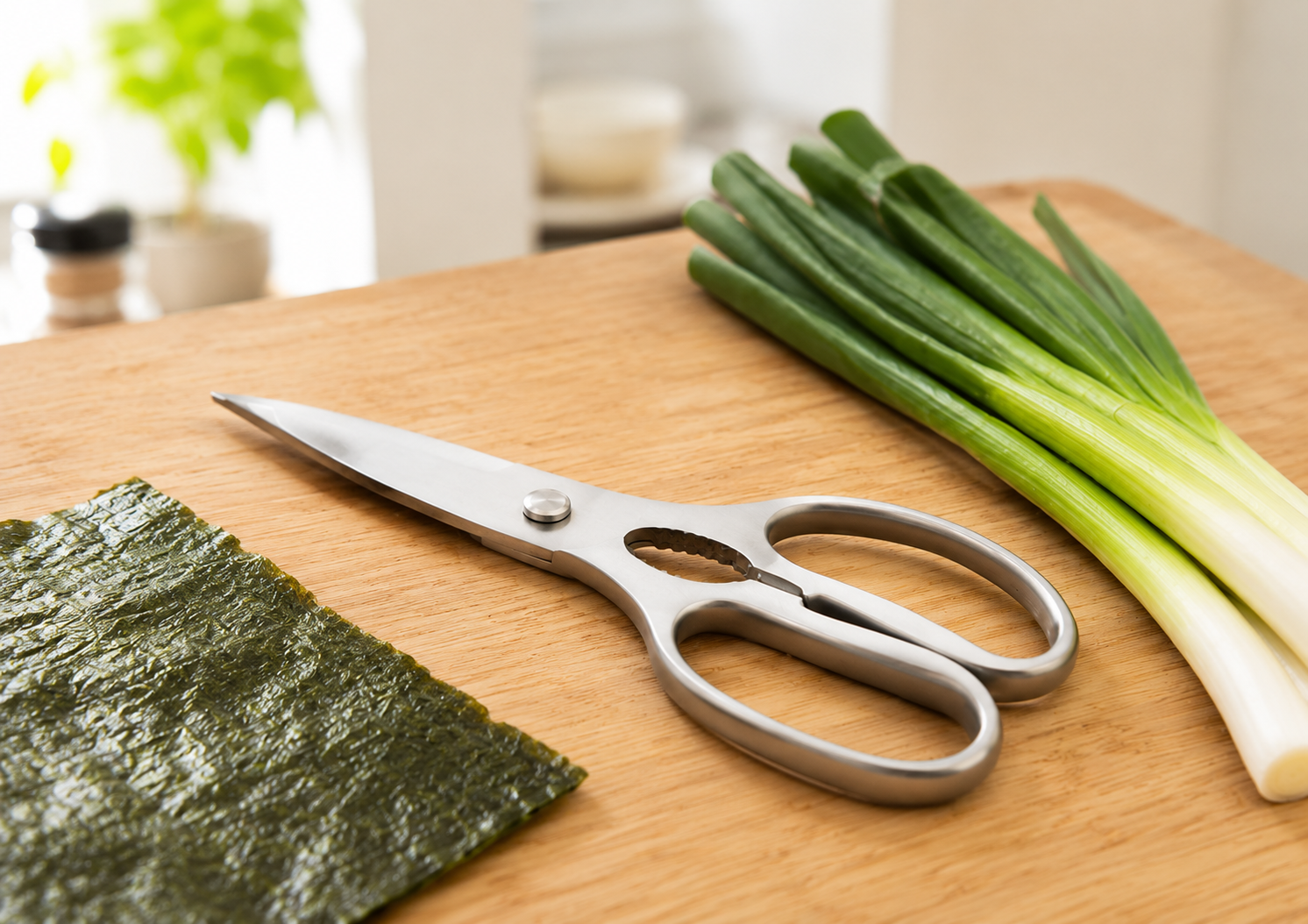
Quick answer: For most kitchens, the Shun Multi-Purpose Shears (DM7300) are the best all-around pick — genuine Made-in-Japan kitchen shears from Shun, part of the Kai Group, with a nutcracker, jar opener, bone notch, lid lifter, and two screwdriver tips built into the handles. They typically sell for around $60. Read on for the full comparison, practical ways to use kitchen shears, and how to clean and care for them.
Why Trust This Guide
I actually use a pair of Kai-made kitchen scissors myself, and they’ve become one of those tools I reach for more than I expected to when I bought them. Kai has a reputation specifically for sharpness that holds up over time, and mine have lived up to that — they’re still cutting cleanly after regular use. The blades come apart for washing, which matters more than it sounds like it would once you’ve actually used a pair of scissors that don’t. The serrated notch near the handle, built for cracking things, is genuinely useful for crab shells during a proper crab dinner, and it turns out it works for cracking walnuts too. For this guide, I combined that hands-on experience with manufacturer specifications and long-term user feedback.
Why Japanese Kitchen Scissors Are Different
Japanese kitchen scissors are commonly marketed for tasks like cutting meat and fish, snipping herbs and nori, and opening food packaging. The better models tend to emphasize precise, serrated edges, corrosion-resistant stainless steel, and designs that separate for washing. Many premium Japanese kitchen scissors, including all three models in this guide, are built to come apart for thorough cleaning, since food residue can otherwise build up in the pivot joint over time. Many also include small built-in tools — a nutcracker notch, a bottle opener, sometimes a jar-lid gripper — making them more of a multi-tool than a single-purpose gadget.
Kai is headquartered in Seki, Gifu Prefecture, and CANARY is produced by Hasegawa Cutlery, another Seki-based manufacturer. Seki itself has an approximately 800-year blade-making history that began with swordsmithing and later developed into a major modern cutlery industry, and it’s recognized internationally today as one of Japan’s best-known cutlery-producing cities.
Comparison at a Glance
| Scissors | Model | Price | Made In | Material | Weight | Best For |
|---|---|---|---|---|---|---|
| CANARY Kitchen Scissors | EL-210 | Around $21 | Japan | Stainless cutlery steel | ~101g | Best value |
| Kai Seki Magoroku | DH3345 | Around $35 | Japan | Forged stainless steel | ~160g | Best everyday pair |
| Shun Multi-Purpose Shears | DM7300 | Around $60 | Japan | 420J2 stainless steel | ~181g | Best overall, most built-in tools |
Prices were checked at the time of publication and may change.
What to Look for When Buying Kitchen Scissors
- Detachable blades — lets you actually clean the pivot joint, which one-piece scissors can’t manage as well
- Made in Japan, stated explicitly — plenty of “Japanese-style” scissors are manufactured elsewhere
- Handle features you’ll actually use — a nutcracker or bottle opener is a nice bonus, not a reason to buy on its own
- Dishwasher-safe rating, if that matters to you — not all Japanese kitchen scissors are rated for it
Product Reviews in Detail
Disclosure: As an Amazon Associate I earn from qualifying purchases.
Shun Multi-Purpose Shears (DM7300) — Best Overall
Made in Japan by the Kai Group, the same maker behind my own pair. See today’s price and reviews on Amazon →
Shun is part of the Kai Group, which has been making blades in Seki for over 110 years, and this pair reflects that: 420J2 stainless steel blades, a non-slip elastomer grip, and a genuinely useful set of built-in tools — a nutcracker, jar opener, bone notch, lid lifter, and two screwdriver tips. In my own use with a similar Kai-made pair, the nutcracker section has also worked well for cracking crab shells at the table.
Pros:
- The nutcracker/shell-cracking notch is genuinely useful, not a gimmick
- Blades separate fully for washing, no gunk hiding in the pivot
- Edge holds up well over months of regular use
Cons:
- The most expensive of the three, though the extra built-in tools help justify it
Bottom line: If you want one pair that does more than just cut, this is it.
Kai Seki Magoroku (DH3345) — Best Everyday Pair
A simpler, forged, all-stainless option from the same maker. See today’s price and reviews on Amazon →
Part of Kai’s well-known Seki Magoroku line, this is a forged, all-stainless-steel pair without the extra handle gadgets. Each half is forged from a single piece of stainless steel, while the two blades separate at the pivot for cleaning — a solid, everyday design at around 160g.
Pros:
- Forged, one-piece stainless construction feels notably sturdy in hand
- Same Seki Magoroku reputation as Kai’s better-known knives
- Simpler shape without extra handle attachments, if that’s not what you want
Cons:
- No built-in nutcracker or bottle opener, unlike the Multi Purpose Shears above
Bottom line: Choose this one if you want Kai’s quality without paying for extra features you might not use.
CANARY Kitchen Scissors (EL-210) — Best Value
A meaningfully lower price without giving up the detachable-blade design. See today’s price and reviews on Amazon →
CANARY is another genuine Seki manufacturer (Hasegawa Cutlery, founded in 1933), and this pair still includes several handle extras — a bottle opener, jar-lid opener, can-lid opener, garlic crusher, meat tenderizer, and a ginkgo-nut cracker — at a noticeably lower price than the Kai Group options here.
Pros:
- Lowest price of the three while still being genuinely made in Seki
- Still includes several handle tools despite the lower price
- Rated dishwasher-safe up to 266°F
Cons:
- At roughly 101g, it’s substantially lighter than the 160g forged Kai Seki Magoroku, which may feel less substantial to anyone who prefers heavier, all-metal shears
Bottom line: A sensible way to try genuine Japanese kitchen scissors without spending on the Kai name specifically.
Which One Should You Buy?
- Want the most functional, do-it-all pair? → Shun Multi-Purpose Shears
- Want Kai quality without the extra gadgets? → Kai Seki Magoroku
- Want to spend less while still buying genuine Seki cutlery? → CANARY Heavy Duty
How to Use and Care for Japanese Kitchen Scissors
Take the blades apart regularly to wash, even if the pair is dishwasher-rated — hand washing gets into the pivot area more reliably than a dishwasher cycle does. Dry them fully before reassembling and storing, since trapped moisture between the blades is what leads to spotting or rust over time. Use the built-in nutcracker or bottle-opener notches as intended rather than improvising with the cutting blades themselves for tasks they weren’t designed for, like prying open tightly sealed jars. If the edge becomes noticeably dull, use an experienced scissor-sharpening service, especially for serrated blades — standard pull-through knife sharpeners aren’t designed for the edge geometry or blade alignment of kitchen shears, and a home attempt can make a serrated edge worse rather than better.
Cooking With Just Scissors: Five Practical Uses
A few practical ways to use them in Japanese home cooking:
- Cutting boneless chicken into bite-sized pieces before cooking — kitchen scissors can be faster than a knife for trimming skin, fat, and portioning smaller cuts.
- Snipping scallions straight into a bowl — hold a bunch of scallions over your miso soup or rice bowl and snip directly into it, which skips a cutting board entirely for a simple garnish.
- Cutting nori into strips or squares — scissors give cleaner edges than tearing by hand and are easier to control than a knife on a single thin sheet.
- Cutting pizza, flatbreads, or thin pancakes into portions — scissors can be an easy way to portion these without dragging a knife through a nonstick pan or a delicate crust.
- Cutting noodles for kids — snipping long noodles like udon or somen into shorter, more manageable lengths directly in a child’s bowl.
None of these require any special recipe — it’s more a matter of substituting scissors for a knife and cutting board in situations where it’s genuinely faster and easier, which is why a good pair can quickly become one of the most frequently used tools in your own kitchen.
FAQ
Can Japanese kitchen scissors cut through bone?
Some models include a bone notch that helps grip small poultry joints or tougher stems, but these shears shouldn’t be treated as a substitute for a cleaver on real bone-cutting tasks.
Are these dishwasher-safe?
It depends on the specific pair — the CANARY here is rated for it, but check the listing for any specific model rather than assuming, since not all Japanese kitchen scissors are.
Why do the blades come apart?
It’s specifically for cleaning — food residue can build up in the pivot screw area of one-piece scissors, and a detachable design lets you wash both blades fully and separately.
Do I need a whetstone to sharpen these?
Not necessarily a whetstone specifically, but a proper scissor-sharpening method or service works better than a standard knife sharpener, which isn’t built for the scissor blade’s angle.
Will these rust?
All three models in this guide use stainless cutlery steel, which is corrosion-resistant but not completely rust-proof. Wash off salty or acidic residue and dry the blades promptly after use to keep them from spotting over time.
Final Thoughts
A good pair of Japanese kitchen scissors can end up doing more of your everyday cutting work than you might expect — mine certainly has. For most kitchens, the Shun Multi-Purpose Shears are the best all-around choice if you value built-in tools and easy cleaning. If you prefer a simpler, heavier all-stainless design without the extra handle features, the Kai Seki Magoroku is the better fit. The CANARY Kitchen Scissors offer many of the same practical benefits at a significantly lower price, making them the strongest value pick of the three.
コメント